

Yes. Every US state requires an LLC to keep a registered agent, and Wyoming is no exception. A Wyoming LLC must maintain one at a physical Wyoming street address, and a founder living abroad cannot be their own agent.
A Wyoming LLC must continuously keep a registered agent and registered office at a real Wyoming street address.
Acting as your own agent needs Wyoming residency and a physical Wyoming address, which a non-resident founder does not have.
A professional Wyoming agent solves it, and CORPBOLT includes the registered agent in every plan.
If you are forming a Wyoming LLC from outside the United States, the registered agent is one requirement you cannot skip or improvise. This guide explains what the agent does, what Wyoming actually requires, whether you can be your own, and why most non-resident founders appoint a commercial agent instead.
What a registered agent actually does
A registered agent is the LLC's official point of contact for legal and state mail. Its core job is to receive service of process, meaning the lawsuit papers delivered when someone sues your company. The agent also accepts official notices from the state on the LLC's behalf.
Under Wyoming law, the registered office is defined as the physical location where the agent can accept service of process for the entity. That definition sits in Wyoming Statutes section 17-28-101(a)(i). Independently, the Cornell Legal Information Institute describes an agent for service of process as the party designated to receive legal documents and notice that the business has been sued.
In day-to-day terms, the agent is the address that receives a specific class of documents on your behalf:
Service of process, the formal papers filed when your LLC is sued or subpoenaed.
Official correspondence and notices sent to the entity by the Wyoming Secretary of State.
Compliance reminders, such as annual report notices, that the state or your agent may forward to you.
So the agent is not a formality on a form. It is the mechanism that guarantees your LLC can be reached with a summons or a state notice, even when the owner lives on the other side of the world.
Wyoming's registered agent rules
You name the registered agent and registered office when you file, not afterward. Wyoming Statutes section 17-29-201(b) requires the Articles of Organization to state the street address of the initial registered office and the name of the initial registered agent at that office, so the designation is one of the first fields on the formation filing. Because the Secretary of State can revise its forms, confirm the current field labels on the live state filing before you submit.
Wyoming is specific about where the agent sits. The registered office must be a physical street address in Wyoming. According to the Wyoming Secretary of State FAQ, it cannot be a PO box, a virtual address, a drop box, or a mail-forwarding location.
The address also has to be staffed. Wyoming law requires the office to be a real location where the registered agent, or a person with an agency relationship to the agent, is physically present to accept service of process. The Secretary of State frames that availability as being present during normal business hours.
The reason for the physical-presence rule is practical. Service of process often has to be handed to a real person on the spot. So the state needs a reliable, staffed location where that delivery can actually happen. A vacant address or an unattended mailbox would defeat the entire purpose of the requirement.
Can you be your own registered agent?
In principle, yes. Wyoming allows an individual to serve as their own registered agent, but only if that person clears every part of the test. Under Wyoming Statutes section 17-28-101(a)(ii)(A) and 17-28-101(e), the individual must be at least 18 years old, reside in Wyoming, hold a physical Wyoming address, and keep a valid email address on file. The Secretary of State FAQ states the same 18-plus, Wyoming-resident, and valid-email conditions. For the rare reader who does meet every one of them, self-appointing saves the annual agent fee but ties you to a staffed Wyoming address and constant business-hours availability, which is the core trade-off to weigh.
Read those conditions against a founder who lives abroad. That person does not reside in Wyoming and has no Wyoming street address, so they cannot serve as their own agent. This is not a separate ban aimed at foreigners. It is the direct consequence of the residency and physical-address rule that applies to everyone.
The misstep we see most often is a founder overseas listing their home-country address as the registered agent, which Wyoming will not accept. A Wyoming-resident friend, family member, or attorney could technically stand in, but only if that person meets the same conditions, at least 18 and a Wyoming resident with a physical Wyoming address, formally consents to the appointment on the state's consent form, and can reliably receive time-sensitive legal papers during business hours. Most non-resident founders have no qualifying Wyoming contact who can do all of that, so the practical path is a professional service.
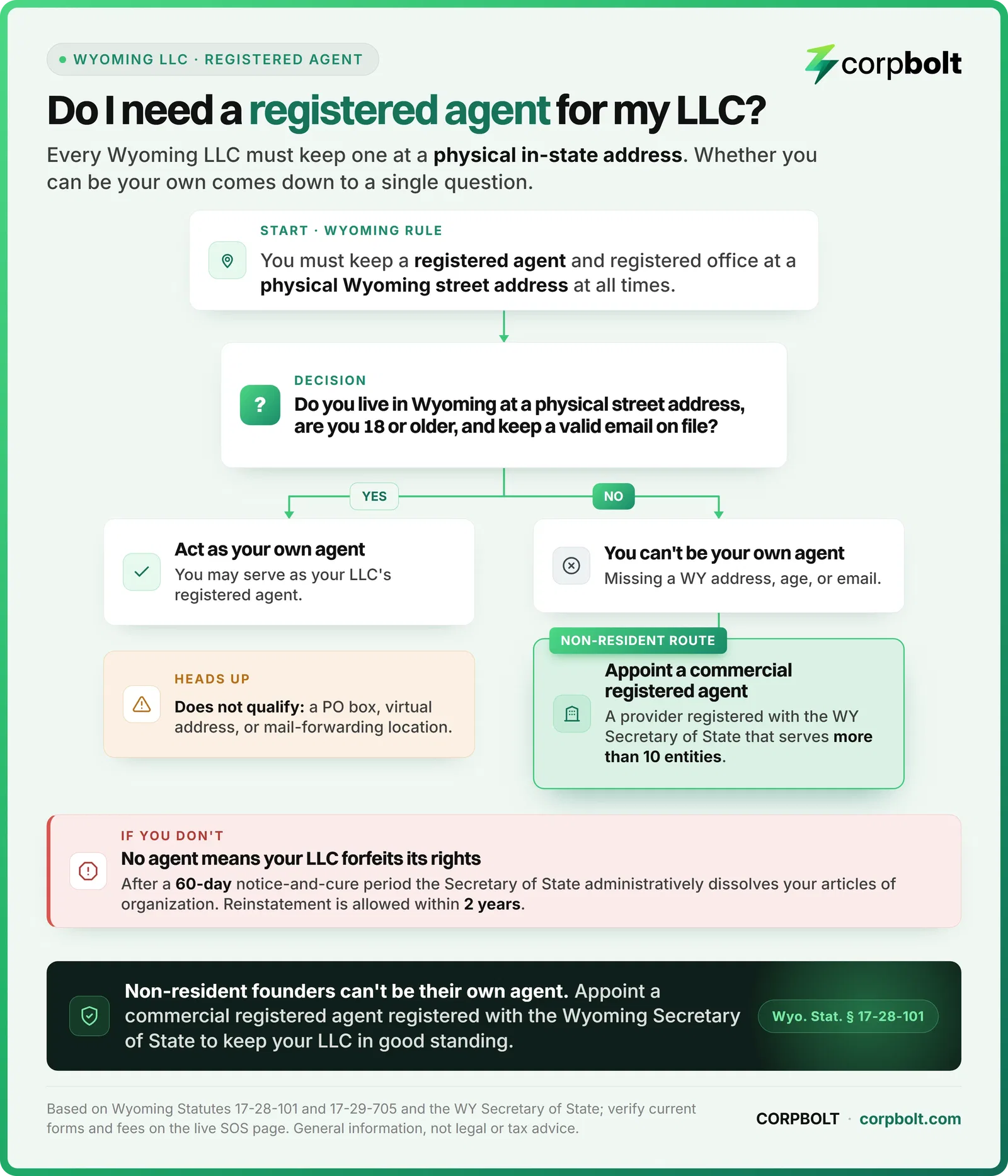
Do you need a registered agent, and can you be your own?
The commercial registered agent option
This is where most non-resident founders land. Wyoming recognizes a specific category called a commercial registered agent. Per Wyoming Statutes sections 17-28-101(a)(ii)(D) and 17-28-105, a commercial registered agent is one in the business of serving as agent for more than ten entities. That agent must register its status with the Secretary of State.
A commercial registered agent service keeps a staffed Wyoming address, accepts your service of process, and forwards state and legal mail to you wherever you are. For a founder with no US presence, it is the only realistic way to meet the physical-office requirement. In practice, a commercial agent typically:
Maintains the staffed Wyoming street address that appears on your registered-office record.
Accepts service of process and signs for official state mail during business hours.
Forwards or scans those documents to you promptly, wherever in the world you are based.
A registered agent is normally an ongoing annual cost when you buy it on its own. CORPBOLT includes the registered agent inside its formation plans instead, so a non-resident founder does not have to source or renew one separately. The exact plan pricing is in the call-to-action below.
What happens if your LLC has no registered agent
Letting the agent lapse is not a quiet oversight. Under Wyoming Statutes section 17-29-705, an LLC left without a registered agent or registered office forfeits its rights and privileges. The Secretary of State then sends notice, and unless the LLC cures the problem within 60 days, the state forfeits its articles of organization. That is an administrative dissolution.
The good news is that reinstatement is allowed within two years of that forfeiture, so a lapse is usually recoverable if you act. Still, it is a status you never want your company to be in.
There is a second, more practical risk tied to the agent's purpose. The whole point of the agent is to make sure your company learns it has been sued. Without a working agent, you can miss a lawsuit you were never told about and lose it by default. That default-judgment outcome is a well-established consequence of not answering a suit, not a Wyoming-specific penalty, but it is exactly the scenario the agent exists to prevent.
Registered agent and your privacy
An agent can also reduce how much of your personal information sits on the public record. Because the registered office and agent address shown on the state filing is the agent's address, using an agent keeps your home address off that particular field. For a founder who works from home, that is a meaningful reduction in exposure.
Be careful not to oversell it. Wyoming filings still require a principal-office or mailing address and can surface organizer or member details, so an agent reduces home-address exposure rather than delivering total anonymity. Anyone who claims a registered agent makes your company fully anonymous is overstating what the public record allows. Many non-resident founders have no US address to expose in the first place, so the benefit is more about a clean record than secrecy.
Frequently asked questions
Can I use my home-country address as my LLC's registered agent?
No. An overseas address cannot serve as the Wyoming registered office, which is why non-resident founders appoint a commercial Wyoming agent instead.
If I register my LLC to do business in another US state, do I need an agent there too?
Yes. Each state you formally register in requires its own registered agent. A single Wyoming LLC with no US presence or nexus only needs a Wyoming agent, so this matters only if you separately register elsewhere.
Does serving as my LLC's registered agent make me an owner of the company?
No. The registered agent is only the LLC's point of contact for legal and state mail, a role defined by Wyoming Statutes section 17-28-101. Being named as agent carries no ownership, control, or economic rights in the company. Membership in a Wyoming LLC is a separate matter under Wyoming Statutes section 17-29-401, so a person can be your registered agent without being an owner, and an owner is not automatically the agent.
How much does a registered agent cost?
It depends on the provider when you buy one on its own. If you are comparing standalone providers, our guide to choosing a registered agent service covers what to weigh on coverage, document handling, and renewal terms.
Can I change my registered agent later?
Yes. A change is needed whenever your agent resigns or stops qualifying, the agent's name or address changes, you move the registered office, or you switch to a different provider. To update the record, the LLC files the appointment of a new registered agent and office with the Wyoming Secretary of State, and the incoming agent must consent to the appointment. Confirm the current form and fee on the live Secretary of State page, since that is the state's current figure to verify.
How this article was prepared
The requirement to keep a registered agent and office, the physical-address rule, the self-agency conditions, and the commercial-agent definition are drawn from Wyoming Statutes sections 17-28-101 and 17-28-105. The formation-filing designation and the separation of the registered-agent role from LLC ownership come from Wyoming Statutes sections 17-29-201 and 17-29-401. Those points are cross-checked against the Wyoming Secretary of State registered-agent FAQ and commercial registered-agent page. The service-of-process role is confirmed by the Cornell Legal Information Institute. The forfeiture and dissolution outcome comes from Wyoming Statutes section 17-29-705. Last reviewed July 2026. This is general information and not legal or tax advice, and CORPBOLT is a formation service, not a law or accounting firm. Treat any fee or filing figure as the state's or IRS's current figure to verify on the live official page.
Handle it at formation with CORPBOLT: CORPBOLT forms and maintains Wyoming LLCs for non-residents from $349/year (Foundation), including the registered agent and annual upkeep. The EIN is included from $599/year (Launch) or as a $199 add-on. Form your Wyoming LLC →
