

Not in any way that actually works. A genuinely free virtual address does not exist for a non-resident's Wyoming LLC, because your LLC needs its address to do two different jobs and no free option does both. A virtual or mailbox address can sit on your Articles of Organization mailing line and your IRS EIN form. But by law it cannot be your Wyoming registered agent, and a bare mail-drop address is often rejected when you open a US bank account. The "free" offers you see are trials, freemium tiers, or an address bundled into a paid formation package.
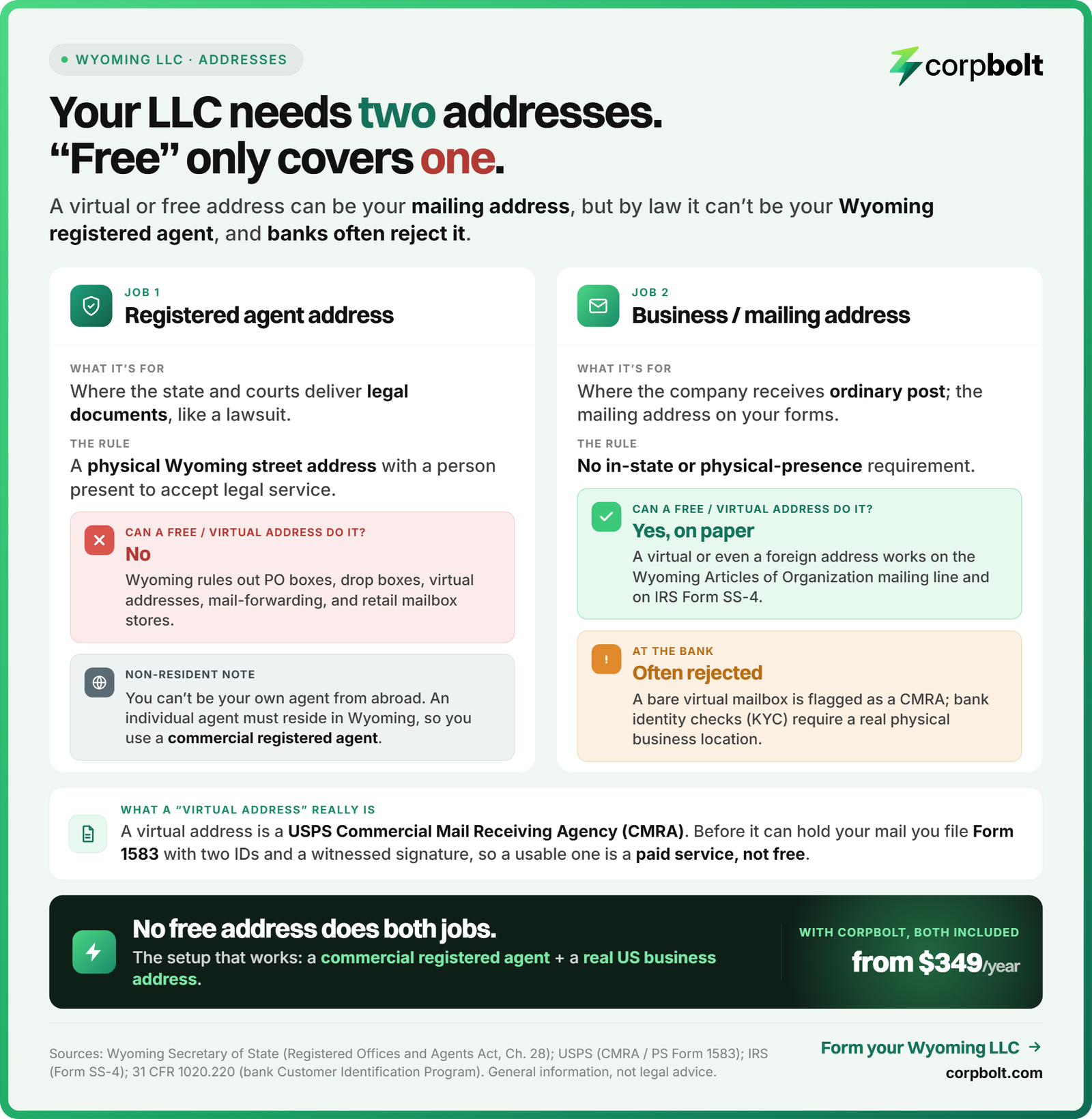
A registered agent address, which is a staffed Wyoming street location, and a general business or mailing address. They are not interchangeable, and this is where most "free address" plans fall apart.
Wyoming requires a physical in-state street address where a person can accept legal papers, and it specifically rules out PO boxes, virtual addresses, and mail-forwarding locations.
A compliant setup is a paid service. The good news is that it is inexpensive and, with a formation package, already included.
It is a reasonable thing to search for. You are forming a US LLC from another country, every service seems to want a US address, and a free one would be one less cost. The honest answer is that a truly free virtual address that does everything your LLC needs does not really exist, and understanding why saves you from a filing that bounces or a bank account you cannot open. The heart of it is that your LLC's address is not one thing but two, and the free options only ever cover one of them. This guide, written for a founder abroad forming a Wyoming LLC, walks through what a virtual address can and cannot do, why, and what actually works instead.
Your LLC needs two different addresses, not one
The confusion behind the "free address" question is that people picture a single company address. An LLC actually uses its address for two separate jobs, and the rules for each are different.
The registered agent address. This is the official point of contact where the state and the courts deliver legal documents, such as a lawsuit. Wyoming is strict about what this can be.
The business or mailing address. This is where your company receives ordinary post, and what you list as the principal or mailing address on your forms. The rules here are far looser.
A free or virtual address can often handle the second job. It almost never handles the first. Mix the two up and the whole plan comes apart. If you are still unsure what the agent even does, start with what a registered agent is.
What a "virtual address" actually is
When a service sells you a "virtual address" or "virtual mailbox," what you are really renting is a Commercial Mail Receiving Agency, or CMRA. The US Postal Service defines a CMRA as a business that accepts the delivery of US mail on behalf of another person or entity as a business service. That definition matters, because it comes with paperwork. Before a CMRA can hand you a single envelope, USPS requires you to complete and sign Form 1583, the Application for Delivery of Mail Through Agent, and to show two current forms of identification. Your signature has to be witnessed, either by the mailbox operator or by a notary, which is the route a founder abroad uses. The operator then files that form, uploads a copy of your ID to a USPS database, and re-certifies it on a schedule. All of that administration is why a real virtual address is a commercial service with a genuine cost behind it, not something anyone gives away for nothing. In day-to-day use, the service receives your mail at that street address, scans each item so you can read it online from anywhere, and forwards or recycles the physical piece on your instruction.
Why a virtual or free address cannot be your Wyoming registered agent
This is the hard limit, and it is set by state law, not by any service's preference. Under Wyoming's Registered Offices and Agents Act, an LLC's registered office must be an actual Wyoming street address, a physical location where the registered agent can accept service of process and is present to receive it. The Secretary of State spells out what does not count: a post office box, a drop box, a virtual address, a mail-forwarding location, and a UPS or FedEx store are all listed as unacceptable. A virtual mailbox is, by definition, one of those things.
There is a second wall for a non-resident. Wyoming law lets an individual serve as the registered agent only if that person is at least eighteen, resides in Wyoming, and keeps a business office at the registered address. A founder living abroad meets none of that. That is why non-residents appoint a commercial registered agent, a company that acts as agent for many entities and is registered with the state to do so. The full picture is in whether you can be your own registered agent.
Where a virtual or foreign address does work
None of this means a virtual address is useless. It just has to go in the right field. On the Wyoming Articles of Organization, the physical-address rule applies only to the registered agent line. The LLC's own mailing address and principal office address carry no in-state or physical-presence requirement, so a virtual US address, or even your real address abroad, is perfectly acceptable there.
The same holds for your EIN. On IRS Form SS-4, the mailing address can be a foreign or third-party address. Only the physical-location line has to be a street address, and only then if it differs from the mailing address. A non-resident with no US premises can get an EIN using a US mailing address or their own foreign one. So a virtual address earns its keep as a place to receive company post and as the correspondence address on your paperwork. It also keeps your personal or home-country address off the public formation record and off your day-to-day business post, since the address the state and your contacts see is the service's rather than your home's. That privacy is a genuine reason many founders abroad use one. It simply cannot stand in for the registered agent. Whether you need a US address at all, and for what, is covered in do I need a US address to form an LLC.
The bank problem
There is one more place a cheap or free virtual address tends to fail, and it catches people by surprise: opening the US business bank account. US banks and payment providers run identity checks under know-your-customer rules, and those rules ask for a physical location for the business, not just a mailbox. The federal Customer Identification Program rule defines an acceptable address as a principal place of business, a local office, or another physical location, and a PO box does not meet that bar. Because a virtual mailbox is flagged in postal data as a CMRA, a bare mail-drop address is frequently kicked out during a bank's screening or pushed into extra review. An address that sailed through your state filing and your EIN can still stop you at the bank. This is about preparation and eligibility, not a guarantee of any particular account, but it is the reason the address you choose is worth getting right the first time.
The "free" routes, and what each one really costs you
When people say "free virtual address," they usually mean one of a handful of routes. Here is what each one actually gets you.
The "free" option | Your Wyoming registered agent? | Mailing / IRS address? | The catch |
|---|---|---|---|
A "free" virtual mailbox | No | Yes | It is a trial or freemium tier, and postally it is a CMRA, the kind of bare mail-drop banks often reject |
Reusing your registered agent's address | It already is the agent | No | The agent receives legal service only, not your business mail, and using it as your address breaks their terms |
A friend's or relative's US address | Only if they live in Wyoming, consent, and are present to accept legal papers | Yes | Their name and address go on the public record, and they carry the legal-mail duty for you |
Your own US home address | Only if it is a staffed Wyoming street address | Yes | Non-residents do not have one, which is the whole reason the question comes up |
A commercial registered agent plus a US business address | Yes | Yes | A paid service, though an inexpensive one and included with CORPBOLT formation from $349/year |
Read down the table and the pattern is hard to miss: every genuinely free option fails the registered agent job, the banking job, or both, and the only setup that covers all of it is a paid one.
What a non-resident founder should actually do
The workable setup is neither complicated nor expensive. You appoint a commercial registered agent that gives your LLC a compliant Wyoming street address and receives its legal documents. Then you pair it with a real US business address you can use for mail and for banking. Together they cover the registered-agent role and the banking role at once, which is what the free options never manage. Because this is the one part of a US LLC a non-resident genuinely cannot improvise, it is usually handled as part of formation rather than stitched together afterward. What such a service actually includes is covered in the registered agent service guide.
Frequently asked questions
Is there a completely free virtual address for an LLC?
Not one that actually works for a non-resident's Wyoming LLC. A usable virtual address is a commercial mail service with real paperwork behind it, and it still cannot serve as your registered agent. The "free" offers are trials, freemium tiers, or an address bundled into a paid package.
Can I use a virtual address as my registered agent in Wyoming?
No. Wyoming requires the registered agent to have a physical Wyoming street address where a person can accept legal documents, and it specifically rules out PO boxes, virtual addresses, and mail-forwarding locations. Non-residents use a commercial registered agent instead.
Can I use a virtual or foreign address on my LLC's formation and EIN forms?
Yes, for the mailing and principal-office fields. The Wyoming Articles of Organization only restrict the registered agent line, and IRS Form SS-4 accepts a foreign or US mailing address. It just cannot be the registered agent address.
Will a bank accept a virtual address for my LLC?
Often not. US banks check for a physical business location under know-your-customer rules, and a virtual mailbox is flagged as a commercial mail-receiving agency, which is frequently rejected. A real business address avoids that problem. This is about eligibility, not a guaranteed account.
What is the difference between a registered agent address and a business address?
The registered agent address is the official spot where the state and the courts deliver legal papers, and it must be a staffed Wyoming street location. The business or mailing address is where you receive ordinary company post. They do different jobs and cannot substitute for each other.
Does a virtual address keep my home address private?
To a degree, yes. Using a virtual US address as your LLC's mailing and principal office address keeps your personal or home-country address off the public formation record and off your business post. It is a genuine side benefit, but it does not change the two hard rules. A virtual address still cannot serve as your Wyoming registered agent, and a bank can still see that the address is a CMRA mail-drop under its customer-identification checks.
How this article was prepared
CORPBOLT prepared this guide for non-US founders weighing a free or virtual address for a Wyoming LLC. The requirement that a Wyoming registered office be a physical in-state street address comes from the Wyoming Secretary of State's registered agent guidance. That guidance also lists what does not qualify: a PO box, drop box, virtual address, mail-forwarding, or UPS or FedEx store. The residency rule for an individual agent and the commercial-registered-agent definition are set by the Registered Offices and Agents Act. The definition of a virtual address as a CMRA, the Form 1583 requirement, the two-identification and witnessed-signature rules, and the recordkeeping behind them come from the US Postal Service. The EIN address rules are from the IRS Instructions for Form SS-4, and the bank identity-check address standard is from the federal Customer Identification Program rule, all linked below. Address and banking rules change and vary by provider, so this is general compliance information, not legal advice, and CORPBOLT is a formation service, not a law firm. Last reviewed July 2026.
Address and agent, sorted with CORPBOLT: CORPBOLT forms your Wyoming LLC with a commercial registered agent and a US business address included from $349/year (Foundation), so both jobs a free address leaves undone are covered from the start. The EIN is included from $599/year (Launch) or as a $199 add-on. Form your Wyoming LLC →
