

Picture a founder living abroad with no American address, wondering if that blocks a U.S. LLC. It does not. Do I need a US address to form an LLC? Not a personal one. What you do need is a registered agent with a physical address in your formation state, and the agent provides it. A separate U.S. business or mailing address is optional and mostly useful for banking.
You do not need a personal U.S. address to own or form the LLC. You can live and work anywhere.
Every state requires a registered agent with a real, physical in-state address. Not a P.O. box, and not a home address abroad.
A U.S. mailing or business address helps with banking and mail, but it is a separate, optional thing, often a virtual address.
Do I need a US address to form an LLC? It is one of the first worries for founders outside the United States, and the good news is that not having an American address does not stop you. You can form and own a U.S. LLC from outside the US. What trips people up is that "address" means three different things here, and only one of them is actually required.
This page sorts out which address you need, which you do not, and what each one is for. It is part of forming a U.S. company as a non-resident, and it is general education, not legal advice.
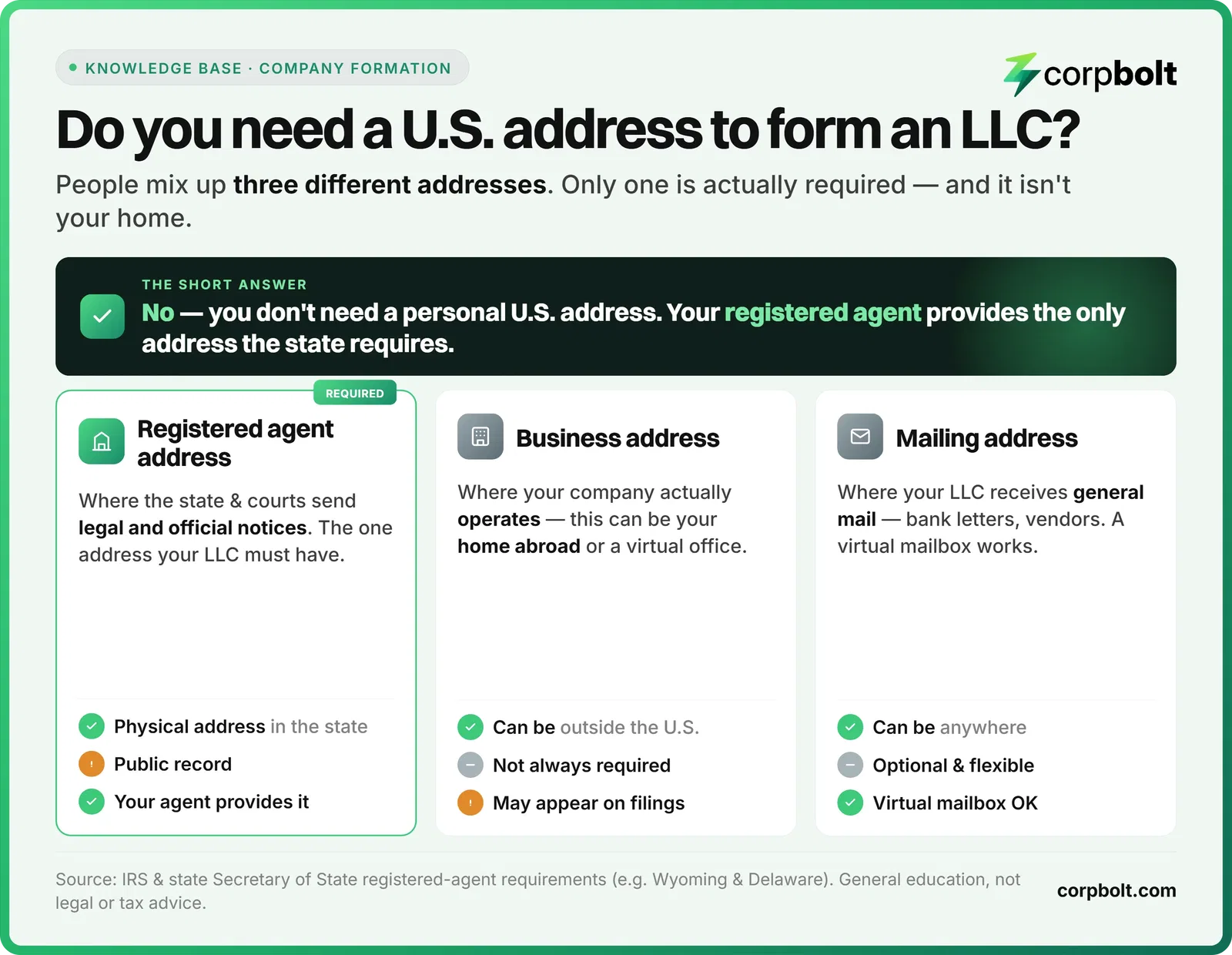
The three addresses people mix up
When founders ask about a "US address," they are usually blending three separate things. Only the first is required:
Address | Do you need it? | What it is for |
|---|---|---|
Registered agent address (a physical street address in your formation state) | Yes, required | Receiving legal notices and state mail; it appears on the public filing |
Your personal U.S. home address | No | Not required to own or form the LLC; you can be based anywhere |
A U.S. business or mailing address | Optional | Banking, customer-facing use, and general mail; usually a virtual address or mail-forwarding service |
The one address you actually need: a registered agent
Every U.S. state requires an LLC to have a registered agent: a person or company with a physical street address in the state of formation who is available during business hours to receive legal documents and official mail. For a non-US founder this is the address that stands in for the U.S. presence you do not have.
Two rules catch people out. The address must be a real physical street address in the formation state, so a P.O. box does not qualify, and it cannot be your home address in another country. This is exactly why non-residents use a commercial registered agent: the agent supplies a compliant in-state address. For example, a Wyoming LLC needs a registered agent with a physical Wyoming address, which a provider handles for you.
Do you need a US business or mailing address?
This one is optional. You do not need a U.S. business or mailing address to form the LLC, but many founders choose one because banks, payment processors, and customers often expect a U.S. point of contact. A virtual business address or a mail-forwarding service is the usual route, and it is separate from your registered agent.
Be realistic about what it does. A U.S. address can help a bank or processor take you seriously, but it does not guarantee an account. Approval depends on the bank, your documents, and your business, not on an address alone.
There is also an image dimension. A real U.S. street address can make the company read as more established to American customers, suppliers, and platforms than a founder with no U.S. footprint at all. The type of address matters too. Banks and payment processors run identity checks, and a recognizable mailbox-store or P.O.-box-style address can prompt extra questions, while a stable commercial business address tends to raise fewer. None of this changes the legal requirement or guarantees an account, but it is worth weighing if you will deal with U.S. banks and customers.
If you want a US address: your options
If you decide a U.S. address is worth it, you have a few routes, and none of them is your registered agent. A virtual business address gives you a real street address that receives and scans your mail, which is what most remote founders use. A mail-forwarding service does the same and ships physical items to you abroad. Some providers bundle an address with extras like a local phone line.
What to look for is simple:
A genuine street address, not a P.O. box.
Mail scanning, so you can read U.S. post without waiting for international shipping.
Clear separation from your registered agent, so legal notices and business mail do not get tangled.
The cost is usually a small recurring fee, not the overhead of a U.S. office lease, so for a remote founder the real question is simply whether to add an address to the registered agent you already need, not office versus home. It is a convenience and credibility choice, not a legal requirement for the LLC itself. You can also add it later: many founders form first, open accounts, and only add a U.S. address if a bank or platform asks for one.
If you form with CORPBOLT, this is already handled. Every plan includes a real Wyoming business address, starting with the Foundation plan at $349 a year, and that address is kept separate from your registered agent, so your legal notices and your everyday business mail stay cleanly divided from day one. Mail scanning through a digital mailbox is included from the Launch plan and available as an add-on on Foundation, so you can read U.S. post from anywhere without waiting on international shipping. Because the address is bundled with formation, most founders never source one separately or bolt it on after the fact.
It helps to know the limits of a mail address too. A virtual or mailing address handles post and gives you a U.S. point of contact, but it is not a staffed office. It is not meant for receiving large shipments or inventory, and it is not somewhere to meet clients in person. For most remote founders that is no problem, since the address exists for banking, mail, and presence. If your business genuinely needs a physical operating location, that is a separate decision from forming the LLC.
What ends up on the public record
Privacy is a fair concern, so it helps to know what is visible. The address on the public formation filing is generally the registered agent's address, not your home address abroad. Using a commercial agent therefore keeps your personal address off the state record in most states. Rules vary by state, so confirm what your state publishes if privacy matters to you, rather than assuming.
State practice differs here too. Some states ask for a principal office or mailing address on the filing, which can be a foreign address, while others put only the registered agent on the public record. If keeping your home address private matters, check what your formation state actually publishes before you file.
Two things are worth being clear about. First, the upside: using a commercial agent rather than your own address keeps your home address abroad off the public state record in most states, which also cuts down on unsolicited mail and contact at home. Second, the limit: this is privacy from the public filing, not anonymity from the government. The IRS still holds your details on the EIN and tax filings, and where federal beneficial-ownership reporting applies it collects owner information privately. A commercial address protects what the public can see, not what regulators can.
Can you change your LLC address later?
Yes, and founders do it often. Addresses are not locked in at formation, and which step you take depends on which address is changing.
A business or mailing address: usually the easiest. You update it with your provider or open a new virtual address, then tell your bank and customers. There is generally no state filing for this.
The registered agent or registered office: this is a state filing, often called a Statement of Change or Certificate of Change, with a small fee. Appoint the new agent before you drop the old one so the LLC is never left without a valid agent.
Your address with the IRS: file Form 8822-B to update the company's address or responsible party. This is separate from the state record.
The mistake we see most
The most common address mistake is trying to use the wrong one as the registered agent. Founders list a home address in their own country, or a P.O. box, or a mailbox-store address, and the filing is rejected or the agent role is invalid. The second most common is the opposite worry: assuming you must rent a U.S. office or have a personal U.S. address before you can start. You do not. A compliant registered agent address satisfies the requirement, and a U.S. business address, if you want one, can come later and be virtual.
If assembling these pieces yourself sounds like one more thing to get wrong, that is the part CORPBOLT takes off your plate: the registered agent, the US business address, and the state filing come together in one formation, so the address question is settled the day your LLC exists.
Quick FAQ
Do I need a US address to form an LLC?
Not a personal one. You can form and own a U.S. LLC while living abroad with no American address. What every state requires is a registered agent with a physical address in the formation state, which a commercial agent provides for you.
Can I use my home address in another country?
You can often list a foreign address as the LLC's mailing or principal address, but not as the registered agent. The registered agent must have a physical address inside the formation state.
Can I use a P.O. box?
Not for the registered agent. The agent needs a real physical street address in the state. A P.O. box can sometimes be used for general mail, but it does not satisfy the registered agent requirement.
Do I need a US address to open a business bank account?
Often a bank or payment processor will want a U.S. point of contact, and a virtual business address can help. It does not guarantee approval, which depends on the bank, your documents, and your business.
Will my home address show up publicly?
Generally the registered agent's address appears on the public filing, not your home address, so using a commercial agent keeps your personal address off the state record in most states. Confirm your state's rules if privacy is important to you.
Is the registered agent address the same as my business address?
No. The registered agent address exists only to receive legal and state mail, and it appears on the public filing. Your business or mailing address, used for banking and customers, is a separate and optional address. Keep the two distinct so mail and notices do not get confused.
How do I change my LLC's address later?
It depends on which address. A business or mailing address is usually just updated with your provider, with no state filing. Changing the registered agent or registered office is a state filing, often a Statement of Change. To update the company's address with the IRS, file Form 8822-B. Appoint any new registered agent before dropping the old one so the LLC always has a valid agent.
Does a US business address make my company look more credible?
It can help. A real U.S. street address can present more professionally to American customers, platforms, and banks than no U.S. presence, and a stable commercial address tends to draw fewer questions in bank checks than a mailbox-store or P.O. box. It is a credibility and convenience choice, though, not a legal requirement, and it does not guarantee any approval.
How this article was prepared
This guide was written for non-US founders by CORPBOLT's formation team and checked against primary sources: the Wyoming Secretary of State for the registered agent physical-address requirement used as an example, the U.S. Small Business Administration on registered agents and business structure, and the IRS, which accepts a foreign address on the EIN application and provides Form 8822-B for changing a company address or responsible party after formation. State rules on addresses and public records vary, so confirm the specifics with your state. Last reviewed June 2026. It is general information, not legal advice.
Official references
Wyoming Secretary of State: LLC Articles of Organization (registered agent address requirement)
IRS: About Form 8822-B (change of address or responsible party)
Approval note: Eligibility and approval decisions are made by each bank, fintech, and payment processor. Requirements can vary by provider, country, business model, and account history.
