

Form 8822-B is the one-page IRS form you mail in to tell the IRS that your business changed its mailing address, its physical location, or its responsible party. It is free, it does not give you a new EIN, and there is no online version. You print it, sign it, and mail it to the IRS service center for your state. This is general information, not legal or tax advice.
Your business mailing address, business location, or responsible party changed after the IRS issued your EIN.
A change of responsible party must be reported within 60 days. Address-only changes have no fixed deadline, but a stale address means missed IRS mail.
There is no e-file option and no filing fee. Mail the signed form to the IRS center that matches your business address.
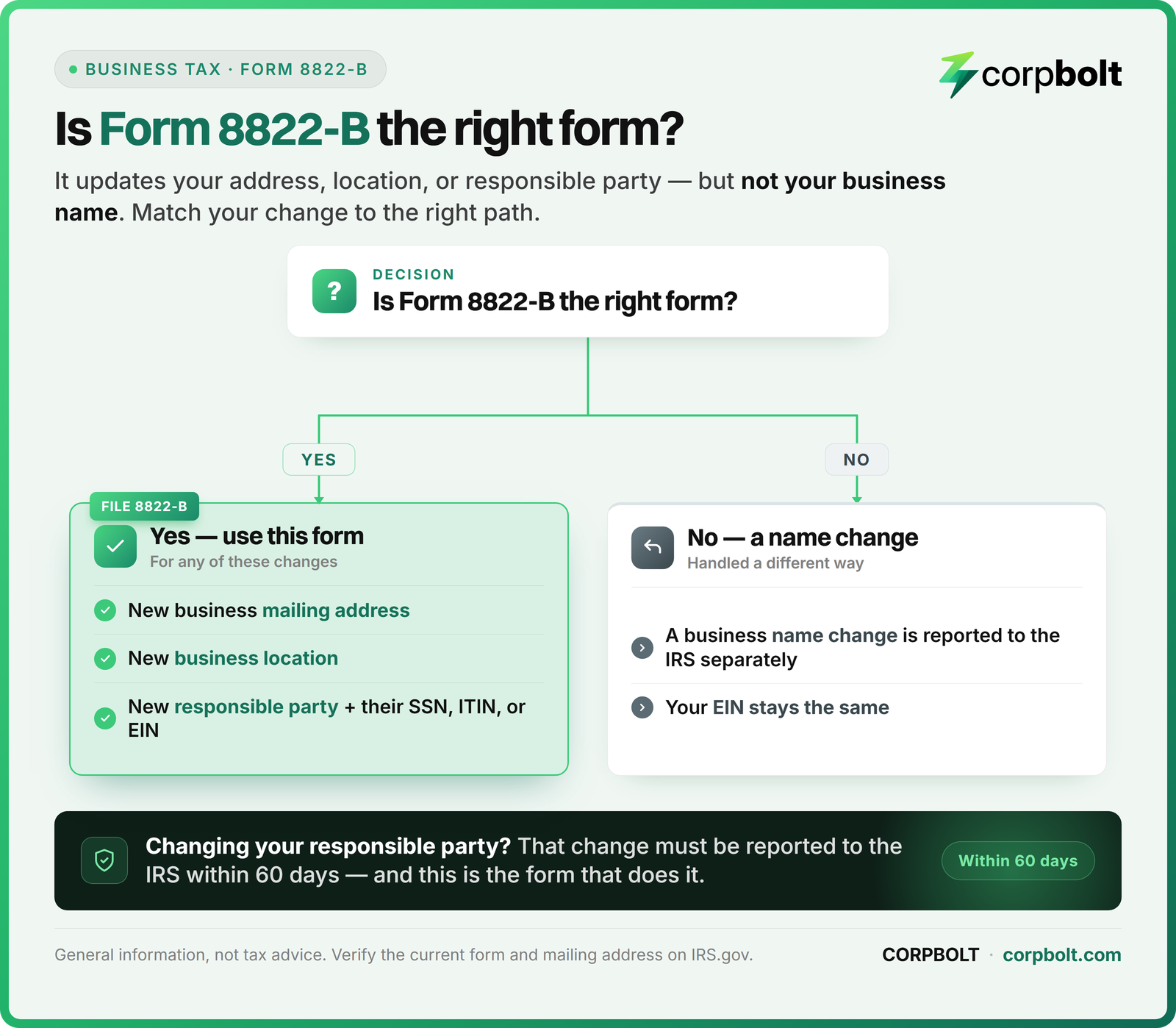
When the IRS issued your EIN, it filed away two things it expects to stay current: where to reach your business, and who the responsible party is. Form 8822-B is how you update either one. It is a short form, but for a foreign-owned LLC a few of its boxes deserve a careful read before you mail it.
What Form 8822-B actually changes
The IRS says Form 8822-B is used to report a change to your business mailing address, your business location, or the identity of your responsible party. You can report one of those, two, or all three on the same form. It covers any business with an Employer Identification Number on file, which means almost every LLC, corporation, or partnership that has ever applied for an EIN.
Who is your "responsible party"?
This is the box most non-resident founders get wrong. The IRS defines the responsible party as the individual who ultimately owns or controls the entity, or who exercises ultimate effective control over it and the disposition of its funds and assets. For a single-member LLC, that is almost always you, the owner, not your registered agent, your accountant, or the formation company that helped you file.
The IRS is explicit that the responsible party must be a real person, identified by an SSN, ITIN, or EIN, and that nominees (someone listed only to get the EIN started) should not stay on the record. If a formation agent put their own name down to open your EIN, the IRS expects you to correct it to the true owner. If you obtained your EIN without a U.S. taxpayer number, the same identification questions you answered then apply when you name a responsible party now; our guide on getting an EIN without an SSN walks through the options.
How to file Form 8822-B, step by step
The form takes about ten minutes once you have your details in front of you.
Get the current form. Download the latest Form 8822-B (PDF) directly from the IRS so you are working from the current revision.
Check what changed. Tick the boxes for a mailing-address change, a business-location change, a responsible-party change, or any combination of them.
Identify the business. Enter your legal business name and EIN exactly as they appear on your IRS records, not a trade name or an abbreviation.
Enter the new details. Add the new business address and, if the responsible party changed, the new person's name and their SSN, ITIN, or EIN.
Sign it. An owner, member-manager, officer, or other authorized person must sign and date the form. An unsigned 8822-B will not be processed.
Mail it to the right center. Send the signed form to the IRS address that matches your business address, using the table below.
Before you start, have these Form 8822-B entries ready so you can complete it in one pass:
Which change to report, using the top checkboxes for business returns, employee plan returns, or a business-location change.
Your legal business name and EIN, exactly as the IRS has them on record.
Your old mailing address, plus the new mailing address or new business location.
If the responsible party changed, the new person's name and their SSN, ITIN, or EIN.
The name, title, and signature of the owner, officer, or authorized person, plus an optional daytime phone number.
Where to mail Form 8822-B
There is no electronic filing for this form, so it goes by mail. Which IRS service center you use depends on the state of your business address as the IRS has it on file. For many non-resident-owned LLCs that address is the registered agent's address in the formation state, so a Wyoming LLC generally falls in the Ogden group below.
If your old business address is in… | Mail Form 8822-B to |
|---|---|
Connecticut, Delaware, District of Columbia, Georgia, Illinois, Indiana, Kentucky, Maine, Maryland, Massachusetts, Michigan, New Hampshire, New Jersey, New York, North Carolina, Ohio, Pennsylvania, Rhode Island, South Carolina, Vermont, Virginia, West Virginia, or Wisconsin | Department of the Treasury, Internal Revenue Service Center, Kansas City, MO 64999 |
Alabama, Alaska, Arizona, Arkansas, California, Colorado, Florida, Hawaii, Idaho, Iowa, Kansas, Louisiana, Minnesota, Mississippi, Missouri, Montana, Nebraska, Nevada, New Mexico, North Dakota, Oklahoma, Oregon, South Dakota, Tennessee, Texas, Utah, Washington, or Wyoming | Department of the Treasury, Internal Revenue Service Center, Ogden, UT 84201 |
If your business has no legal residence, principal place of business, or principal office in any U.S. state, follow the address printed in the form's own instructions before you mail it. You can confirm the current routing on the IRS Where to file Form 8822-B page, since these addresses change from time to time.
A common situation for non-resident founders
Here is a pattern we see often. A founder abroad forms a Wyoming LLC and, to get the EIN issued quickly, the formation provider is listed as the initial responsible party. The EIN comes through, the business starts operating, and a year later the founder realizes the IRS still has the provider, not them, as the responsible party.
Form 8822-B is the fix. The owner files it to replace the provider with themselves, naming their own SSN, ITIN, or, if they have neither, following the form's instructions for a responsible party without a U.S. taxpayer number. Getting this right matters beyond tidiness. A foreign-owned single-member LLC has real reporting duties, including Form 5472 and a pro forma 1120. The IRS works from the responsible party and address it has on file when it needs to reach you about them.
Form 8822-B vs. changing your state filings
Updating the IRS is not the same as updating your state. If you move your company to a different formation state, change your registered agent, or amend your Articles, those are filings with a Secretary of State, not the IRS, and Form 8822-B does not handle them. Form 8822-B only updates your federal EIN record, and it is separate from any BOI report filed with FinCEN. When your business address actually changes, you often need to do both: tell the state through the right amendment, and tell the IRS with Form 8822-B.
What about a change in LLC ownership or members?
Form 8822-B updates your business contact details, its mailing address and location, and your responsible party. It does not record who owns the LLC or how many members it has. So bringing in a new member, buying out an existing one, or having a co-owner leave is not something you "file" on this form. The member count the IRS captured on your SS-4 is not a field 8822-B edits. What it can do in that situation is update the responsible party, if the person who ultimately controls the company has changed as a result.
A membership change can still reach the IRS another way: it can change how the LLC is taxed. A single-member LLC that takes on a second owner usually becomes a partnership, and a multi-member LLC that drops to one owner usually becomes a disregarded entity. In fact the IRS generally treats that kind of reclassification as needing a brand-new EIN, not a Form 8822-B update. It also changes which returns the LLC files: a partnership return instead of the owner's, or the Form 5472 and pro forma 1120 a foreign-owned disregarded LLC files. Form 8822-B does not handle any of that, so if your ownership is changing, treat the EIN and the tax classification as separate questions and confirm both with a qualified tax professional.
Frequently asked questions
What is the difference between Form 8822 and Form 8822-B?
Form 8822 changes the home address of an individual taxpayer. Form 8822-B changes a business's mailing address, location, or responsible party. If you are updating anything about your company's IRS record, including who controls it, you need 8822-B, not 8822.
Do I get a new EIN after filing Form 8822-B?
No. Form 8822-B updates the information attached to your existing EIN. Your EIN does not change because you moved or because the responsible party changed. You only apply for a new EIN if the business itself changes in a way the IRS treats as a brand-new entity.
Is there a fee to file Form 8822-B?
No. The IRS does not charge anything to file Form 8822-B. The only cost is the postage to mail it to the correct service center.
Can I file Form 8822-B online?
No. There is no electronic or online filing option for Form 8822-B. You complete the paper form, sign it, and mail it to the IRS. Keep a dated copy, because the IRS instructions do not describe sending a receipt.
Can I fax Form 8822-B to the IRS?
No. The current Form 8822-B instructions give a mailing address only and list no fax number, so you mail the signed paper form. Always use the submission method shown in the latest IRS instructions before you file.
Do I need to attach any documents to Form 8822-B?
Usually not. When the owner or an officer signs, you mail Form 8822-B on its own, and the IRS says not to attach it to your tax return. If someone signs as your representative, they must attach a copy of a power of attorney, such as Form 2848, or the IRS will not process the change.
I only changed my registered agent. Do I still file Form 8822-B?
Changing your registered agent is a state filing, not an IRS one, so on its own it does not require Form 8822-B. But file 8822-B if that change also changed the business address the IRS has on file, or if your old registered agent had been listed as your responsible party.
If a member joins or leaves my LLC, do I file Form 8822-B?
Only for what the form actually covers. Use it to update the responsible party if control of the LLC changed, and the business address if that changed too. It does not transfer ownership or update the number of members on your EIN record, and it does not change how the LLC is taxed. A shift between single-member and multi-member can change your tax classification and often means applying for a new EIN, which are separate matters to confirm with a tax professional.
How this article was prepared
This guide is based on the IRS's own materials for Form 8822-B: the form and its instructions, the IRS page on where to file it, and IRS guidance on responsible parties and the Employer Identification Number. Where the IRS states a rule directly, such as the 60-day responsible-party deadline, we use its wording; where details like exact processing times can change, we point you to the live IRS page to confirm before you mail. We review this article when the IRS revises the form or its filing addresses. Last reviewed July 2026. It is general information for non-resident founders, not legal or tax advice for your specific situation.
Official references
Important: This article is general information for non-resident founders, not legal or tax advice, and requirements can change. Confirm the current form, deadlines, and mailing address on IRS.gov, and consider speaking with a qualified tax professional about your situation. CORPBOLT helps organize formation and filing paperwork but does not provide legal or tax advice.
