

Yes, you can get an EIN without an SSN. The IRS lets a non-US responsible party apply on Form SS-4 by phone, fax, or mail, entering "Foreign" where a Social Security Number would go. You do not need an ITIN first, and the EIN itself is free. The only route closed to you is the instant online tool, which requires a U.S. taxpayer ID.
A responsible party with no SSN or ITIN writes "Foreign" on Form SS-4, line 7b. The application still goes through.
Fax (about 4 business days), mail (about 4 weeks), or the international phone line. Online is the only method that needs a U.S. tax ID.
The IRS never charges for an EIN. Any fee a service charges is for preparing the SS-4, never for the number.
For founders outside the United States, the EIN is usually the step that feels most uncertain. Almost every U.S. bank, Stripe account, and federal tax form asks for one, yet the fastest way to get it seems to assume you already hold a Social Security Number. You do not need one. This guide walks through exactly how to get an EIN without an SSN: the three application methods the IRS allows, the timelines to plan around, and the single line on Form SS-4 that decides whether your application clears.
Can you really get an EIN without an SSN?
Yes. The IRS does not require the person applying for a business EIN to have a Social Security Number. What it requires is a responsible party: a real individual who owns or controls the company. When that person has no SSN and no ITIN, the Instructions for Form SS-4 say to enter "Foreign" on line 7b, and the application proceeds normally.
This is the fact that changes everything for non-US founders, because it removes the assumption that stops most people: that a U.S. personal tax ID is a prerequisite. It is not. An EIN identifies your business; an SSN or ITIN identifies an individual. The IRS will issue your company its EIN even when the owner holds neither, whether you have formed a Wyoming LLC or any other U.S. entity.
Why the online EIN application will not work for you
The IRS online EIN Assistant returns a number on the spot, which is why nearly every guide recommends it first. The catch is in the eligibility rules. The online tool requires the responsible party to have a valid SSN, ITIN, or existing EIN, and it is closed to anyone with no legal residence or principal place of business in the United States. Most non-US founders meet neither condition, so the online route is simply not open to them.
From preparing these applications for non-resident founders, the practical pattern is consistent: time spent on the online tool is time wasted, because it was built around a U.S. taxpayer ID that most foreign founders do not have. The working process starts and ends with Form SS-4, submitted by fax, mail, or the international phone line. Treat the online route as closed from the outset, and the rest of the application gets noticeably simpler.
How to get an EIN without an SSN, step by step
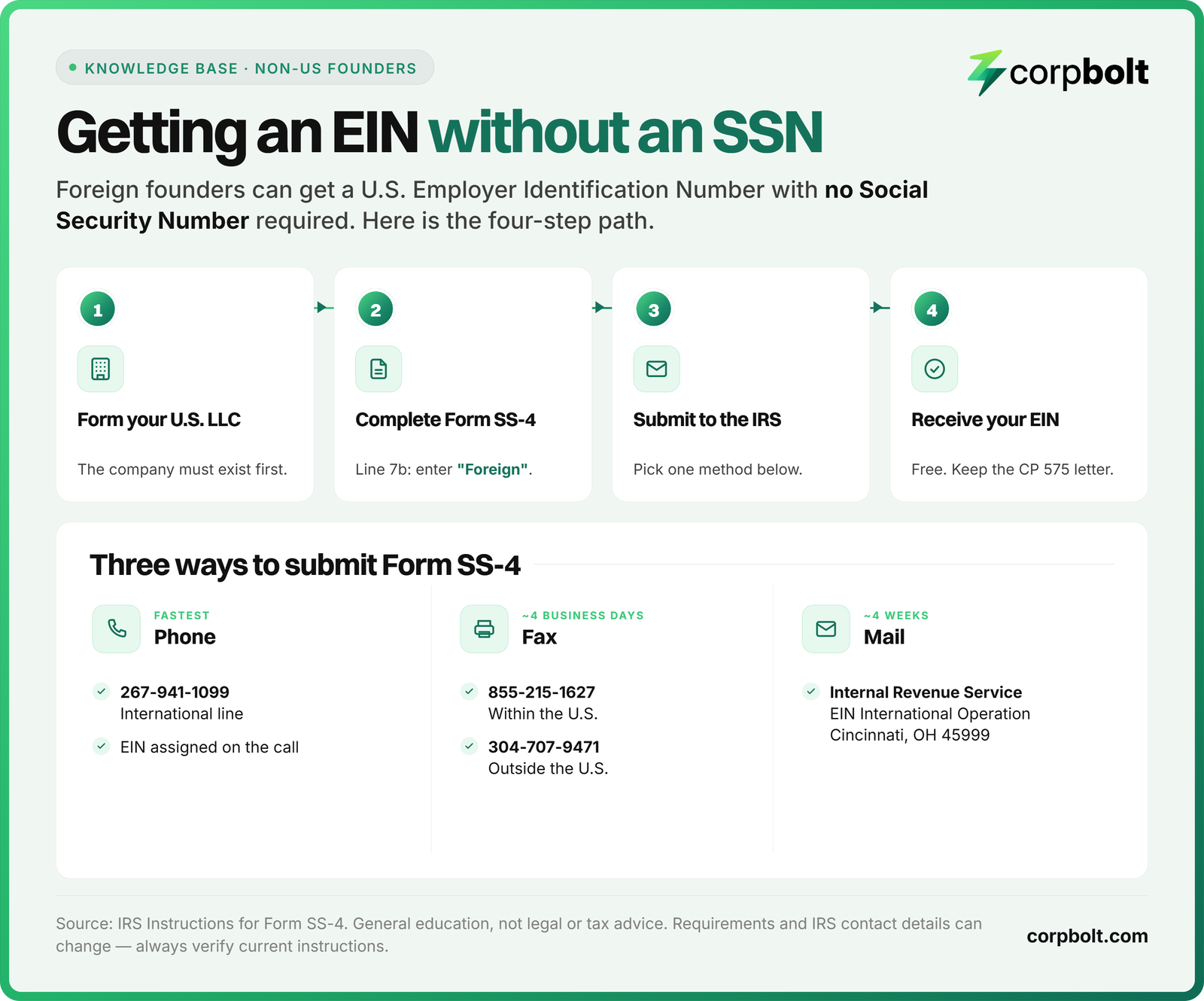
Here is the full process for a foreign-owned U.S. LLC, from formation through to the EIN confirmation letter.
Form your U.S. LLC first. The EIN belongs to the company, so the company has to exist before you apply. You will need its exact legal name, mailing address, and formation date. If you have not started yet, the full U.S. company formation guide for non-residents covers the steps that come before this one.
Complete Form SS-4. This is the IRS application for an EIN. The lines that matter most are 7a and 7b (the responsible party and their tax ID), where a founder with no SSN or ITIN enters "Foreign"; line 9a (the entity type); and the reason you are applying. Keep your formation documents in front of you so the company name, address, and date match them exactly.
Choose how to submit it: fax, mail, or phone. All three reach the IRS unit that handles applicants without a U.S. taxpayer ID. The next section compares them so you can pick the one that fits your deadline.
Receive your EIN. By fax, the IRS sends the number back to your return fax line; by mail, you receive the CP 575 confirmation letter. Either way, keep the confirmation, because banks and payment processors often ask to see it. The IRS prints that CP 575 only once and will not issue a duplicate, so if it is ever lost you ask the IRS for a Letter 147C instead, an official EIN verification letter it sends on request and that banks accept in the original's place. Your EIN does not expire and stays with the company for its life.
Fax, mail, or phone: which method should you use?
The method you pick decides your timeline and how much you handle live, in English, with an IRS agent. Here is how the three compare for an applicant with no U.S. taxpayer ID.
Fax is the route most non-US founders use. Send the completed SS-4 to 855-215-1627 (from inside the United States) or 304-707-9471 (from outside it). Include a return fax number, and the IRS generally faxes your EIN back within about four business days.
Mail is the slowest path but needs nothing more than a printed, signed form. Send it to Internal Revenue Service, Attn: EIN International Operation, Cincinnati, OH 45999. Expect your EIN in roughly four weeks.
Phone is open to international applicants only, at 267-941-1099 (not a toll-free number), Monday to Friday, 6:00 a.m. to 11:00 p.m. Eastern. The call can be made by an authorized person: an officer or owner of the company, or a Third Party Designee named on the SS-4. That person answers the IRS agent's questions from the completed form, and the EIN can be assigned on the call. It is the quickest option if you are comfortable handling the questions in real time.
Who can be the responsible party?
The responsible party is not a formality. The IRS defines it as the individual who owns or controls the entity and manages its funds and assets, and it must be a person, not a company. For a single-owner LLC that is normally you, the founder. Your registered agent, your accountant, and your formation provider cannot be listed in that role, and the IRS states plainly that nominees cannot apply for an EIN or be listed on Form SS-4.
One more limit is worth knowing before you file: the IRS issues only one EIN per responsible party per day, across every method. If you are forming more than one company, you cannot collect every EIN in a single sitting.
Do you need an ITIN to get an EIN?
No. This is one of the most common mix-ups, so it is worth saying directly: you do not need an ITIN to get an EIN. An ITIN is a personal U.S. tax ID for an individual, while an EIN is the federal tax ID for your business. Because the SS-4 lets a foreign responsible party enter "Foreign" in place of a personal tax number, your company can receive its EIN while you hold no ITIN at all. If the distinction between the two still feels blurry, our guide to what an EIN is and how it differs from an ITIN and an SSN lays it out in full.
Some founders do eventually apply for an ITIN, usually for their own U.S. tax filing obligations, but that is a separate process on a different form. It should never hold up your company's EIN. If you are unsure whether you need an ITIN at all, that is a separate question.
After the EIN: your LLC's annual filing
Getting the EIN is the start of your company's U.S. compliance, not the end of it. A foreign-owned single-member LLC is treated as a reportable entity by the IRS, so once it has an EIN it generally has to file Form 5472 together with a pro forma Form 1120 every year, even in a year with no income and no U.S. tax to pay. Those returns are filed under the EIN you just obtained, which is one more reason to keep the confirmation somewhere safe.
Frequently asked questions
Can I get an EIN without an SSN or ITIN?
Yes. A responsible party who has no SSN or ITIN and cannot get one enters "Foreign" on line 7b of Form SS-4 and applies by fax, mail, or the international phone line. The IRS issues the EIN to the business regardless of the owner's personal tax status.
Can a non-resident apply for an EIN online?
Usually not. The online EIN Assistant requires the responsible party to have an SSN, ITIN, or existing EIN, and it is closed to applicants with no U.S. residence or place of business. Non-residents in that position apply by fax, mail, or phone instead.
How long does it take to get an EIN without an SSN?
By fax, about four business days when you include a return fax number. By mail, about four weeks. By the international phone line, the EIN can be assigned during the call. The instant online route is not available without a U.S. taxpayer ID.
How much does an EIN cost?
Nothing. The IRS issues EINs for free. If you use a formation service, the fee covers preparing and submitting Form SS-4 correctly, never the EIN number itself.
Can someone apply for my EIN for me?
Yes. You can name a Third Party Designee on Form SS-4 to apply for and receive the EIN on the company's behalf. The responsible party listed on the form must still be a real owner or controller of the business, not the designee.
Official references
How this article was prepared
CORPBOLT prepared this guide for non-US founders who need an EIN after forming a U.S. LLC. Every rule and number in it, the application methods, the line 7b "Foreign" instruction, the fax and phone details, the four-business-day and four-week timelines, and the one-EIN-per-day limit, is drawn from current IRS source material: the IRS EIN guidance and the Instructions for Form SS-4 (revised December 2025) linked above. We reviewed it for accuracy and for honesty about the parts of the process the IRS controls, such as processing time, which no formation service can speed up or guarantee. It is refreshed when the IRS changes its EIN process. This article is general information, not legal or tax advice.
Getting your EIN with CORPBOLT: CORPBOLT forms your Wyoming LLC with a registered agent and U.S. business address from $349/year (Foundation); the EIN is included from $599/year (Launch) or available as a $199 add-on. The EIN is always free from the IRS, so you pay for the formation and the prepared SS-4, never the number. Approval for any bank or payment processor is still each provider's decision. Form your Wyoming LLC →
Approval note: An EIN is something banks and payment processors require, but it does not guarantee approval. Each bank, fintech, and processor makes its own decision based on your documents, business model, and country.
Approval note: Eligibility and approval decisions are made by each bank, fintech, and payment processor. Requirements can vary by provider, country, business model, and account history.
