

EIN vs ITIN vs SSN comes down to one split: an EIN is a tax number for a business, while an SSN and an ITIN are tax numbers for a person. "Tax ID" is not a separate number at all, it is the umbrella term that covers all three. If you are forming a U.S. LLC from outside the country, the number your company needs is an EIN, and you can get it without ever having an SSN.
A free, nine-digit federal number the IRS assigns to a company (format 12-3456789).
An SSN is for U.S. citizens and work-authorized residents. An ITIN is the personal tax number for someone who owes U.S. tax but cannot get an SSN.
Tax ID, or TIN, is the family name. An SSN, an ITIN, and an EIN are all types of TIN, which is why the labels get mixed up.
The quick difference
Most of the confusion here is vocabulary. Three different numbers do similar-sounding jobs, and a fourth label, "tax ID," floats over all of them. Here is the clean way to hold it in your head.
An EIN, or Employer Identification Number, identifies a business. An SSN and an ITIN both identify a person: the SSN for people who can get one, the ITIN for those who cannot. And "tax ID" is not a number you apply for, it is the category that all three belong to. When people search EIN vs ITIN vs SSN, they are usually trying to work out which of these their U.S. company actually needs, and the short version is the EIN.
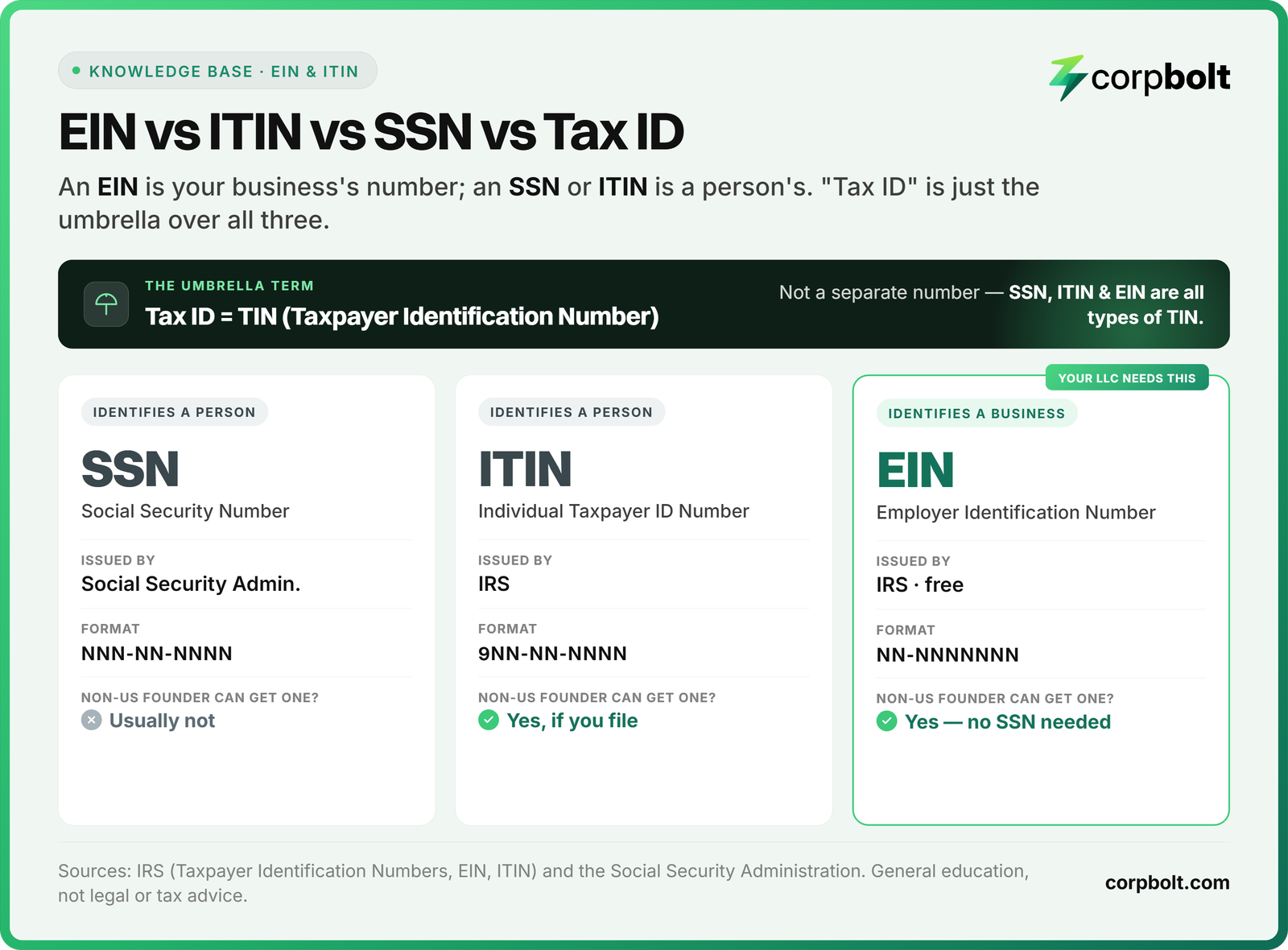
SSN, ITIN, and EIN side by side
SSN | ITIN | EIN | |
|---|---|---|---|
Type of TIN | A type of TIN | A type of TIN | A type of TIN |
Identifies | A person | A person | A business |
Issued by | Social Security Administration | IRS | IRS |
Format | NNN-NN-NNNN | 9NN-NN-NNNN (begins with 9) | NN-NNNNNNN |
Main purpose | Wages, personal taxes, and benefits | A personal U.S. tax filing when you cannot get an SSN | Your company's federal tax ID |
Can a non-US founder get one? | Usually not (needs U.S. work authorization) | Yes, on Form W-7, when a filing requires it | Yes, for the LLC, with no SSN needed |
What each number actually is
Social Security Number (SSN)
An SSN is issued by the Social Security Administration for U.S. citizens, permanent residents, and certain noncitizens who are authorized to work in the United States. It is the number tied to wages, personal income tax, and Social Security benefits. Most founders living outside the U.S. are not eligible for one, and that is not a problem: you do not need an SSN to own a U.S. LLC.
Individual Taxpayer Identification Number (ITIN)
An ITIN is a personal tax number the IRS issues to someone who has a U.S. tax filing requirement but is not eligible for an SSN. It is a nine-digit number that always begins with the number 9 (format 9NN-NN-NNNN), and you apply for it on Form W-7. An ITIN does not authorize work and does not grant any immigration status. It exists for one reason: so the IRS can process a personal filing. Its limits follow from that narrow purpose, and if you ever become eligible for an SSN you are expected to switch to it and tell the IRS, since the ITIN only bridges the gap until then. An ITIN can also lapse: if it is not used on a federal tax return for three consecutive tax years, the IRS deactivates it, and reviving it means filing Form W-7 again. If you are not sure it applies to you, here is when a non-US founder actually needs an ITIN.
Employer Identification Number (EIN)
An EIN is the company equivalent of those personal numbers. The IRS issues it to identify a business, and a U.S. LLC uses it to open a bank account, file federal forms, and work with payment processors. It is free. A foreign founder with no SSN or ITIN can still get one by applying on Form SS-4 and entering "Foreign" on the responsible-party line. The full walkthrough is here: how to get an EIN without an SSN.
Where "Tax ID" fits in
So what is a "tax ID"? It is not a fourth number. "Tax ID" is everyday shorthand for Taxpayer Identification Number, or TIN, which the IRS defines as the identification number it uses to administer the tax laws. The IRS lists the SSN, the EIN, and the ITIN (along with two specialist numbers most people never touch: the ATIN, a temporary number for a pending U.S. adoption, and the PTIN, which paid tax preparers use) as the types of TIN, and notes that the SSA issues the SSN while every other TIN is issued by the IRS. In other words, your EIN is a tax ID, your ITIN is a tax ID, and your SSN is a tax ID. The phrase does not point to one specific number, which is exactly why forms that ask for a "tax ID" cause so much second-guessing.
A common real example we see: a founder opens a Stripe or a business bank account, gets asked for a "tax ID," and starts hunting for a Social Security Number they will never have. The number the platform wants is the company EIN. Once they enter that, the application moves on. The label was the only thing standing in the way.
Which one do you actually need as a non-US founder?
For most founders forming a U.S. LLC from abroad, the answer is short: your company needs an EIN, and usually nothing else. You do not need an SSN, and in most cases you do not need an ITIN either, because the LLC files under its own EIN and the foreign owner is simply listed as "Foreign" on Form SS-4. You would only reach for an ITIN in the separate situation where you personally have to file a U.S. return, such as a Form 1040-NR, or claim a tax-treaty benefit in your own name. If you are weighing both, the full EIN and ITIN guide for non-US founders walks through which you need and in what order. None of this is tax advice, and your own facts can change the answer, so confirm anything specific with a qualified tax professional.
One rule of thumb ties it together: the business files under its EIN, and anything personal files under your SSN or ITIN. Keeping the two separate is ordinary IRS practice, and it is why a single-member LLC can run on an EIN while the foreign owner only needs a personal number in the narrow cases above. If you ever hire US-based staff, the company also uses its EIN for payroll and collects each worker's SSN or ITIN, but that is a separate situation most remote founders never reach.
One more place the question surfaces: a US client may ask the company to fill out a tax form, usually a Form W-9 or a W-8, before paying it. The company's US tax ID on these forms is its EIN, but which form applies, and whose details go on it, depends on the LLC's tax classification, because a single-member LLC treated as disregarded is looked through to its foreign owner. It is worth confirming the right form with a tax professional rather than guessing.
Official references
How this article was prepared
This explainer is built from primary government sources rather than other articles. The definitions and the "tax ID is the umbrella" point come straight from the IRS Taxpayer Identification Numbers page. The EIN and ITIN details come from the IRS pages for each number and the Form SS-4 and Form W-7 instructions, and the SSN eligibility points come from the Social Security Administration. CORPBOLT helps non-US founders form a U.S. company and obtain an EIN, so the practical notes reflect what founders actually run into. This is general information, not legal or tax advice, and we review it whenever the IRS updates its guidance.
Frequently asked questions
Is a Tax ID the same as an EIN?
Not exactly. "Tax ID" is the umbrella term, Taxpayer Identification Number, and an EIN is one type of it. So an EIN is always a tax ID, but a "tax ID" could also be an SSN or an ITIN depending on who is being identified. When a U.S. business form asks a company for its tax ID, it almost always means the EIN.
Is an EIN a TIN?
Yes. The IRS lists the EIN as one of the types of Taxpayer Identification Number, alongside the SSN, the ITIN, and two specialized numbers. An EIN is simply the TIN that identifies a business rather than a person.
Can I use my ITIN instead of an EIN for my LLC?
No. An ITIN identifies you as an individual, not your company, and a U.S. LLC needs its own EIN to open a bank account, file federal forms, and work with payment processors. The two numbers do different jobs, and you may end up holding both.
Does my LLC need an SSN?
No. A U.S. LLC does not need an SSN, and its owner does not need one either. If the responsible party has no SSN or ITIN, you enter "Foreign" on the Form SS-4 application and the IRS still issues the EIN. Many non-US founders run their company on an EIN alone.
What tax ID does a foreign-owned U.S. LLC use?
Its EIN. The EIN is the company federal tax ID for banking, for IRS filings such as Form 5472, and for processors like Stripe. The foreign owner only needs a personal tax ID, an ITIN, in the separate case where they must file or be claimed on a U.S. personal return.
Getting your tax IDs sorted: CORPBOLT forms your Wyoming LLC with a U.S. business address from $349/year; Launch ($599) adds the EIN and a digital mailbox. See how CORPBOLT does this →
Approval note: Eligibility and approval decisions are made by each bank, fintech, and payment processor. Requirements can vary by provider, country, business model, and account history.
