

Do you need an EIN for your LLC? Almost certainly yes. Any LLC with more than one owner, with employees, or with a foreign owner needs its own EIN, which covers nearly every LLC. The one case that can technically skip it is a single-member, US-owned LLC with no employees, and even then a bank will ask for one. The EIN is free from the IRS.
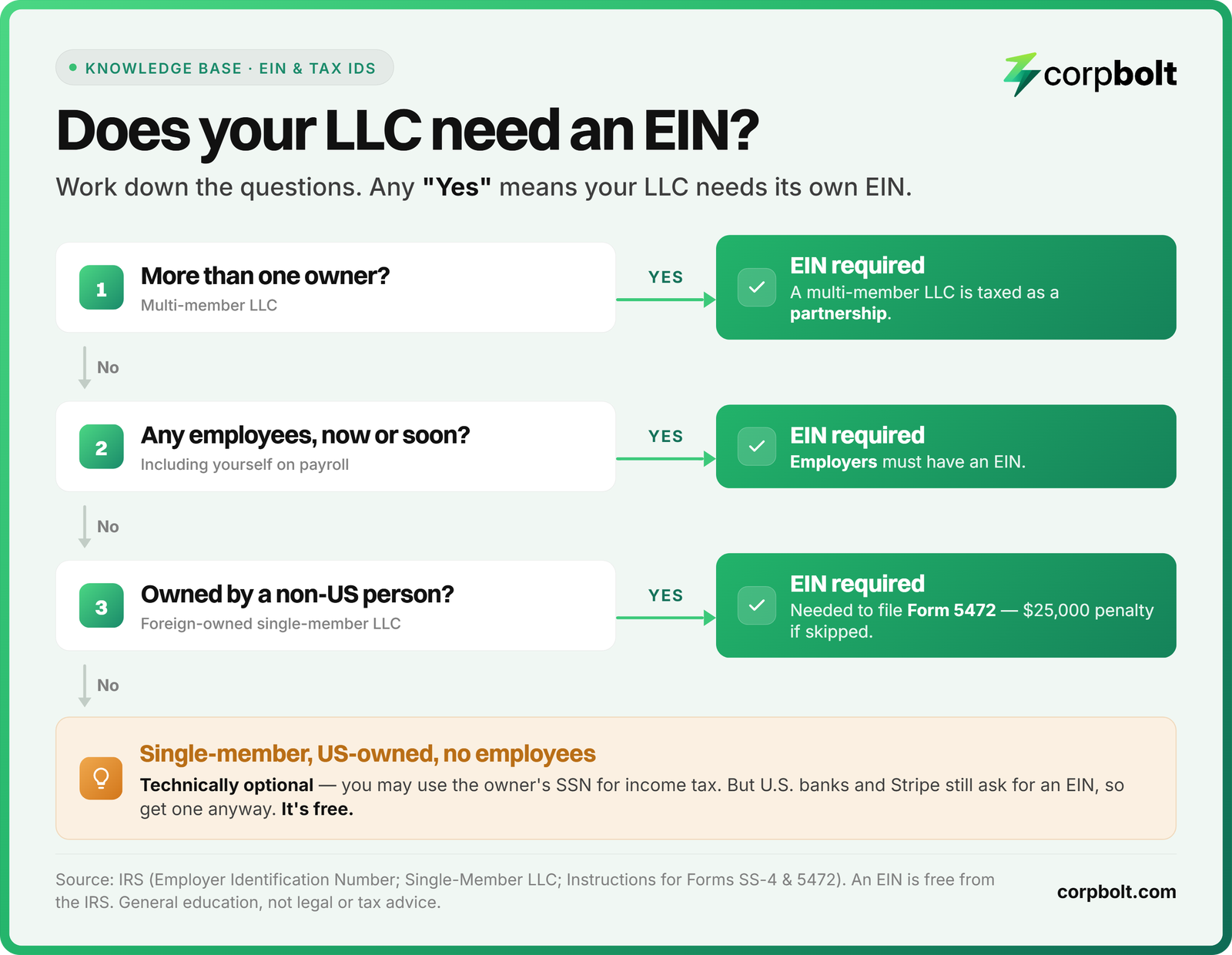
More than one owner, any employees, or a foreign owner all require an EIN. That is nearly every LLC.
Even a single-member foreign-owned LLC needs its own EIN to file Form 5472, the return the IRS requires of it.
A single-member US-owned LLC can use the owner's SSN, but banks and Stripe still ask for an EIN.
It is one of the first questions after forming a company: do I need an EIN for my LLC, or can I skip it? For almost every LLC the answer is yes, and for a foreign-owned one it is effectively always yes. This guide walks through exactly when an EIN is required, the one narrow case where it is technically optional, and why even then you will almost certainly want one.
Do you need an EIN for your LLC?
Yes, in most cases. The IRS requires an LLC to have its own EIN if it has employees, if it owes employment or excise taxes, or if it is taxed as a partnership or a corporation. On top of that, a foreign-owned LLC needs an EIN to meet a reporting duty unique to it. The single situation where an LLC can operate without its own EIN is narrow, and it rarely fits a founder outside the US. If you are not yet sure what the number even is, what an EIN is covers the basics; this page is only about whether you need one.
When is an EIN required?
The IRS treats an EIN as mandatory for an LLC in several common situations. Your LLC needs its own EIN if any of these are true:
It has more than one owner. A multi-member LLC is taxed as a partnership by default, and a partnership must have an EIN.
It has employees, now or once you start hiring.
It elects to be taxed as a corporation (by filing Form 8832 or 2553).
It owes employment, excise, or alcohol, tobacco, and firearms taxes.
It is a foreign-owned single-member LLC, which carries the reporting duty covered in the next section.
For most founders at least one of these is true, which is why the practical answer to "do I need an EIN for my LLC" is almost always yes.
One ownership wrinkle is worth a flag. A multi-member LLC is a partnership and needs its own EIN, and that includes an LLC co-owned by a married couple. The one twist is in US community-property states, where the IRS lets a wholly spouse-owned LLC be treated as a single disregarded entity under Revenue Procedure 2002-69 if the couple reports it consistently; in other states a two-spouse LLC files as a partnership. LLCs also cannot use the "qualified joint venture" shortcut that some unincorporated spouse-run businesses use. If that is your situation, confirm the treatment with a tax professional. For a non-US founder this rarely applies, and the foreign-owned EIN rule below settles the question anyway.
The single-member exception, and why it rarely helps non-US founders
There is one case where an LLC can skip its own EIN. A single-member LLC with no employees and no excise-tax liability is a "disregarded entity," and the IRS says it generally uses the owner's SSN or EIN for income-tax reporting rather than getting its own number. On paper, a solo US owner could run the LLC on their personal SSN.
In practice this exception almost never helps a founder outside the US, for two reasons. First, you usually have no US Social Security Number to use in its place. Second, and more decisive, a foreign-owned LLC has a separate reporting duty that overrides the exception. When we set up an LLC for a founder abroad, the disregarded-entity rule is the first thing people hope will let them skip the paperwork; it almost never does, because there is no SSN to fall back on and the Form 5472 duty below forces the issue.
Why a foreign-owned LLC always needs its own EIN
This is the part that catches non-US founders out. A foreign-owned single-member US LLC is still a disregarded entity for income tax, but under IRS section 6038A it must file Form 5472 with a pro forma Form 1120 every year. To make that filing, the LLC has to have its own EIN. The IRS Form SS-4 instructions even describe this exact case: a foreign-owned disregarded entity requesting an EIN "for purposes of filing Form 5472." So the general single-member exception does not apply to you. A foreign-owned LLC needs its own EIN, full stop.
What if you technically do not need one?
Suppose you are the rare case: a US-based solo owner, no employees, no foreign ownership. You could run on your SSN. Should you? Almost always, no. A US business bank account, a payment processor like Stripe, or a banking platform like Mercury will ask for an EIN rather than your SSN, and many will not open an account without one. Using an EIN also keeps your Social Security Number off vendor and client paperwork. Since the number is free and takes minutes to request, the upside of having one far outweighs the effort of skipping it.
Beyond the bank requirement, an EIN is worth having even when it is technically optional, for a few practical reasons:
It opens business banking and payment accounts. A US business bank account and a processor like Stripe almost always ask for the EIN rather than a personal number, and many will not open an account without one.
It keeps the company's finances separate from yours. Using the EIN on the LLC's accounts and filings, rather than a personal ID, supports the liability separation the LLC is meant to give you and keeps cleaner records.
It is the business's tax ID to share. You give the EIN to vendors, clients, and platforms as the company's identifier, so a personal number stays off their paperwork.
It is the starting point for a business credit profile. An EIN is what a business credit history is built on. Building US business credit as a non-resident is its own slow process, but without an EIN you cannot begin it at all.
How do you get an EIN once you need one?
Once you know you need one, getting it is straightforward. With an SSN or ITIN, the IRS online tool issues the number immediately. Without one, which is the usual case for a founder abroad, you apply on Form SS-4 by fax or mail and enter "Foreign" where a Social Security Number would go. The full walkthrough is in how to get an EIN without an SSN. For how the EIN fits alongside an ITIN and the rest of your tax IDs, see the EIN and ITIN guide for non-US founders.
Before you apply, it helps to have these details ready so the SS-4 goes through cleanly the first time:
What the IRS asks for | What you put |
|---|---|
The LLC's legal name and formation state | Exactly as they appear on your state filing |
A mailing address, and a trade name if you use one | The address for IRS mail; your DBA only if you have one |
The responsible party and their tax ID | A real owner who controls the LLC; their SSN or ITIN, or "Foreign" if they have neither |
Entity type and number of members | LLC, and how many owners it has |
Reason for applying | Usually starting a new business or banking |
Your main business activity | The closest description of what the company does |
The full SS-4 walkthrough, including the fax and mail routes a non-resident uses, is in what an EIN is and how to get one.
Frequently asked questions
Does a single-member LLC need an EIN?
Not always for US income tax: a solo US owner with no employees can use their own SSN. But a foreign-owned single-member LLC does need its own EIN to file Form 5472, and any LLC with employees needs one regardless of how many owners it has.
Does a foreign-owned LLC need an EIN?
Yes, always. Even as a disregarded entity it must file Form 5472 each year, and that filing requires the LLC's own EIN. The single-member SSN exception does not apply when the owner is a non-US person.
Can I use my SSN instead of an EIN for my LLC?
Only a single-member, US-owned LLC with no employees can use the owner's SSN for income-tax reporting. A non-US founder usually has no SSN to use, and a foreign-owned LLC needs its own EIN anyway.
Is an EIN required to open a business bank account?
Banks and payment processors typically require one, although that is their rule rather than an IRS mandate. In practice you will not get far with a US bank or Stripe without an EIN, and approval still depends on the institution.
How much does an EIN cost?
Nothing. The IRS issues EINs for free. If a service charges a fee, it is for preparing and submitting the application, never for the number itself.
What information do I need to apply for an EIN?
Have the LLC's legal name and formation state (as filed), a mailing address and any trade name, the responsible party's name and their SSN or ITIN (or "Foreign" if they have neither), the entity type and number of members, the reason for applying, and a short description of the business activity. The number itself is free.
Is it worth getting an EIN even if my LLC does not strictly need one?
Usually yes. Even in the narrow case where an LLC could run on the owner's SSN, a US bank or payment processor will ask for an EIN, and using it keeps the company's finances separate from your personal ones. The EIN is free and quick, so the upside outweighs skipping it.
How CORPBOLT can help
CORPBOLT prepares and submits the EIN application for non-US founders as part of forming the LLC, so the number is ready by the time a bank asks for it. The IRS controls how long issuance takes, and no provider can guarantee a bank's decision. The EIN and ITIN guide covers the wider picture.
Official references
How this article was prepared
CORPBOLT wrote this guide for non-US founders deciding whether their LLC needs an EIN. The conditions that require one, the single-member disregarded-entity exception, and the foreign-owned Form 5472 duty are drawn from the IRS Employer Identification Number guidance, the IRS single-member LLC page, and the Instructions for Forms SS-4 and 5472 linked above. The point that banks and payment processors require an EIN is a practical requirement set by those institutions, not an IRS rule, and account approval is never guaranteed. We refresh this article when the IRS changes its EIN rules. This is general information, not legal or tax advice.
Forming with CORPBOLT: CORPBOLT forms your Wyoming LLC with a U.S. business address from $349/year; Launch ($599) adds the EIN and a digital mailbox. See how CORPBOLT does this →
Approval note: Eligibility and approval decisions are made by each bank, fintech, and payment processor. Requirements can vary by provider, country, business model, and account history.
