

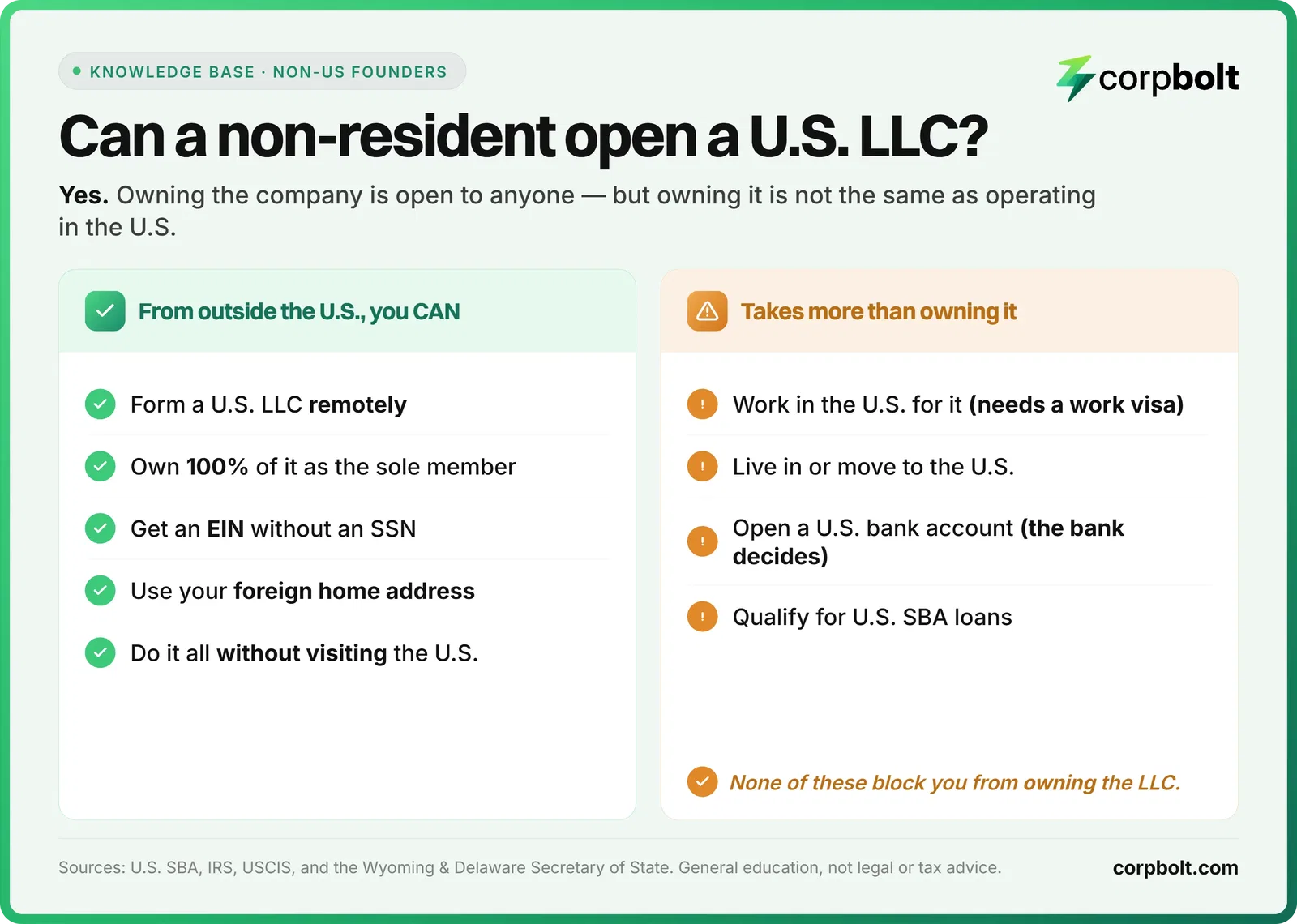
Yes, you can open a US LLC from outside the US. Any non-resident can form and own one remotely, with no US citizenship, residency, visa, or Social Security Number required to start. What you do need is a formation state, a registered agent with a US address, and an EIN. The harder part is everything after formation, banking and tax compliance, not setting up the LLC itself.
No US state requires you to be a citizen or resident to be an LLC member, and you can file without ever visiting the US.
A formation state, a registered agent with a physical address there, and an EIN (a non-resident can get one without an SSN).
An LLC lets you own a US business. On its own it does not give you the right to live or work in the US.
It is the first question almost every founder abroad asks: can you really open a US LLC from outside the US, with no green card, no US address, and no trip to the country? The short version is yes, and it is more routine than it sounds. The US does not require you to be a citizen or a resident to own a company. This guide covers what is and is not required, the myths that stop people before they start, and the parts that genuinely are harder than the paperwork.
Can you open a US LLC if you live outside the US?
Yes. No US state imposes a citizenship or residency requirement to be the owner (in an LLC, owners are called "members"). The two states non-residents most often choose, Wyoming and Delaware, confirm it: neither requires you to live in the state, or even the country, to own an LLC there. Forming the company is a filing you make with a state, not something that depends on where you live. You can complete it from anywhere and never set foot in the US.
If you want the full procedure from start to finish, our step-by-step US company formation guide for non-residents walks through it. This page answers a narrower question: are you even allowed, and what does it actually take?
Do you need to be a US citizen or resident?
No. Ownership of a US LLC carries no citizenship or residency test. A non-resident can be the sole member, and the personal address on your paperwork can be a foreign one. This is the single biggest myth that stops founders before they begin, and it simply is not how US LLC law works. Your country of citizenship does not disqualify you, and you do not need a US partner or co-owner to hold the company with you.
Do you need a US visa or the right to live in the US?
No, and this is the distinction worth getting right. You can own a US LLC from your home country with no US immigration status at all. What ownership does not do is give you the right to live in the US or to work for the company inside the US. US immigration law treats owning a business and being authorized to work in the country as two separate things. Performing the company's actual work while physically in the US requires a visa that permits employment, which is its own process. US Citizenship and Immigration Services outlines the visa options for entrepreneurs who want to work in the US.
Do you need an SSN, an ITIN, or to visit the US?
None of them are required to form the company. You do not need a Social Security Number or an ITIN to set up the LLC, and you do not need to travel to the US to do it. You will want an EIN, the company's federal tax ID, for banking and tax filings. A non-resident can get one without an SSN by entering "Foreign" on the responsible-party line of IRS Form SS-4. Because the IRS online EIN tool requires an SSN or ITIN, a non-resident without either applies on paper, by fax or mail, rather than online. The full process is in how to get an EIN without an SSN.
What do you actually need, then?
Stripped down, forming a US LLC as a non-resident takes three things:
A state to form in. Wyoming and Delaware are the usual picks for non-residents. Our guide to choosing the best state explains the trade-offs, and there is a dedicated walkthrough for a Wyoming LLC for non-residents.
A registered agent in that state. Every state requires your LLC to keep a registered agent with a physical street address in the state (not a P.O. box) who can accept legal mail on the company's behalf. Since you are abroad, you use a commercial registered agent. More on that in what a registered agent is.
An EIN. The federal tax ID the company uses to open a bank account, connect a payment processor, and file taxes. It is free from the IRS and, as above, obtainable without an SSN.
That is genuinely the whole list to get formed. In practice, the only things we need from a founder abroad are the company name, the owner's details, and a passport for identity checks. The state filing itself is paperwork the formation handles.
Your registered agent and US address, explained
The registered agent is the one US requirement a non-resident cannot satisfy alone, so it is worth understanding what the role actually is. Every US state requires an LLC to name a registered agent in its formation state. That agent is a person or company that agrees to receive legal documents and official state mail on the company's behalf, such as service of process in a lawsuit or annual-report notices.
The agent does not have to be a US citizen, but they must have a real street address in the formation state (a P.O. box does not qualify) and be available there during normal business hours. That street address is the agent's responsibility, not yours. A non-resident owner can keep a home address abroad on file and never needs a personal US address to form or own the company.
One distinction trips up a lot of founders: the registered agent address is not the same as your business or mailing address.
Registered agent address | Your business or mailing address | |
|---|---|---|
What it is for | Receiving service of process and official state mail | Everyday business and customer mail |
Where it can be | A physical street address in the formation state, never a P.O. box | Anywhere, including your home country |
On the public record | Yes, listed in your state filing | Not required to be your personal address |
Who provides it for a non-resident | A commercial registered agent service | You, a virtual mailbox, or a US business address service |
For an owner outside the US, a commercial registered agent service is the practical answer rather than an optional upgrade. You have no in-state presence, you cannot accept legal papers in person on a weekday, and a service reliably scans and forwards anything official to you wherever you are. Our guides on what a registered agent service covers and whether you need a US address go deeper on each.
What a US LLC actually gets a founder abroad
Eligibility is one question; whether it is worth doing is another. For most non-residents, a US LLC is less about US taxes and more about access and standing in the world's largest market. The practical advantages are concrete:
Limited liability. An LLC is legally separate from you, so the company's debts and claims generally stay with the business rather than reaching your personal assets at home.
Credibility with US platforms and customers. A registered US company, an EIN, and a US business presence make it far easier to be taken seriously by suppliers, marketplaces, and clients who prefer to contract with a US entity.
Access to US payment rails. A US LLC plus an EIN is what most US payment processors, including Stripe and PayPal, expect before they will let you accept card payments in dollars.
A simple, flexible structure. A single-member LLC is pass-through by default with light ongoing admin: no shares, no board, and no in-person meetings required.
A foothold in the US market. It gives you a US billing entity, the option of a US business bank account, and a base to sell into the US without relocating.
None of this requires you to move. It is ownership and market access, not immigration, which is the same line drawn earlier in this guide.
What is actually hard: banking, tax, and reporting
Forming the LLC is the easy part. The friction for non-residents shows up afterward, and it is worth knowing before you start so nothing catches you off guard.
Opening a US business bank account from abroad
This is the step most non-residents find hardest. You want a business account because it keeps the company's money separate from your personal funds. It is also what you use to receive customer payments, pay suppliers and bills, and settle any US tax you owe. A US business bank account or a Stripe account is approved by the bank or processor, not by the government and not by the act of forming the LLC.
What providers ask for is fairly consistent, even when approval is not. Most want:
your EIN and the LLC's formation documents, such as the articles of organization;
proof of identity for the owner, usually a passport; and
some evidence of the business, and for many banks a US address or phone number for the account.
The real split is between traditional banks and fintech providers. Most traditional US banks still expect an in-person visit to a branch to open a business account, which is the genuine obstacle when you are abroad. A number of fintech providers built for startups onboard remotely and work with non-resident-owned LLCs, which is the route many founders take instead. Approval still depends on your country of residence, the provider, and the documents you can show, so it is never guaranteed. If a traditional bank declines, a remote-friendly fintech account is usually the next move. Plan for this step to take more effort than the formation did.
US tax and reporting, even in a year with no income
A foreign-owned single-member LLC is usually treated as a "disregarded entity" that must file Form 5472 with a pro forma Form 1120 each year. The filing applies even in a year with no income and no US tax due, and missing it carries a $25,000 penalty. It is a reporting form rather than a tax bill, but it is not optional.
How the LLC is taxed depends on how many owners it has, and the annual filing differs:
Owners | Default federal tax treatment | Main annual filing |
|---|---|---|
One owner (single-member) | Foreign-owned disregarded entity | Form 5472 with a pro forma Form 1120 |
Two or more owners (multi-member) | Partnership | Form 1065 with a Schedule K-1 for each owner |
A multi-owner LLC with US-connected income can also face partnership withholding, so a multi-member setup is worth running past a tax professional before you file.
Beneficial ownership (BOI) reporting status
As of June 2026, under FinCEN's interim final rule from March 2025, companies formed in the US, including LLCs owned by non-residents, are exempt from Beneficial Ownership Information (BOI) reporting under the Corporate Transparency Act. Only companies formed under foreign law and then registered in a US state still report. Because that is an interim rule FinCEN may revise, confirm the current position at fincen.gov/boi before you rely on it.
Frequently asked questions
Can a non-resident be the sole owner of a US LLC?
Yes. A single non-resident can be the only member of a US LLC. For tax purposes that makes it a foreign-owned disregarded entity, which brings a yearly Form 5472 filing, but the ownership itself is fully allowed.
Do you need a US address to open an LLC?
Your LLC needs a registered agent with an address in the formation state, but the personal address you put on file can be your home address abroad. You do not need a personal US address to form or own the company.
Can you open a US business bank account from outside the US?
Sometimes, but it is the hardest step and never guaranteed. Approval is the bank's or processor's decision, based on your business, your country, and your documents. Forming the LLC does not secure an account on its own.
Which state is best for a non-resident LLC?
Wyoming and Delaware are the most common choices for non-residents, mainly for cost and simplicity. The right answer depends on where you actually operate; our guide on choosing a state compares them in detail.
Do you need a US partner or co-owner?
No. You can own 100% of a US LLC as a non-resident. A US co-owner is not required, and adding one does not make formation or banking automatically easier.
Do you need a registered agent if you live abroad?
Yes. Every US state requires your LLC to keep a registered agent with a physical address in the formation state. A non-resident owner has no in-state address and cannot be there on weekdays. So you appoint a commercial registered agent service to fill the role, normally included when a formation service sets up your LLC.
Is a US LLC worth it for a non-resident?
For most founders abroad the value is access, not tax savings: limited liability, credibility with US platforms and customers, eligibility for US payment processors like Stripe and PayPal, and a base to sell into the US market without relocating. Whether it pays off depends on your business, but the structure itself is cheap to keep and simple to run.
How CORPBOLT can help
CORPBOLT forms Wyoming LLCs for founders living anywhere, handling the state filing, the registered agent, and the EIN application so the setup is done right the first time. Whether a bank approves your account and how any tax filing turns out stay with the bank and the IRS, never something we guarantee. The full formation guide shows the whole path from decision to a ready-to-operate company.
Official references
How this article was prepared
CORPBOLT wrote this guide for founders outside the US deciding whether they can form a US company at all. The eligibility points (no citizenship or residency requirement, the registered-agent rule, and getting an EIN without an SSN) are drawn from the U.S. Small Business Administration, the Wyoming Secretary of State, and the IRS Form SS-4 instructions linked above. The ownership-versus-work-authorization point reflects U.S. Citizenship and Immigration Services guidance. The BOI status is current as of June 2026 under FinCEN's March 2025 interim final rule and is the one item to re-check, since FinCEN may finalize different terms. We refresh this article when these requirements change. It is general information, not legal, tax, or immigration advice.
Doing it with CORPBOLT: CORPBOLT forms your Wyoming LLC with a U.S. business address from $349/year; Launch ($599) adds the EIN and a digital mailbox. See how CORPBOLT does this →
Approval note: Forming an LLC does not guarantee a US bank account, a payment processor, a visa, or any particular tax outcome. Banking and immigration decisions are made by those institutions under their own rules.
Important: This article is for general information only and is not legal or tax advice. Requirements can vary by state, provider, and individual circumstances, so consider speaking with a qualified legal or tax professional before making filing, tax, banking, or payment decisions. Eligibility and approval decisions are made by each bank, fintech, and payment processor.
