

The best state for a non-resident LLC depends on where the business will actually operate, whether investors or contracts expect a specific state, annual compliance costs, privacy preferences, and the documents needed after formation. For many remote non-US founders with no fixed U.S. footprint, Wyoming is often the first state to compare. General education, not legal or tax advice.
A practical default for non-US founders with no fixed U.S. office, employees, inventory, or local operations.
Can make sense when a specific contract or counterparty expects a Delaware entity.
May fit some cases, but don't assume it is automatically cheaper or better; verify the full cost.
If you are forming from outside the US, the full company-formation guide for non-residents covers the whole process. If you are still choosing the entity itself, review what an LLC is before treating state choice as the first decision.
How to choose the best state for LLC non resident founders
Start with operations, not marketing claims. Business-structure guidance generally points to the same practical factors: taxes, personal liability, paperwork, fundraising, and day-to-day operations. For an LLC, the state you choose also affects registered agent requirements, annual filings, state fees, and whether you may need to register in another state later.
For that reason, the best state for LLC non resident founders is a fact-pattern decision, not a universal state ranking. A founder with no fixed U.S. operating state may compare Wyoming, Delaware, and Nevada differently than a founder with employees, inventory, or local services in one state.
A useful state-choice framework has five questions:
Where will the business physically operate? Look at employees, contractors who create local registration issues, inventory, warehouses, offices, storefronts, local services, and repeated in-state activity.
Do partners or contracts expect a specific state? Some counterparties are more comfortable with a Delaware entity.
What are the state filing and annual compliance costs? Compare the formation fee, annual report or tax, registered agent cost, and any business license or state tax registrations.
What information becomes public? Different states publish different entity and organizer details. Privacy rules should be verified with the state, not assumed from a comparison chart.
What documents will banks, payment processors, and platforms request? Formation documents help with readiness, but they do not guarantee account approval.
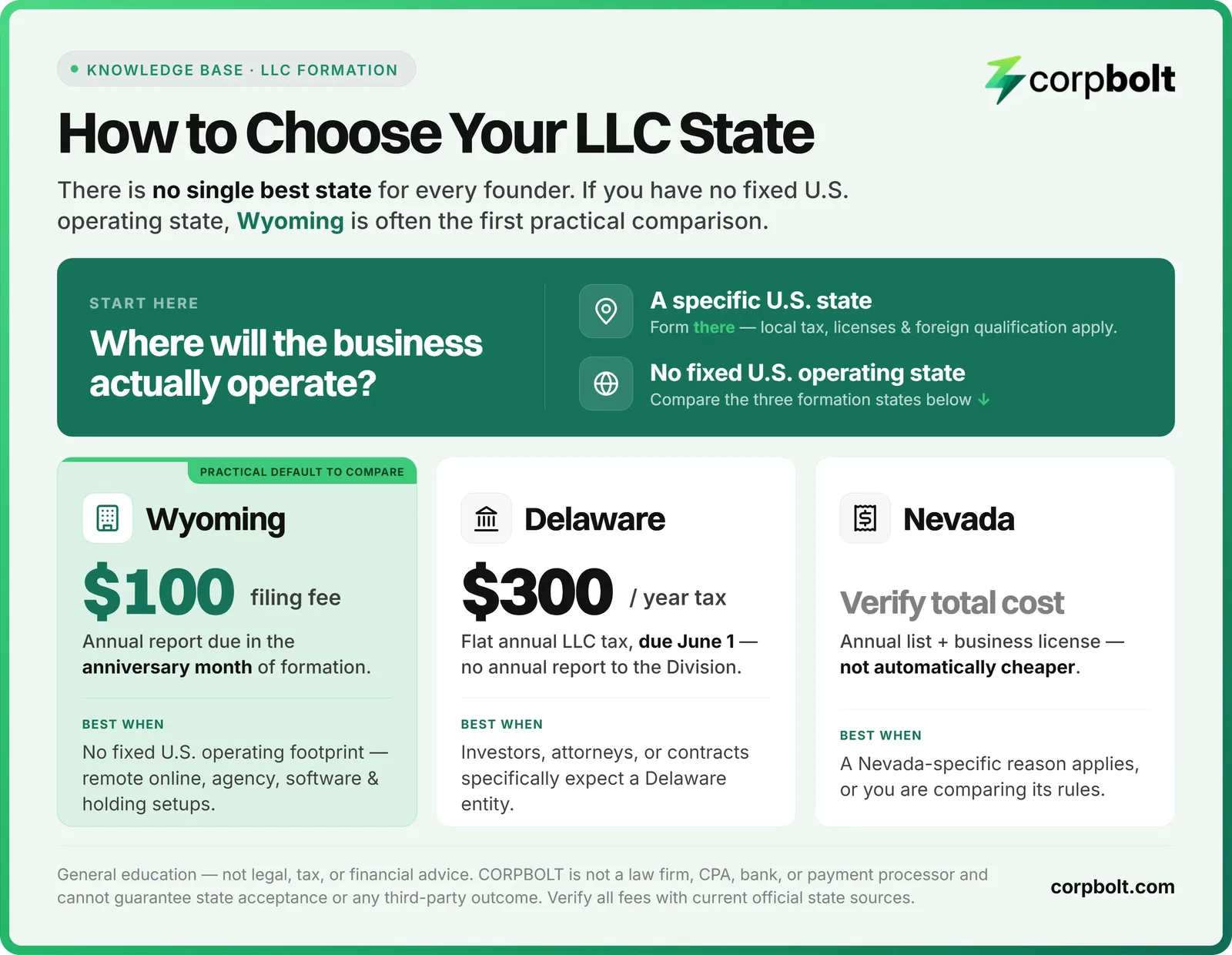
LLC state options at a glance
Use this table as a starting screen, not as a final answer. The right state still depends on operations, contracts, investor expectations, current state fees, tax facts, and professional advice.
Option | When it can fit | What to verify before filing |
|---|---|---|
Operating state | The LLC has a U.S. office, employees, warehouse, inventory, local services, or repeated in-state activity. | Foreign qualification, state tax registration, licenses, annual reports, and local filing requirements. |
Wyoming | The founder has no fixed U.S. operating state and wants a common non-resident LLC formation path. | Current filing fee, registered agent requirements, annual report timing, and any out-of-state obligations. |
Delaware | Investors, attorneys, contracts, or counterparties specifically expect a Delaware entity. | Annual LLC tax, and whether Delaware's familiarity is genuinely worth the extra cost versus a simpler state. |
Nevada | The founder has a Nevada-specific reason or wants to compare privacy and compliance rules. | Current annual list, business license, Secretary of State fees, and total first-year plus ongoing cost. |
New Mexico | The founder wants the lowest ongoing cost and strong privacy, with no fixed U.S. operating state. | That New Mexico requires no annual report, the current formation fee and registered agent cost, and whether its newer LLC track record fits your needs versus Wyoming. |
When Wyoming can make sense
Wyoming can make sense for some non-US founders who want a straightforward LLC formation state and do not already have a specific U.S. operating footprint. The Wyoming Secretary of State LLC Articles instructions list a $100 filing fee and require a registered agent with a physical Wyoming address. Annual reports are then due every year on the first day of the anniversary month of formation.
This makes Wyoming attractive for founders who want a common non-resident LLC setup, a registered agent structure, and a state process that is familiar to formation providers. It can be especially relevant for online businesses, agencies, software businesses, consultants, and holding-company style setups where the founder is outside the United States and does not have a physical U.S. location. One reason holding-style setups in particular favor Wyoming: the state extends charging order protection to single-member LLCs, which not every state does.
Wyoming is not automatically the right answer for everyone. If the business later creates real activity in another state, by hiring there, storing inventory, opening an office, or providing local services, that state may want its own steps. Those can include foreign qualification, local tax registration, permits, or additional filings. A Wyoming LLC can still have obligations outside Wyoming depending on what the business actually does.
When Delaware can make sense
Delaware can make sense when the founder expects legal or contract preferences around a Delaware entity. Delaware LLCs do not file an annual franchise-tax report, but the Delaware Division of Corporations charges a flat $300 annual tax. It is due on or before June 1, whether or not the LLC was active.
Delaware is often discussed because its business entity system is familiar to attorneys, investors, and corporate counterparties. For a simple owner-operated LLC, that familiarity may or may not be worth the annual cost. For a founder who works with contracts or counterparties that specifically expect a Delaware entity, it becomes more relevant.
Delaware's reputation comes mostly from large, established companies, which is a different situation from a simple owner-operated LLC formed by someone abroad. For most non-resident founders without a specific Delaware reason, that reputation is not worth the extra annual cost. If you are weighing the entity type itself rather than the state, the LLC versus corporation comparison covers that separately.
Where Nevada fits
Nevada is another state that appears in many LLC state comparisons, but non-US founders should verify the full filing and annual cost before treating it as a low-cost option. Nevada statutes include annual list requirements for LLCs, and founders should verify any Secretary of State filing, annual-list, state-business-license, and fee amounts against current official Nevada sources before deciding.
Nevada may be relevant if the founder has a Nevada connection, wants to compare privacy and compliance rules, or has advice pointing to Nevada for a specific reason. It should not be chosen just because a comparison page lists it beside Wyoming and Delaware. Review the current Nevada Secretary of State fee schedule and state business license requirements before deciding.
If you do not have operations in Nevada and you are mainly choosing among common non-resident LLC states, compare Nevada's total first-year and annual costs against Wyoming and Delaware. The cheapest-looking formation fee is not always the total cost of keeping the entity active.
What about privacy and anonymity?
Privacy is one reason non-residents look closely at Wyoming. When you form a Wyoming LLC, the state does not list the members or managers on the public formation filing, so your name does not show up in the state business record simply for owning the company. New Mexico is similar and is often the lowest-cost private option. Some states are the opposite and publish more owner or manager detail, so confirm what your chosen state makes public before you file.
Be clear about what this privacy does and does not do. It keeps your name off the public state record, which cuts down on data-broker scraping and unsolicited contact. It is not anonymity from the government or from the businesses you deal with. The IRS still has your details through the EIN application, a U.S. bank runs full know-your-customer checks on the owner before opening an account, and where federal beneficial-ownership reporting applies it collects owner information privately. A private formation state protects what the public can see, not what regulators or your bank can.
When your operating state can matter more than Wyoming, Delaware, or Nevada
If the LLC does business in a state, that state may require registration, tax filings, or other compliance even if the LLC was formed somewhere else. California's Franchise Tax Board, for example, says every LLC doing business or organized in California must pay an annual tax and meet its filing requirements.
The operating-state question is important because forming in a popular state does not erase obligations in the state where the business activity happens. A founder who forms in Wyoming but later opens a California office, hires California workers, stores inventory in California, or earns California-source income may need California-specific guidance.
For a non-US founder, the practical question is: "Where will the business create state-level obligations?" If the answer is "nowhere fixed in the United States yet," Wyoming, Delaware, and Nevada can be compared as formation options. If the answer is a specific state, start there before choosing a remote formation state.
If the business ends up operating in more than one state, the compliance adds up rather than replaces. Each state where you are "doing business" generally wants its own foreign registration, its own registered agent, and its own annual report, so you can end up tracking two or more sets of deadlines and fees at once. Skipping a required registration is not harmless either: a state can charge back fees and penalties and can block the company from bringing a lawsuit in its courts until you register. This is why matching the formation state to the actual operations usually beats chasing the lowest filing fee.
For a purely online or remote business, this is usually simpler than it sounds. Having customers in many states does not, by itself, create a physical presence anywhere. What triggers another state's registration is people or property on the ground there, such as employees, an office, or inventory in a warehouse, not the location of your buyers. A non-resident founder selling online from abroad typically has no such footprint, which is why a single Wyoming LLC is often enough.
What costs should you compare before filing?
Compare total first-year and ongoing costs, not just the initial Articles of Organization fee. At minimum, review the state filing fee, annual report or tax, registered agent fee, business license requirements, foreign qualification costs, and any state tax registration that may apply to the business model.
Also compare administrative complexity. A lower state fee does not help much if the business still has to register elsewhere. You could be maintaining two registered agents, tracking two sets of annual filings, and handling tax obligations in another state. The cleanest state is often the one that matches the business facts.
One thing the state choice does not change is your federal position. Every U.S. LLC uses the same federal EIN from the IRS, which is free (a formation service charges for preparing and filing the SS-4, not for the number), and a foreign-owned LLC carries the same federal filing duties wherever it forms. A foreign-owned single-member LLC, for instance, generally has to file Form 5472 with a pro forma Form 1120 no matter which state it is in. Choosing Wyoming over Delaware changes your state fees, not your federal tax forms.
What CORPBOLT can help with
CORPBOLT helps with administrative formation support for non-US founders. Depending on the plan and information you provide, that can include:
Preparing filing details and submitting the formation documents.
Organizing company records.
Supporting EIN filing steps, when included.
Helping keep bank-ready records in one place.
CORPBOLT does not choose the legal or tax answer for you. We are not a law firm, CPA firm, tax advisor, bank, payment processor, or marketplace. We cannot guarantee state acceptance, EIN issuance, bank approval, payment processor approval, platform approval, or tax treatment. Those outcomes depend on government agencies, third parties, and your specific facts.
If you are unsure whether Wyoming, Delaware, Nevada, or an operating state is right for your situation, use this page as a discussion checklist for a qualified legal or tax professional.
Best state for LLC non resident decision checklist
Before choosing a state, answer these questions:
Will the LLC have a U.S. office, warehouse, employees, local services, or inventory in a specific state?
Will customers, platforms, banks, contracts, or investors expect a specific state or entity type?
Are you forming an LLC because you need operational simplicity, or should you compare a corporation first?
What is the official state formation fee today?
What annual report, annual tax, annual list, or business license does the state require?
What registered agent arrangement will you use?
What company documents will you need for EIN, banking, payment processor, or marketplace readiness?
What legal or tax advice do you need before filing?
If your answers point to no fixed U.S. operating state, Wyoming may be a practical default to compare first. If investor or contract expectations point to Delaware, review Delaware next. If Nevada is being considered, verify the full Secretary of State and state business license costs before assuming it is lower-maintenance.
Quick FAQ
Is Wyoming the best state for every non-US founder?
For many non-US founders with no fixed U.S. office, employees, inventory, or state-specific operations, Wyoming is one of the strongest default LLC states to consider first. It works well for remote founders who want a straightforward U.S. company setup for banking, payments, contracts, ecommerce, consulting, or software businesses.
Wyoming is not a universal answer if your business will physically operate, hire, store inventory, or create tax obligations in another U.S. state. In those cases, that operating state may matter more. But for a non-US founder starting remotely with no fixed U.S. operating footprint, a Wyoming LLC is usually the practical first choice to compare.
Is Delaware better than Wyoming for an LLC?
Not always. Delaware can make sense when legal or contract expectations point there. For a simple non-US founder LLC with no Delaware-specific reason, compare Delaware's annual LLC tax and compliance profile against Wyoming and any operating-state obligations.
Should I form in the state where my customers are?
Customer location alone is not always the deciding factor, but business activity in a state can create registration, tax, or licensing questions. Employees, inventory, offices, local services, warehouses, and state-source income are stronger signals to review with a professional.
Does forming an LLC in a state guarantee privacy or asset protection?
No. State rules can affect what appears in public records, but privacy and liability protection are not absolute. Guarantees are unsafe because outcomes depend on state law, company records, contracts, owner conduct, tax compliance, and court or agency decisions.
Can CORPBOLT tell me which state to choose?
CORPBOLT can explain common formation options and help with administrative filing steps based on your instructions. We do not provide legal, tax, financial, or fiduciary advice, and we do not guarantee government or third-party outcomes.
Which state gives an LLC the most privacy?
Wyoming and New Mexico are the two states non-residents most often choose for privacy, because neither lists the LLC's members or managers on the public formation filing. New Mexico is usually the cheapest to maintain, while Wyoming has more established LLC law. Either way, this is privacy from the public record, not anonymity: the IRS, your bank, and any required federal reporting still collect owner information.
Official references
How this article was prepared
This state-by-state guidance is built from official sources rather than opinion: IRS guidance on LLC taxation and official state pages for the states non-US founders most often compare, including Wyoming and Delaware. We review it for factual accuracy, for what genuinely matters to a founder living outside the United States, and for honesty about what the state choice does and does not change. Filing fees and state rules shift over time, so confirm the current figures with the state before you file. This is general education, not legal or tax advice.
Forming with CORPBOLT: CORPBOLT forms your Wyoming LLC with a registered agent and U.S. business address from $349/year (Foundation); the EIN is included from $599/year (Launch) or available as a $199 add-on. Approval for any bank or payment processor is still each provider's decision. Form your Wyoming LLC →
Approval note: Eligibility and approval decisions are made by each bank, fintech, and payment processor. Requirements can vary by provider, country, business model, and account history.
Important: This article is for general information only and is not legal or tax advice. Requirements can vary by state, provider, and individual circumstances, so consider speaking with a qualified legal or tax professional before making filing, tax, banking, or payment decisions. Eligibility and approval decisions are made by each bank, fintech, and payment processor.
