

In Wyoming, a charging order is the only remedy a member's personal creditor can use to reach that member's LLC interest under W.S. 17-29-503. It lets the creditor collect distributions the LLC actually pays the debtor-member, and nothing more.
The creditor cannot seize the LLC, vote, manage it, force a payout, or foreclose on the interest.
Wyoming applies charging-order-only treatment to single-member LLCs, not just multi-member ones.
Outcomes still depend on the facts, the court, and whether another state applies Wyoming's law.
Charging order protection is one of the main reasons founders form in Wyoming. It is also one of the most oversold. This article explains what the protection actually does, in plain terms, straight from the Wyoming LLC Act. Treat it as asset-protection education, not a promise. Real outcomes depend on the facts, the jurisdiction, and how a court reads them.
What a charging order actually attaches to
Start with what a creditor can even reach. When you own part of an LLC, you hold what the statute calls a transferable interest. That is your economic right to receive distributions the company decides to pay out. If you are new to the structure, our explainer on what an LLC is covers how membership interests work.
Under W.S. 17-29-501, a transferable interest is personal property. That framing matters. A charging order attaches to that property right, meaning the stream of distributions, not to the company itself or its assets. So the creditor stands between you and any money the LLC pays you. The creditor does not step into your seat inside the company.
The charging order is the exclusive remedy (W.S. 17-29-503)
This is the load-bearing rule. Under W.S. 17-29-503, a charging order is the exclusive way a member's personal judgment creditor may satisfy a judgment from that member's transferable interest. Subsection (g) states this plainly. It says the section provides the exclusive remedy, including where the judgment debtor is the sole member, a dissociated member, or a transferee.
Read that carefully. We are talking about a member's own personal creditor coming from the outside. Someone wins a personal lawsuit against you, then tries to reach your LLC interest to collect. That is the outside-in scenario the charging order governs. It is not about a creditor of the LLC chasing the company's own debts. Those are a separate matter covered later.
Because the remedy is exclusive, the creditor is boxed into one tool. They cannot invent a workaround, ask the court to hand over your interest, or attack the company directly. The statute deliberately narrows their options to collecting distributions that flow to you.
What a charging order does not let a creditor do
The gap between what a charging order does and what people assume it does is where most confusion lives. Under W.S. 17-29-503(a), the order only requires the LLC to pay the creditor any distribution that would otherwise go to the debtor-member. That is the full extent of it. Subsection (g) goes further and expressly bars foreclosure on the interest, along with court orders for directions, accounts, and inquiries, and provides no other equitable remedy.
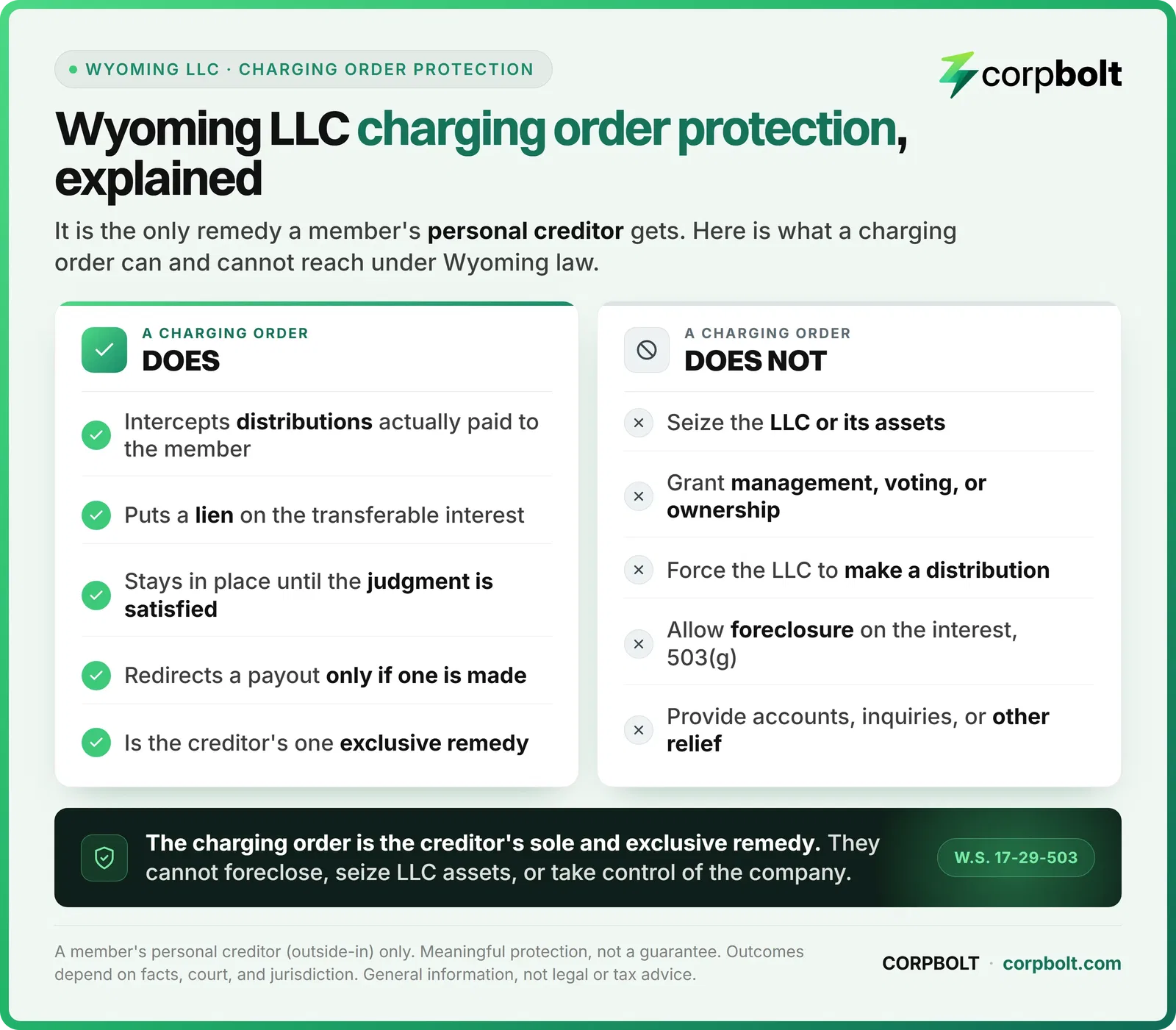
What a Wyoming charging order does, and does not, do.
What a charging order DOES | What it does NOT do |
|---|---|
Intercept distributions the LLC actually pays the debtor-member | Seize the LLC or any of its assets |
Give the creditor a lien on the transferable interest | Grant management, voting, or ownership rights |
Stay in place until the judgment is satisfied | Force or compel the LLC to make a distribution |
Redirect a payout if and when one is made | Allow foreclosure on the charged interest (503(g)) |
Limit the creditor to this single remedy | Provide directions, accounts, inquiries, or other equitable relief |
Note what is absent. The statute never forces the company to declare a distribution. It only redirects one if the LLC chooses to make it. That is a meaningful practical shield, because a creditor can end up holding a charging order that pays nothing for a long time.
Why single-member Wyoming LLCs still get this protection
In several states, charging order protection is strongest for LLCs with more than one member. A lone member can be a weak point. Wyoming closes that gap in the statute itself. W.S. 17-29-503(g) names the sole member directly, so charging-order-only treatment reaches single-member LLCs, not just multi-member ones.
For background, some other states have leaned on the reasoning in the In re Albright decision, a Colorado bankruptcy case from 2003. In that line of cases, a single member's LLC interest could pass through to a creditor or trustee. That is case-law context from another jurisdiction, not a Wyoming holding. Because Wyoming addresses the sole member by statute, you do not need to add a second member to earn the protection here.
A charging order does not permanently trap the interest
A charging order is not a life sentence on your ownership. The Wyoming statute builds in two exits. Under W.S. 17-29-503(d), the debtor-member can extinguish the charging order by satisfying the judgment behind it. Once the debt is paid, the order comes off.
There is a second path in W.S. 17-29-503(e). The LLC itself, or the other members, may pay the creditor the full amount owed and then succeed to the creditor's rights under the charging order. This gives the company a way to remove an outside creditor from the distribution line. Together, these provisions show the interest is encumbered, not permanently lost.
Inside-out versus outside-in: two separate shields
It helps to keep two different protections apart, because a charging order only covers one of them. The charging order handles the outside-in risk, meaning a member's personal creditor trying to reach into the company. The second shield runs the other way.
Under W.S. 17-29-304(a), the debts, obligations, and liabilities of a Wyoming LLC are solely the company's. They do not become a member's or a manager's personal liabilities just because that person is a member or manager. That is the inside-out shield, and it is a core reason people choose the LLC structure. If you are weighing structures, our comparison of how an LLC compares to a corporation walks through the liability and ownership differences.
The limits: where this protection does not apply
No structure makes you untouchable, and honest planning starts there. Charging order protection has real edges, and it is worth naming them.
First, it does not shield your own fraud or veil-piercing conduct. Under W.S. 17-29-304(c), a court weighing personal liability may consider fraud, inadequate capitalization, failure to observe formalities, and commingling of assets. The statute is clear that fraud alone can be enough. Your own torts or criminal acts also create direct personal liability, entirely apart from any charging order analysis.
Second, timing matters a great deal. Moving assets around once a claim is already on the horizon can backfire.
Third, personal bankruptcy is a separate track. A member's personal bankruptcy can potentially override charging-order protection, because the member's LLC interest can become property of the bankruptcy estate. That result rests on federal bankruptcy law under 11 U.S.C. 541, not on the Wyoming LLC Act. We are not asserting a specific Wyoming outcome here, only flagging the federal layer.
Will another court actually apply Wyoming's law?
This is the honest hedge that most marketing skips. If you are sued where you actually live or operate, the court there may apply its own forum law to creditor remedies. The internal-affairs doctrine governs a company's internal relationships. It does not clearly extend to how an outside creditor may collect against a member.
That gap matters most for founders who do not live in Wyoming. If you form there while based elsewhere, a foreign or out-of-state court might not reach for the Wyoming charging order rule at all. Operating in another state can also create its own obligations: a Wyoming LLC that actually does business elsewhere may have to register as a foreign LLC in that state and pay its filing and annual fees on top of Wyoming's, so confirm the requirements with that state's Secretary of State. Which state to form in, set against where you will really operate, is its own decision that our guide to the best state for an LLC works through in detail. Our guide to a Wyoming LLC for non-residents covers that scenario in more depth. The takeaway is simple. Charging order protection is meaningful, and it is not a guarantee.
A note on privacy and taxes, kept separate on purpose
Two topics often get bundled into asset protection but really sit apart. Handle them as their own questions.
On privacy, Wyoming articles of organization are not required to list the members. Under W.S. 17-29-201, the filing needs the company name, the initial registered office street address, and the initial registered agent, with the agent's written consent. So members are not named in the public formation filing. That is not total anonymity. A registered agent is publicly listed, and members can still be reached through a subpoena or other court process.
On taxes, classification is a separate subject from asset protection. For federal tax, a single-member LLC is a disregarded entity by default, and a multi-member LLC is a partnership by default, per the IRS. Both are pass-through unless the LLC elects corporate treatment on Form 8832. For non-resident owners, do not read pass-through status as no US tax. A foreign-owned single-member LLC still faces filing obligations such as Form 5472 with Form 1120. People also mention that Wyoming levies no state income tax. That is our current understanding rather than a quote from one primary line, so verify the specifics on the live Wyoming Department of Revenue page before relying on it.
Frequently asked questions
What is Wyoming LLC charging order protection?
Wyoming LLC charging order protection is the rule in W.S. 17-29-503 that makes a charging order the only remedy a member's personal creditor can use to reach that member's LLC interest. The order limits the creditor to distributions the LLC actually pays the debtor-member, so it cannot seize company assets, take over management, or force a payout.
Am I personally liable if my Wyoming LLC gets sued?
Generally no. Under W.S. 17-29-304(a), the LLC's debts and obligations are the company's alone and do not become yours just because you are a member or manager, so a claim over company obligations reaches the business, not your personal assets. Direct personal misconduct and veil-piercing are separate, fact-specific questions that can still create direct personal exposure.
Can a creditor force my Wyoming LLC to make a distribution?
No. The statute redirects a distribution if one is made. It does not compel the LLC to make one in the first place. A creditor holding a charging order may have to wait indefinitely for any payout to reach them.
Does a Wyoming LLC make me judgment-proof?
No, there is no such thing. Charging-order protection is meaningful but fact-dependent. It does not shield your own fraud, your own torts, or veil-piercing conduct, and a court can still reach you for those.
How this article was prepared
Every rule here is taken straight from the Wyoming LLC Act and the primary federal and tax sources linked under Official references below, each checked against the statutory text rather than summarized second-hand. Last reviewed July 2026. This is general information, not legal or tax advice, and CORPBOLT is a formation service, not a law or accounting firm.
One note on cost: CORPBOLT's package prices cover its formation service. Wyoming also charges its own state filing and annual report fees, which the state sets and updates over time. If cost is your main question, verify the current state figures on the Wyoming Secretary of State site, and see our Wyoming LLC guide for non-residents for how formation and upkeep costs fit together.
Form it the right way with CORPBOLT: CORPBOLT forms and maintains Wyoming LLCs for non-residents from $349/year (Foundation), including the registered agent and annual upkeep. The EIN is included from $599/year (Launch) or available as a $199 add-on. Form your Wyoming LLC →
