

A multi-member LLC operating agreement is the internal contract among two or more owners. It should set ownership percentages, capital contributions, profit and loss splits, voting, management, transfers and buy-sell, deadlock, and dissolution. It is not filed with the state, and a ready template is included with any CORPBOLT plan.
Ownership, capital, profit and loss allocation, voting, management, transfers and buy-sell, deadlock, and dissolution.
If your agreement is silent, Wyoming's LLC Act fills the gap with default rules the owners may not want.
A multi-member LLC files Form 1065 and issues each member a Schedule K-1 by default. It is not disregarded.
What a multi-member LLC operating agreement actually is
An operating agreement is the internal contract that governs how co-owners run their company. Under Wyoming law it can cover relations among the members, relations between members and the LLC, the activities of the business, management and voting rights, transferability of interests, and how distributions are made (W.S. 17-29-110(a)).
It is important to know what this document is not. It is not filed with the Wyoming Secretary of State. To form a Wyoming LLC as a non-resident, only the articles of organization are delivered to the state (W.S. 17-29-201(a)). The operating agreement stays private among the owners.
One more framing point matters for co-founders. LLC ownership is expressed as a membership interest, which the statute calls a transferable interest, meaning the right to receive distributions (W.S. 17-29-102). It is not shares of stock. If you want the fuller contrast, see our guide on LLC vs corporation. That distinction shapes how you write every ownership and transfer clause below.
Why a multi-member LLC especially needs one
Here is the thesis of this article. A single owner rarely disputes with themselves, so a single-member operating agreement is mostly about formality and bank onboarding. With two or more owners, the agreement is what settles disagreements before they start.
The reason is simple. Wyoming's LLC Act says that to the extent the operating agreement does not provide for a matter, the chapter governs that matter (W.S. 17-29-110(b)). In plain terms, every gap you leave is filled by a state default. Some of those defaults will not match what the co-owners actually intended.
What a multi-member operating agreement must contain
The clearest way to read your agreement is as a series of choices. For each topic you either set your own rule or you stay silent and accept Wyoming's default. The table below maps the core clauses against the default that applies if you say nothing.
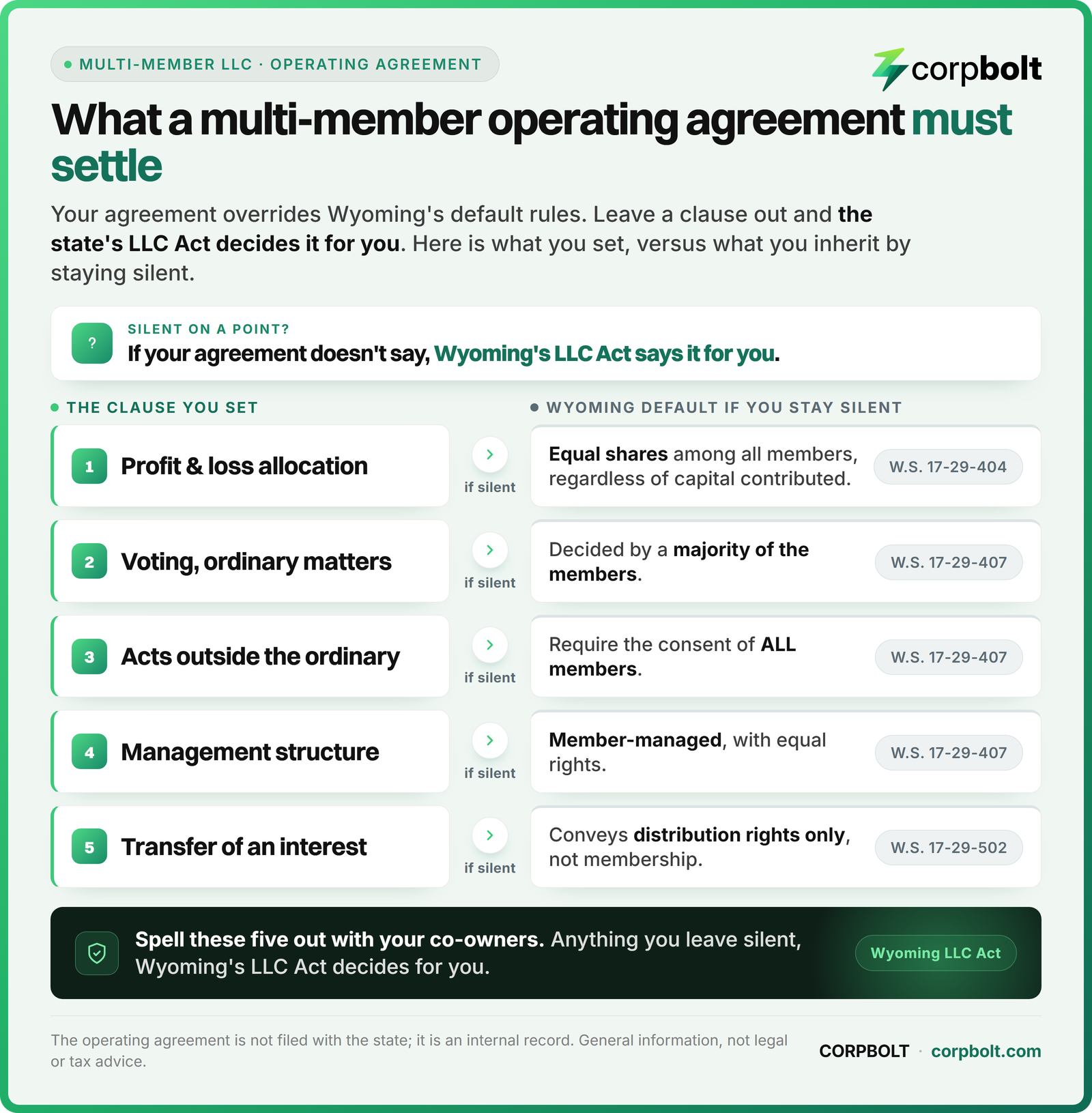
The clauses you set versus Wyoming's default rules.
Clause you set | Wyoming default if you stay silent |
|---|---|
Distributions and profit or loss allocation | Equal shares among members regardless of capital contributed (W.S. 17-29-404) |
Voting on ordinary matters | Decided by a majority of the members (W.S. 17-29-407) |
Acts outside the ordinary course | Require the consent of all members (W.S. 17-29-407) |
Management structure | Member-managed with equal rights (W.S. 17-29-407) |
Transfer of an interest | Conveys only the right to distributions, not membership (W.S. 17-29-502) |
Company details that open the agreement
Before the substantive clauses, the agreement identifies the company. Pull these from your filed articles of organization and your Wyoming Secretary of State record so the document stays consistent with the state filing, and confirm the live details before you finalize.
Legal name, exactly as it appears in your articles of organization, which Wyoming requires the articles to state (W.S. 17-29-201).
Registered agent and Wyoming registered office, the name and street address on file with the state, which the articles also require (W.S. 17-29-201).
Formation date, the date the Secretary of State recorded the LLC, which you can confirm on the state's business search.
Principal business address, where the company operates or receives mail. Wyoming does not require this in the articles, so it is an internal detail you set.
Stated purpose and term, both optional. Wyoming does not require a purpose or an end date, so the LLC runs perpetually unless the owners write in a term.
Ownership percentages and membership interests
State each member's stake clearly, expressed as a percentage or units of membership interest rather than shares. This is the backbone every other clause references. Avoid leaving it implied, because an unstated split invites the disagreement the agreement exists to prevent.
Capital contributions
Record what each member put in, whether cash, property, or services, and how any non-cash contribution was valued. Note that the LLC is not obligated to repay a contribution the way a loan is repaid. If members may be asked for future contributions, define when and how that call is made.
Profit and loss allocation and distributions
This is where the state default surprises people. Absent a written or verbal agreement to the contrary, Wyoming distributes in equal shares among members regardless of how much capital each one contributed (W.S. 17-29-404). If one member funded most of the business, tie allocation to ownership percentage or a stated special allocation. Each member's share then flows onto their own Schedule K-1.
Allocating a profit on paper is not the same as paying out cash, so the agreement also decides when money actually leaves the company. A short distribution policy keeps that from becoming an argument. Say whether distributions happen on a set schedule, after each tax year, or only when the members vote to make one, and how much cash the company holds back as an operating reserve for expenses, taxes, and a cushion before anything is paid out. Decide too whether some profit stays in the business to fund growth, and who actually authorizes a payment, because Wyoming's equal-share default (W.S. 17-29-404) governs the split but not the timing or the decision to pay.
Voting and decision-making
By default each member has equal management rights, and ordinary matters are decided by a majority of the members rather than strictly by ownership stake (W.S. 17-29-407). The agreement is where you can change that. You might set voting by interest, supermajority thresholds, or a list of reserved matters that need broader approval.
Management structure
A Wyoming LLC is member-managed by default, with each member sharing equal rights (W.S. 17-29-407). If you prefer a manager-managed setup, where named managers run daily operations, that choice must be made in the articles or the operating agreement. Neither structure is inherently better, so pick what fits how the owners want to operate.
Once the structure is chosen, spell out who can do what. Wyoming's default gives each member equal management rights and lets ordinary matters pass by majority while acts outside the ordinary course need every member's consent (W.S. 17-29-407), and the agreement is where you make those lines concrete. Name the routine decisions a managing member or manager can make alone, such as ordinary spending, hiring, or signing customer contracts, then set the reserved actions that always go back to the members, such as taking on debt, selling major assets, admitting a member, or amending the agreement. It helps to add a dollar threshold above which even a routine-looking decision needs a member vote, and to state whether a manager or managing member is paid for the role.
Transfers, buy-sell, and admitting new members
Here is a rule many co-founders miss. A transfer of an LLC interest conveys only the right to receive distributions. It does not make the transferee a member, and it does not grant management rights or access to company records (W.S. 17-29-502). That is precisely why transfer restrictions, buy-out mechanics, and rules for admitting new members belong in your agreement.
A buy-sell provision works best when it answers a fixed set of questions before anyone needs it:
Exit triggers: which events start a buyout, such as a member choosing to leave, death, long-term incapacity, divorce, or insolvency.
Purchase rights: whether the company, the remaining members, or both get the first right to buy a departing member's interest before an outsider can.
Valuation method: how the interest is priced, for example a fixed formula, a set book value, or an independent appraisal, agreed in advance so no one argues the number later.
Payment terms: whether the buyout is paid as a lump sum or over time, and on what schedule.
Admission approval: what a transferee must obtain to become a full member rather than a holder of economic rights only, since a bare transfer conveys just the right to distributions (W.S. 17-29-502).
Deadlock: what happens on a 50/50 tie
A two-person, evenly split LLC has a specific risk that a solo owner never faces. Acts outside the ordinary course of business require the consent of all members by default (W.S. 17-29-407). With a 50/50 split and no tie-breaker written in, a single disagreement can freeze the company.
The misstep we see most often is two friendly co-founders skipping the deadlock clause because they cannot imagine disagreeing. Agreements are for the day the mood is not friendly. Common approaches, discussed here conceptually rather than as drafted language, include a buy-out option, a designated tie-breaker, or a clean exit mechanism. Decide the method while everyone is still aligned.
Resolving disputes that are not a voting tie
Not every conflict is a tied vote. Members can also fall out over money, performance, access to records, or how a clause should be read. Wyoming lets the operating agreement govern relations among the members and the conduct of the company's activities (W.S. 17-29-110(a)), so you can write in a calm, staged process for handling those disputes before they escalate:
Direct negotiation first: require the members to raise the issue in writing and meet to try to resolve it within a set number of days.
Then mediation: if talking does not work, agree to bring in a neutral mediator before anyone files anything.
Then a defined escalation: state what happens if mediation fails, such as binding arbitration or the courts, and where. Because this step has real legal consequences, have the exact clause reviewed by a qualified professional before you sign.
A staged process will not guarantee a particular result, but it gives co-founders an orderly path instead of an immediate standoff.
Dissolution and winding up
Deadlock and dissolution are two chapters of the same exit story. On winding up, section 17-29-702 requires a Wyoming LLC to first discharge its debts and obligations to creditors, including any members who are also creditors, then settle its affairs and distribute the remaining assets. Wyoming's statute does not set the order in which any surplus is divided among the members, so your operating agreement should spell that out, for example returning unreturned capital contributions first and then dividing the remainder by ownership share.
Statutes can change, so confirm the current statute text before you rely on it. Your agreement can also set its own dissolution triggers, such as a member vote or a defined end date, so the owners control when winding up begins.
Federal tax: a multi-member LLC is taxed as a partnership, not disregarded
This is the point competitor templates most often gloss over. For federal tax, a domestic LLC with at least two members is classified as a partnership by default, unless it files Form 8832 to elect corporate treatment (IRS, Limited Liability Company page). It is not a disregarded entity the way a single-member LLC is.
As a partnership, the LLC files Form 1065, the U.S. Return of Partnership Income, under its own EIN. The LLC itself generally pays no income tax, because profits and losses pass through to the members. Each member receives a Schedule K-1 to report their share on their own return (IRS, Instructions for Form 1065).
Filing deadlines and any dollar figures shift over time, so treat them as the IRS's current figures and verify them on irs.gov before you plan around a date.
Other clauses worth including
Wyoming's Act lets the operating agreement govern all other aspects of the company's management and activities (W.S. 17-29-110(a)). That latitude is what makes the following clauses valid additions rather than legal requirements.
Amendment procedures: define how members change the agreement later, which the Act expressly treats as a matter the agreement itself sets (W.S. 17-29-110(a)).
Banking-authority clause: state who may open and operate the company account, as an internal governance term. Bank onboarding rules are the bank's policy, not Wyoming law, so this clause organizes authority rather than promising an outcome.
Meeting and decision procedures: set out how often members meet and how much notice they get, how many must take part for a decision to count, whether they can join remotely (useful for a distributed non-resident team), and whether they can approve a decision in writing without holding a meeting. Confirm any live state requirement before you rely on these.
Multiple classes of interest: you can define voting interests separately from economic-only interests, since the Act allows members' interests to be differently defined (W.S. 17-29-407).
Member-managed or manager-managed: the one section that changes
Most of a Wyoming multi-member agreement reads the same whichever way you run the company, because the Act lets the members set each clause for themselves (W.S. 17-29-110(a)). The section that genuinely changes is management. In the member-managed version, every member shares management authority and the voting rules apply directly to the members. In the manager-managed version, that section instead names one or more managers, defines their authority, and lists the reserved decisions the members keep. A ready multi-member template comes with any CORPBOLT plan, so you can compare a drafted version against Wyoming law before you sign.
How it becomes effective
All members signing the agreement is recommended best practice, not a statutory mandate. Wyoming recognizes operating agreements that are oral, written, implied, or a combination, and notarization is generally not required to make one effective (W.S. 17-29-102). Even so, a signed written document is what you will want to show a bank or a court, so verify local expectations.
One simplifying fact for non-resident founders: a Wyoming LLC is governed by Wyoming's LLC Act. There is no 50-state template matrix to reconcile, so you draft to one jurisdiction rather than many.
Frequently asked questions
Where is the download, can I just fill in a template?
There is no fillable form on this page; a ready multi-member template comes with any CORPBOLT plan. The page teaches what the agreement must contain first, so you can review a template knowingly rather than fill blanks you do not understand.
Is a multi-member LLC operating agreement legally required in Wyoming?
It is not filed with the state or required to form the company. Only the articles of organization are delivered to create the LLC (W.S. 17-29-201). But if the agreement is silent, Wyoming's LLC Act defaults govern the gap (W.S. 17-29-110(b)), so co-owners strongly want a written one.
What should a two-member 50/50 LLC decide before a deadlock freezes it?
Decide your tie-breaker in advance. By default, an act outside the ordinary course of business needs the consent of all members (W.S. 17-29-407), so in a 50/50 LLC either owner can block it. Before that happens, agree on one of a buy-out option, a designated tie-breaker, or a clean exit mechanism, and write it into the agreement while both owners are still aligned. A simple two-member operating agreement can be short, but it should not skip this clause.
Does every member have to sign it, and does it need to be notarized?
All members signing is recommended best practice, not a statutory mandate. Wyoming recognizes oral, written, or implied agreements, and notarization is generally not required to make one effective (W.S. 17-29-102). A signed written version is still the practical standard, so confirm what your bank or advisor expects locally.
How is a multi-member LLC taxed, is it disregarded like a single-member LLC?
No. Two or more members means partnership treatment by default, filing Form 1065 with a Schedule K-1 per member (IRS, Limited Liability Company page and Instructions for Form 1065). It is not disregarded, and corporate treatment applies only if you elect it via Form 8832.
Can we change the agreement after everyone signs it?
Yes. The means and conditions for amending the agreement are themselves set by the agreement, which the Act lists among the matters it may govern (W.S. 17-29-110(a)). Define your amendment procedure up front, such as the vote needed to approve a change.
How this article was prepared
The scope, filing, and default rules are drawn from Wyoming Statutes Title 17 Chapter 29. Sections 110, 102, and 201 cover scope, definitions, and formation. Section 404 covers distributions, section 407 covers management and voting, section 502 covers transfers, and section 702 covers winding up. The federal tax treatment is drawn from the IRS Limited Liability Company page and the Instructions for Form 1065. Last reviewed July 2026. This is general information and not legal or tax advice, and CORPBOLT is a formation service, not a law or accounting firm. Statutory figures, filing forms, and any dates are the state's or the IRS's current figures, so verify them on the live page before you rely on them.
A quick note on CORPBOLT: CORPBOLT forms and maintains Wyoming LLCs for non-residents from $349/year (Foundation), including the registered agent and annual upkeep. The EIN is included from $599/year (Launch) or as a $199 add-on, and a ready multi-member operating-agreement template comes with any plan. Form your Wyoming LLC →
Official references
W.S. 17-29-404: sharing of and right to distributions before dissolution
W.S. 17-29-407: management rights and voting of members and managers
Wyoming Secretary of State: Limited Liability Company Act (full statute, W.S. 17-29-702 winding up)
IRS: Limited Liability Company (LLC) federal tax classification
IRS: Instructions for Form 1065 (U.S. Return of Partnership Income)
Approval note: Eligibility and approval decisions are made by each bank, fintech, and payment processor. Requirements can vary by provider, country, business model, and account history.
