

In US business law, foreign means out of state, not non-US. Your Wyoming LLC is domestic in Wyoming and becomes a foreign LLC only in another state where it starts transacting business. When that happens, that state makes you register there, obtain a Certificate of Authority, and appoint a registered agent with a local address. Fees and rules vary by state, so confirm them on the target state's Secretary of State site.
A foreign LLC is one formed in a different US state, not a company owned by a non-US person. Your Wyoming LLC is foreign in every other state, wherever you live.
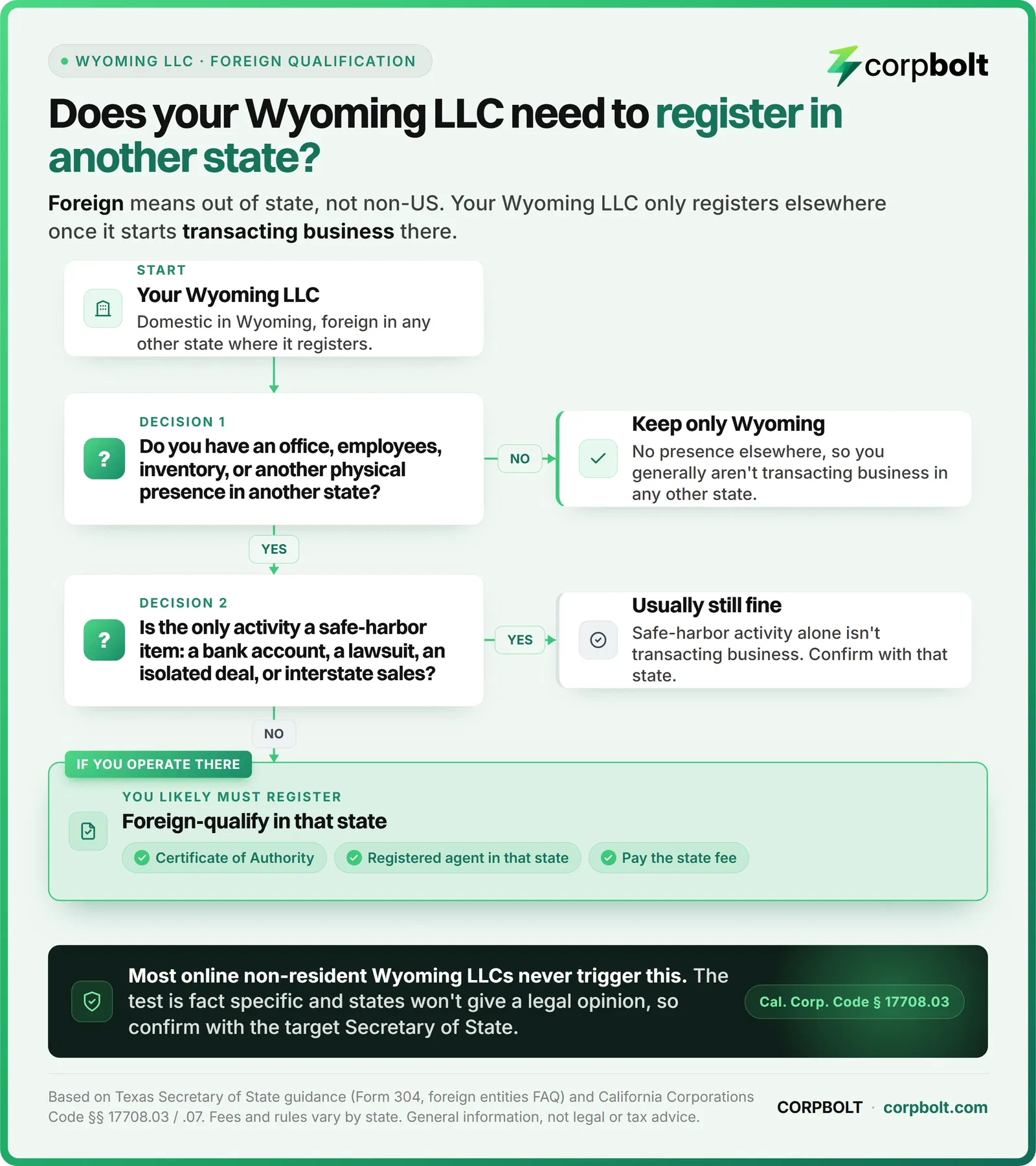
You only register elsewhere once you transact business in that state, which generally means an office, staff, or a physical or operational presence. Passive or interstate activity usually does not count.
A purely online Wyoming LLC with no US office, staff, or inventory generally is not transacting business anywhere else, so it keeps only its Wyoming registration.
What is a foreign LLC, and why foreign does not mean non-US
This is the single biggest source of confusion for this topic, so it is worth stating plainly. In US business law, foreign does not mean a foreign country or a non-US owner. It means an entity formed under the laws of a different US state.
Your Wyoming LLC is domestic in Wyoming, the state where you formed it. In every other US state, that same LLC is a foreign LLC once it registers to do business there. Texas, for example, defines a foreign entity as one formed under the laws of a jurisdiction other than Texas. Your nationality and where you live make no difference to the label.
Does your Wyoming LLC actually need to register in another state?
The trigger is not where you or your owners live. It is whether your LLC transacts business in another US state. If it does, that state generally requires you to register there before you start, a process usually called foreign qualification. If it does not, you have nothing to file outside Wyoming.
For many non-resident founders, the honest answer is that no second registration is needed. Your Wyoming LLC is your home base, and unless you build a real presence in another state, Wyoming is the only place you are registered. The rest of this guide shows where that line sits.
What counts as transacting business, and what usually does not
Transacting business is the trigger, and there is no single national definition of it. Texas guidance is typical: an entity is generally transacting business if it has an office or an employee in the state, or is otherwise pursuing one of its purposes there. Because it is fact specific, a Secretary of State will not give you a legal opinion on your particular activity.
State statutes also list activities that, on their own, do not count as transacting business. California's LLC law and the Texas Business Organizations Code both include long safe-harbor lists. Common examples include:
Holding company meetings or maintaining bank accounts in the state.
Defending or settling a lawsuit or administrative proceeding.
Selling through independent contractors.
Soliciting or taking orders that require acceptance outside the state before they become contracts.
Completing a single isolated transaction within a set period, such as 180 days, that is not a repeated series.
Creating or collecting debts, or enforcing security interests.
Transacting business in interstate commerce.
These lists are not identical from state to state, so read the specific statute for the state you care about. The point is that a lot of ordinary remote activity does not, by itself, force you to register.
What a Certificate of Authority is
A Certificate of Authority is the document a state issues to let an out of state LLC transact business there. Some states call it a Certificate of Registration, and others simply register the LLC as a foreign entity. Either way, you get it by filing a foreign registration application with that state's Secretary of State before you start transacting business. Texas, for instance, uses an Application for Registration of a Foreign Limited Liability Company under its Business Organizations Code.
How to register your Wyoming LLC as a foreign LLC, step by step
The exact form and fee differ by state, but the shape of the process is consistent. Here is the usual sequence once you have decided a state requires you to register.
Confirm you are actually transacting business in that state. If you are unsure, ask its Secretary of State or a professional first, because the test is fact specific.
Get a current Wyoming Certificate of Good Standing, also called a Certificate of Existence. Many states require one from your home state, sometimes dated within a set window such as 90 days, so check that deadline.
Appoint a registered agent with a physical address in that state, since your LLC cannot serve as its own agent there.
File that state's foreign registration application, often called an Application for Registration or a Certificate of Authority, with its Secretary of State, and pay the filing fee.
Keep up with that state's ongoing duties, such as annual reports and agent fees, on top of the ones you already handle for Wyoming.
Why you need a registered agent in every state you register in
Registration is not a one-time act. A registered foreign LLC must maintain a registered agent and a registered office in that state for as long as it stays registered. The agent is the person or company that accepts legal and state mail for you, and your LLC generally cannot act as its own agent.
That means each new state you foreign-qualify in adds another registered agent to keep, and another address to maintain. For a non-resident founder, this is usually the practical reason to avoid registering in states where you do not truly operate. Every extra registration is an extra ongoing cost.
How much does foreign registration cost? Fees vary by state
There is no single national fee for foreign qualification. Each state sets its own filing fee, and the range is wide. Texas, for example, charges $750 to file its foreign LLC registration, while Florida's foreign LLC application is far cheaper, in the region of $125. Treat both as examples, not fixed figures, and look up the current amount on the target state's Secretary of State website before you file.
Cost is also a reason the choice of home state matters. Part of why founders pick Wyoming is its low fees, which is covered in our guide to the best state for an LLC. If you end up registering in several higher-fee states anyway, those savings can shrink, so it is worth mapping where you truly need to register before you file.
What happens if you transact business without registering
Skipping registration when you should have registered carries real, but limited, penalties. The main one is a court access bar. A foreign LLC that transacts business without registering generally cannot bring or maintain a lawsuit in that state's courts until it registers. California and Texas both apply that rule.
You may also owe back fees. Texas, for example, gives a foreign entity 90 days after it starts transacting business before late fees begin. After that, it charges a late filing fee for each year of delinquency, plus a civil penalty equal to the fees and taxes that would have been due. Other states set their own back fees, so treat Texas as one example.
The good news is what does not happen. Failing to register does not void your contracts, and it does not strip the limited liability protection of your members or managers. The penalty is the court access bar and money, not the loss of your company or your liability shield.
Do non-resident online founders usually need this?
Here is the part that matters most for our typical reader. Foreign qualification is triggered by transacting business in a specific US state, meaning an office, employees, inventory, or a similar physical or operational footprint there. A founder running an online business from outside the US, with no US office, no US staff, and no US inventory, generally is not transacting business in any state. So a purely online, non-resident Wyoming LLC usually keeps only its Wyoming registration and does not foreign-qualify anywhere.
That is a general pattern, not a personal ruling. The office, staff, or inventory analysis must be checked under the current law of each state where you might have a footprint, since every state defines its own transacting-business exclusions, such as California's safe-harbor list. Whether a specific activity counts is fact specific, and no Secretary of State will give a legal opinion on your exact situation. If you are unsure, confirm with the relevant state or a professional before you conclude you owe nothing. Deciding where you actually operate is part of US company formation for non-residents.
How to withdraw a foreign registration when you stop operating in a state
Foreign qualification is not permanent. If you stop transacting business in a state, you can end the registration so you are not left paying agent fees and filing annual reports there forever. Leaving a registration active but neglected can pile up penalties, so close it out on purpose.
The exact filing differs by state, but the shape is consistent. Verify each step on that state's Secretary of State site before you file.
Settle any final annual reports, franchise or state taxes, and fees you still owe in that state.
File that state's withdrawal or cancellation form for a foreign entity. Texas, for example, uses a Certificate of Withdrawal and asks for a tax clearance from its Comptroller first.
Keep the registered agent in place until the withdrawal is accepted, since the state still serves legal mail through that agent until then.
Confirm the effective date and keep the filed confirmation with your records.
Frequently asked questions
Does foreign LLC mean a company owned by a non-US citizen?
No. In US law, foreign means out of state. A Wyoming LLC is domestic in Wyoming and foreign in any other state where it registers to do business, no matter where the owner lives.
When does my Wyoming LLC have to register in another state?
When it transacts business there, which generally means an office, employees, or another physical or operational presence in that state. Passive or interstate activity, such as a bank account or an isolated short deal, usually does not trigger it. Confirm with that state's Secretary of State.
What is a Certificate of Authority?
It is the document a state issues to authorize an out of state LLC to transact business there. Some states call it a Certificate of Registration. You get it by filing a foreign registration application with that state's Secretary of State.
Do I need a registered agent in the new state?
Yes. Every state where you foreign-register requires a registered agent with a physical address in that state, and your LLC generally cannot be its own agent.
What happens if I do not register but should have?
You typically cannot bring a lawsuit in that state's courts until you register, and you may owe back fees and penalties. Texas, for example, charges late fees per year of delinquency plus a civil penalty. Your contracts and limited liability stay valid.
How much does foreign LLC registration cost?
It varies by state, from around $125 in Florida to $750 in Texas. Check the current filing fee on the target state's Secretary of State website before you file.
Does a foreign LLC pay taxes in both states?
Not automatically. Foreign qualification is an entity registration, not a tax ruling, and it does not by itself decide your income or sales tax in either state. Federal tax follows the IRS rules for your LLC, while each state sets its own income and sales tax tests. Check your position with the IRS and the destination state's revenue department.
I run an online business from outside the US with no US office. Do I have to register anywhere besides Wyoming?
Usually not. Foreign qualification is triggered by transacting business in a specific state, such as having an office, staff, or inventory. A purely online, non-resident Wyoming LLC with no US footprint generally is not transacting business elsewhere, so it keeps only its Wyoming registration. If in doubt, confirm with the state or a professional.
How this article was prepared
The rules here are drawn from state sources on foreign qualification. The definition of a foreign entity, the registration requirement, the registered agent rule, the 90-day grace period, and the certificate-of-withdrawal example come from the Texas Secretary of State's Form 304 instructions and its Foreign or Out-of-State Entities FAQ. The same Texas sources back the back-fee and civil-penalty points. The safe-harbor list of activities that do not count as transacting business comes from the California Corporations Code, section 17708.03. The court access bar, and the point that failure to register does not void contracts or strip limited liability, come from section 17708.07. The Florida fee and the home-state good-standing window are examples, so verify them on Florida's official business filing pages. State fees, deadlines, and definitions vary and change, so confirm the current rules on the target state's Secretary of State site before you file. This guide was last reviewed in July 2026, when the Texas Form 304 fee, the Texas foreign-entity FAQ, and the cited California statutes were rechecked against their official pages. This is general information, not legal or tax advice, and CORPBOLT is a formation service, not a law or accounting firm.
A quick note on CORPBOLT: CORPBOLT is a US business formation service for non-resident founders that forms Wyoming LLCs without an SSN or a US visit, and it includes a Wyoming registered agent so your home-state registration stays compliant. Formation with the registered agent and a US business address starts from $349 a year, and the complete package with the EIN included is $599 a year. If you later build a real presence in another state and need to foreign-qualify there, that is a separate state filing, and this guide shows what it involves. Start your US LLC.
Official references
Florida Division of Corporations: limited liability company forms (foreign LLC application and fee)
IRS: Limited Liability Company (LLC) federal tax classification
Approval note: Eligibility and approval decisions are made by each bank, fintech, and payment processor. Requirements can vary by provider, country, business model, and account history.
