

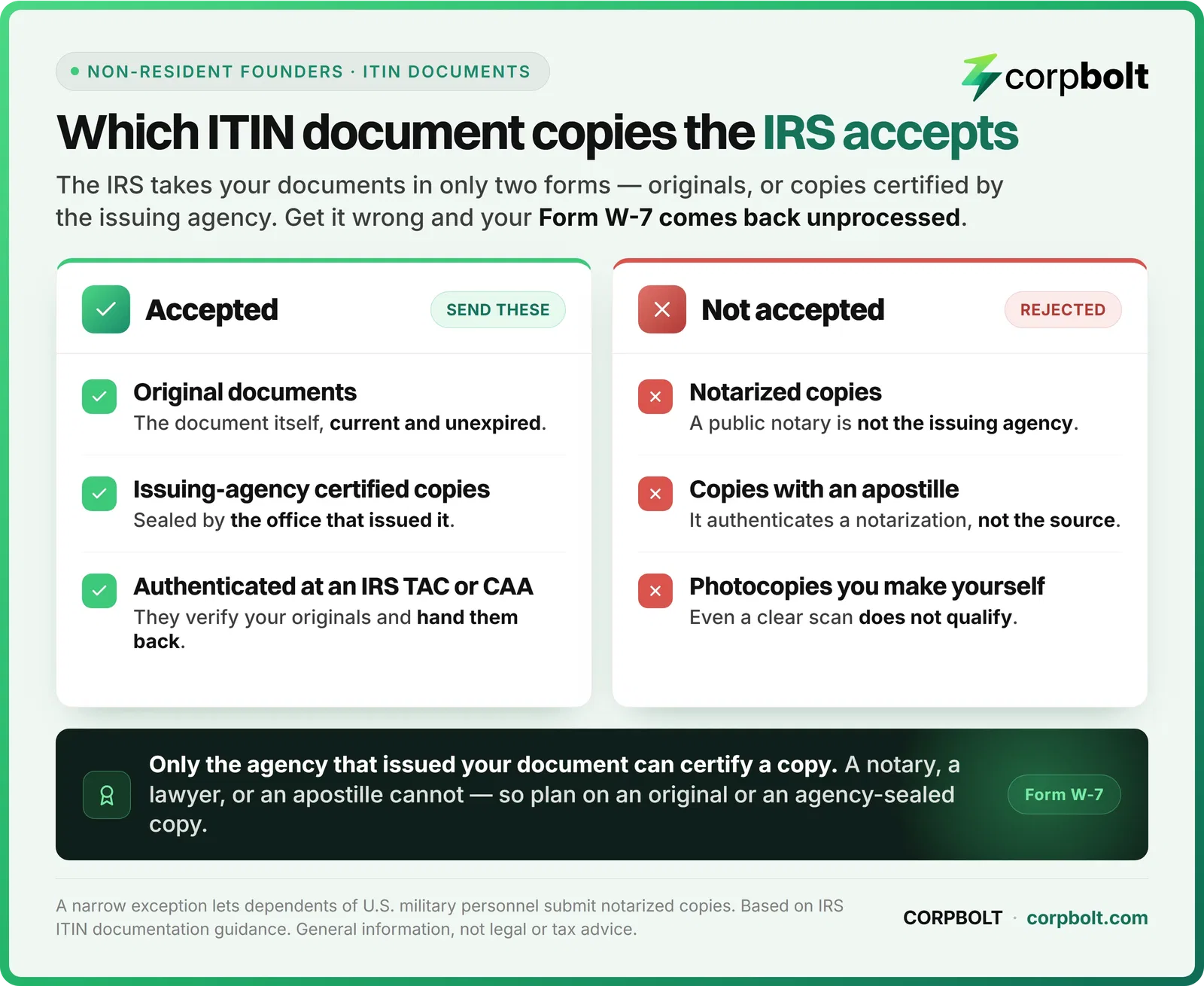
To apply for an ITIN on Form W-7 you must prove two things at once: your identity and your foreign status. You do that with documents from the IRS list of 13 accepted documents, and the IRS takes only originals or copies certified by the agency that issued them.
A valid, unexpired passport is the only stand-alone document. Submit it and you prove identity and foreign status together, so you need nothing else.
Without a passport you combine at least two accepted documents that together prove identity and foreign status, and at least one must show your photograph.
Notarized copies and apostilled copies are not accepted, apart from a narrow exception for dependents of U.S. military personnel.
Gathering the right paperwork is the step that trips up most ITIN applicants, and getting it wrong means the IRS returns your Form W-7 unprocessed. If you are still working out what an ITIN actually is or whether you even need one, start there first, because most non-resident founders do not need an ITIN to form a Wyoming LLC or get an EIN. An ITIN exists only for federal tax reporting when you are not eligible for a Social Security number, so confirm you actually need one before gathering documents. This page assumes you have decided to apply and focuses on one thing: the documents Form W-7 requires and how the IRS wants them supplied.
What Form W-7 makes you prove: identity and foreign status
Form W-7 is the application for an ITIN, and its documentation rule has two halves. Every applicant must establish identity, meaning the document shows you are who you say you are. Every applicant must also establish foreign status, meaning it shows you are not a U.S. citizen or permanent resident. A document can satisfy one half, the other, or both, which is why the combination you send matters so much. Whatever you submit must also be current, that is, not expired at the time you file, so an out-of-date passport or ID will not count.
The 13 documents the IRS accepts for an ITIN
The IRS accepts exactly 13 types of document to establish identity and foreign status for an ITIN, and the same list appears in the Form W-7 instructions and on the ITIN supporting documents page. The table below shows what each one proves on its own. Read it as a menu: your job is to cover both columns, either with one document that does everything or with a combination that adds up.
Document | Proves identity? | Proves foreign status? |
|---|---|---|
Passport (stand-alone) | Yes | Yes |
National identification card | Yes | Yes |
U.S. Citizenship and Immigration Services (USCIS) photo identification | Yes | Yes |
Visa issued by the U.S. Department of State | Yes | Yes |
Foreign military identification card | Yes | Yes |
Foreign voter's registration card | Yes | Yes |
U.S. driver's license | Yes | No |
U.S. state identification card | Yes | No |
Foreign driver's license | Yes | No |
U.S. military identification card | Yes | No |
Civil birth certificate | Yes | Only if foreign* |
Medical records (dependents under 6) | Yes | Only if foreign* |
School records (students under 24) | Yes | Only if foreign* |
*A civil birth certificate, medical records, and school records establish foreign status only when they are foreign documents. A U.S. version proves identity only. Medical records and school records apply only to dependents (children), so they are not options for an adult founder applying for their own ITIN. Under the current Form W-7 instructions, medical records are accepted only for a dependent under age 6, and school records only for a dependent under age 24 who is a student.
Why a valid passport is the only document you need on its own
Of the 13, the passport is the only stand-alone document. If you submit an original valid passport, or a copy certified by the issuing agency, it proves both your identity and your foreign status by itself, and you do not need to send anything else. That is why the passport is the simplest route by a wide margin, and it is the one most non-resident founders already hold. A narrow exception applies to some dependents whose passport lacks a U.S. date of entry, but that does not affect an adult applying for their own number.
What to submit if you don't have a passport
Without a passport, you build a case from at least two of the accepted documents that together prove identity and foreign status, and at least one of them must contain your photograph. A common pairing is a national identification card with a foreign voter's registration card, but any combination that covers both halves works. A national identification card is accepted only if it is current and carries the standard identifying details the IRS lists, such as your name, photograph, address, date of birth, and expiration date. Check the exact required fields on the current Form W-7 instructions before you rely on it.
Originals or agency-certified copies only
The IRS accepts your documents in only two forms: the originals, or copies certified by the agency that issued them. A certified copy has a specific meaning here. It is a copy that the original issuing agency provides and certifies as an exact copy of the original, and it carries that agency's official stamped seal, as the IRS ITIN documentation FAQ defines it. A photocopy you make yourself, even a clear one, is not a certified copy and will not be accepted. When you request a certified copy, you go back to the office that issued the document, such as the passport authority or the civil registry, and ask that office to produce and seal it.
Why notarized and apostilled copies get rejected
This is where good applications most often fail, because two widely repeated shortcuts do not work. A notarized copy is one a public notary has stamped, and an apostille is a certificate that authenticates a notarization or public record for use abroad. Neither satisfies the IRS, because neither comes from the agency that issued your document. The IRS states plainly that it does not accept notarized documents, and that copies with an apostille are not acceptable for obtaining ITINs. If an old blog told you a notarized copy is fine, it is out of date.
How to avoid mailing your original passport to the IRS
Many founders balk at posting a valid passport overseas, and you do not have to. You can have your supporting documents authenticated in person, so the originals stay with you. An IRS Taxpayer Assistance Center can authenticate most supporting documents by appointment and returns them at the end of the visit. A Certifying Acceptance Agent can do the same and hand your originals straight back. If you are outside the United States, a U.S. embassy or consulate can also provide certification. Remember these documents are only the supporting evidence, not the whole application. You attach Form W-7 to the front of a federal tax return, unless you qualify for one of the IRS exceptions. There is no online ITIN application, so you file by mail or in person and submit everything together. Once your documents are ready, our guide on how to apply for an ITIN with Form W-7 walks through the filing itself.
Your ITIN document checklist
Before you file, run through this short list so nothing sends your application back:
Decide your route: a single valid passport, or a combination of at least two documents with one showing your photograph.
Confirm every document is current and not expired at the time you submit.
Supply each document as an original or an issuing-agency certified copy, never a notarized or apostilled copy.
If you would rather not mail originals, book an IRS Taxpayer Assistance Center appointment or use a Certifying Acceptance Agent.
Check the current Form W-7 instructions for any wording change before you file, because the IRS updates the rules.
Frequently asked questions
What documents do I need to apply for an ITIN?
Proof of identity and foreign status from the IRS list of 13 accepted documents. A valid, unexpired passport covers both on its own. Without one, you submit at least two documents, at least one with your photo, that together prove identity and foreign status. Only originals or agency-certified copies are accepted.
Can I use just my passport to apply for an ITIN?
Yes. A valid, unexpired passport is the only stand-alone document. It proves both identity and foreign status, so you do not need any other documents. Some dependents can be an exception where the passport lacks a U.S. date of entry.
Does the IRS accept notarized or apostilled copies for an ITIN?
No. The IRS accepts only original documents or copies certified by the agency that issued them. Notarized copies and copies with an apostille are not accepted. A narrow exception exists only for dependents of U.S. military personnel.
What if I don't have a passport?
Submit at least two of the accepted documents that together prove identity and foreign status, with at least one showing your photograph, for example a national identification card plus a foreign voter's registration card. All of them must be current and unexpired.
Do I have to mail my original passport to the IRS?
Not necessarily. You can have your documents authenticated in person by an IRS Taxpayer Assistance Center by appointment or by a Certifying Acceptance Agent, both of which return your originals. U.S. embassies and consulates also provide certification overseas.
What proof do I get after my ITIN is approved?
The documents on this page are what you gather to apply. They are different from the proof you receive afterward. Once the IRS assigns your ITIN, it mails you Notice CP565, the official assignment notice, and returns your original documents in a separate envelope. Keep that notice safe as your record of the number.
How this article was prepared
The document list, the stand-alone passport rule, and the two-document combination here are drawn from the IRS Instructions for Form W-7 and the IRS ITIN supporting documents page. The certification requirements come from the IRS how to apply for an ITIN page and the IRS ITIN documentation FAQ. Those pages carry review dates through 2025 and early 2026. IRS forms and rules change, so treat the specifics as current guidance and confirm the accepted-document list, the dependent age limits, and the national identification card fields on the live IRS pages before you file. This is general information and not legal or tax advice, and CORPBOLT is a formation service, not a law or accounting firm.
A quick note on CORPBOLT: CORPBOLT forms and maintains Wyoming LLCs for non-residents from $349/year (Foundation), with the EIN included from $599/year (Launch) or as a $199 add-on. CORPBOLT does not process ITIN applications or guarantee that the IRS will issue one, so you file Form W-7 and your supporting documents with the IRS yourself. Start your US LLC.
Official references
IRS: Instructions for Form W-7 (identity and foreign status, two-document rule, certification)
IRS: ITIN supporting documents (the list of 13 and the stand-alone passport)
IRS: How to apply for an ITIN (authenticating documents at a TAC or with a CAA)
IRS: ITIN documentation frequently asked questions (certified copy, notarized and apostille rules)
