

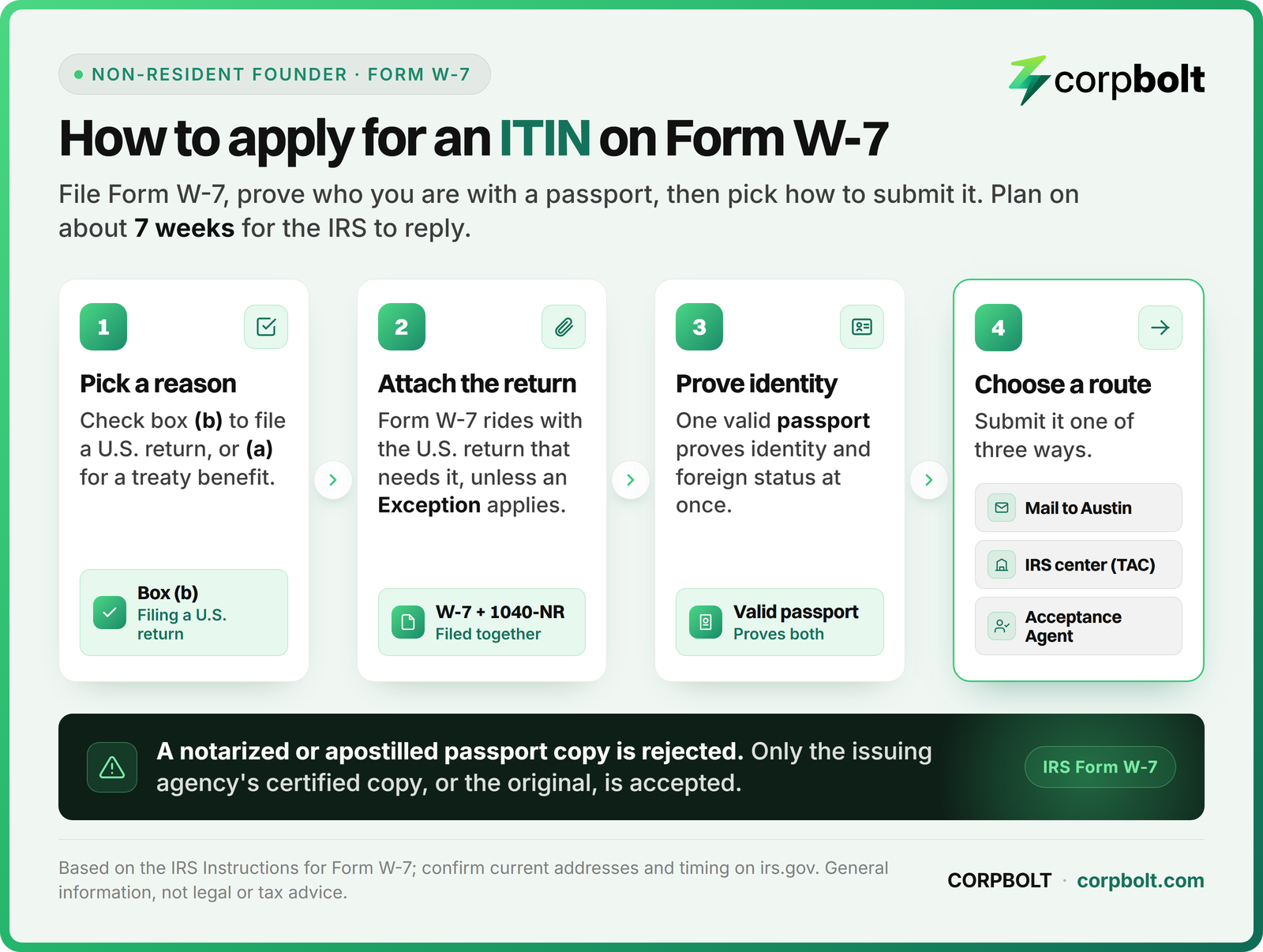
You apply for an ITIN by filing IRS Form W-7 and proving both your identity and foreign status. For most non-residents, one valid passport does both. You attach the form to the U.S. tax return that creates the need, then submit it by mail, at an IRS center, or through a Certifying Acceptance Agent.
A valid passport is the only stand-alone document that proves identity and foreign status at once. Submit the original or a copy certified by the issuing agency, and you need nothing else.
Form W-7 normally attaches to the U.S. federal return that requires the ITIN, such as Form 1040-NR, unless you qualify for one of five IRS Exceptions.
Mail it to Austin, book an IRS Taxpayer Assistance Center, or use a Certifying Acceptance Agent so your original passport never leaves your country.
The IRS says to allow roughly 7 weeks, and 9 to 11 weeks in peak season or from overseas. Confirm the current window on irs.gov.
Applying for an ITIN is a paperwork exercise, not a test. An Individual Taxpayer Identification Number lets someone who cannot get a Social Security number meet a U.S. tax obligation. This guide walks the Form W-7 procedure step by step, from the reason box to the day your number arrives.
Do you actually need an ITIN to apply?
Before you touch Form W-7, confirm you actually need an ITIN. The IRS assigns one only to someone who must furnish a U.S. taxpayer identification number, or file a U.S. federal tax return, and who cannot get a Social Security number. If neither applies to you yet, you do not file yet.
This matters for founders. A foreign-owned single-member LLC files its own federal information return under the company's EIN, not under your personal ITIN. So forming a U.S. LLC does not, by itself, mean you need an ITIN. You need one when you personally must file a U.S. return, such as Form 1040-NR, or when you claim a treaty benefit. Run the check in our guide on whether you need an ITIN first, and see how the personal ITIN differs from the company's EIN.
Step 1: Confirm your qualifying reason
Form W-7 opens by asking why you need an ITIN. You check one reason box, and it drives the rest of the application. The boxes are:
(a) Nonresident alien claiming a tax treaty benefit.
(b) Nonresident alien filing a U.S. federal tax return.
(c) U.S. resident alien filing a return.
(d) Dependent of a U.S. person.
(e) Spouse of a U.S. person.
(f) Nonresident alien student, professor, or researcher.
(g) Dependent or spouse of a nonresident alien holding a U.S. visa.
(h) Other.
A non-resident owner who has to file a U.S. return usually checks box (b). If a tax treaty is the reason you need the number, check box (a) instead. Pick the one box that fits, because it tells the IRS which documents and attachments to expect.
Step 2: Attach your tax return, or qualify for an Exception
In most cases, Form W-7 does not travel alone. You attach it to the completed U.S. federal tax return that creates the need for the ITIN, and you file the two together. The ITIN and the return are then processed as one package.
The IRS carves out five Exceptions that let you apply without attaching a return:
Exception 1: passive income with third-party withholding or treaty benefits, including partners in a U.S. or foreign partnership that invests in the United States.
Exception 2: other income, such as wages, scholarships, or gambling winnings covered by a treaty.
Exception 3: mortgage interest reporting on U.S. real property.
Exception 4: dispositions of U.S. real property interests subject to withholding.
Exception 5: reporting under the section 6038A e-filing compliance rules (TD 9363).
If none of these fits, attach the return. When in doubt, read the Exceptions tables in the Form W-7 instructions, because each one carries its own documentation.
Step 3: Gather your identity documents
Your application has to prove two things: who you are, and that you are a foreign national. One document can settle both.
A valid passport is the only stand-alone document that proves identity and foreign status at once. Submit the original, or a copy certified by the passport-issuing agency, and you need nothing else from the IRS list of supporting documents. Without a passport, you must combine two documents, for example a national ID card plus a birth certificate, so that together they cover both identity and foreign status.
Two rules apply to whatever you send. The documents must be current and not expired on the day you submit. The name, date of birth, and country of citizenship on them must match your Form W-7 exactly.
Step 4: Choose how you submit Form W-7
You have three ways to get Form W-7, your documents, and any return to the IRS. They differ mainly in what happens to your original passport.
Mail to Austin. Send Form W-7, the tax return, and your original documents or agency-certified copies to the IRS ITIN Operation, P.O. Box 149342, Austin, TX 78714-9342. Do not use the address printed in your tax-return instructions. The IRS returns your originals by mail afterward.
IRS Taxpayer Assistance Center (TAC). Designated centers review your original documents in person and return them on the spot, so you skip mailing a passport. Service is by appointment only, booked by calling 844-545-5640.
Certifying Acceptance Agent (CAA). A CAA authenticates your supporting documents, completes or reviews Form W-7 with you, and returns your documents immediately, so the originals never go to the IRS. A plain Acceptance Agent, by contrast, reviews and then mails your documents rather than authenticating them.
How long does an ITIN take to come back?
Plan on weeks, not days. The IRS says to allow about 7 weeks for it to notify you of your ITIN status. If you apply during peak processing, January 15 to April 30, or you file from overseas, allow 9 to 11 weeks. Filing from abroad puts most non-resident founders in that slower band.
Treat those figures as the current IRS estimate, not a promise. The IRS revises its processing window, so confirm the latest timing on irs.gov before you build a deadline around it. There is one more timing quirk: you cannot e-file a return using a brand-new ITIN in the year it is assigned, so that first return goes in on paper.
Common reasons ITIN applications get rejected
Most rejections come down to documents, not eligibility. The ones that catch non-residents most often are:
A notarized or apostilled passport copy in place of the original or an agency-certified copy. Only the issuing agency's certification counts.
Expired documents. Your passport and any other document must be valid on the day you submit.
Details that do not match. The name, date of birth, and country on your documents must match Form W-7 exactly.
No tax return attached when you do not qualify for an Exception. The return is part of the application in most cases.
The wrong mailing address. ITIN applications go to the Austin ITIN Operation, not the address in your return instructions.
Fix these before you file and you remove the reasons behind most delays and rejections.
If the IRS needs more from you, it mails a notice that explains what is missing and by when. Read it, follow its instructions and deadline, and send only what it asks for. If an application is rejected, the notice states the reason, so you can correct that specific problem and reapply rather than starting over blindly.
What happens after your ITIN is approved
When the IRS finishes, it notifies you of your ITIN in writing. If you mailed original documents, the IRS returns them to the mailing address on your Form W-7. International mail can be slow, so an in-person route that returns your passport on the spot is worth weighing if being without it for weeks would be a problem.
From that point, the ITIN is your personal U.S. tax identification number, and you use it on the return that needed it and on any future U.S. filings. It belongs to you as an individual, separate from the EIN that identifies your company.
Frequently asked questions
Can I apply for an ITIN online, and is it free?
No, there is no online ITIN application. You submit Form W-7 on paper, by mail, in person at an IRS Taxpayer Assistance Center, or through an Acceptance Agent. The IRS does not charge a fee to apply. A Taxpayer Assistance Center or VITA site is free, while a Certifying Acceptance Agent sets its own fee, and getting an agency-certified passport copy may also cost something.
Do I have to mail my original passport to the IRS?
No, and you can avoid it. Mailing works, and the IRS returns your originals afterward. But most non-residents use a Certifying Acceptance Agent or an IRS Taxpayer Assistance Center. Both verify your passport in person and hand it straight back, so it never leaves your country by mail.
Can a notary certify my passport copy for the ITIN application?
No. The IRS accepts only your original passport or a copy certified by the agency that issued it, meaning your country's passport authority. A notary public's certification or an apostille is not accepted, and it is a common rejection reason.
How long does an ITIN take?
The IRS says to allow about 7 weeks, and 9 to 11 weeks if you apply in peak season, January 15 to April 30, or from overseas. That slower band covers most non-resident founders. Confirm the current window on irs.gov before you plan around it.
Can I get an ITIN immediately?
No. An ITIN is never issued on the spot, even in person. The IRS says to allow about 7 weeks to hear back, and 9 to 11 weeks in peak season or from overseas. An IRS Taxpayer Assistance Center or Certifying Acceptance Agent can verify and return your passport the same day, but the number itself still arrives later. Confirm the current window on the IRS how to apply for an ITIN page.
Do I need to file a tax return with Form W-7?
Usually yes. Form W-7 normally attaches to the U.S. federal tax return that creates the need for the ITIN. You can apply without a return only if you qualify for one of the five IRS Exceptions, such as a partner receiving partnership income subject to U.S. withholding.
Which document proves both identity and foreign status?
A valid passport is the only stand-alone document that does both. Submit that, either the original or an agency-certified copy, and you need nothing else from the IRS list. Without a passport, you must combine two documents to cover identity and foreign status.
I already have an ITIN. Do I need to renew it?
Maybe. An ITIN expires if it is not used on a U.S. federal tax return for three consecutive years. Renewing is not a fresh application. You use the same Form W-7, marked as a renewal, with your identity documents. The current IRS instructions control what a renewal needs, so check them before you file.
How this article was prepared
The steps, documents, routes, and timeframes here come from the IRS Instructions for Form W-7, the IRS how to apply for an ITIN page, and the IRS ITIN Acceptance Agents page. Last reviewed July 2026. This is general information, not legal or tax advice, and CORPBOLT is a formation service, not a law or accounting firm. The IRS revises its processing times, addresses, and phone numbers, so confirm every figure on the live IRS pages before you rely on it.
A quick note on CORPBOLT: CORPBOLT forms and maintains Wyoming LLCs for non-residents from $349/year (Foundation), and can prepare your company's EIN from $599/year (Launch) or as a $199 add-on. The ITIN is a personal filing you make on Form W-7, so it sits outside that service. A clean LLC and EIN are what most founders need first, though. Start your US LLC.
