

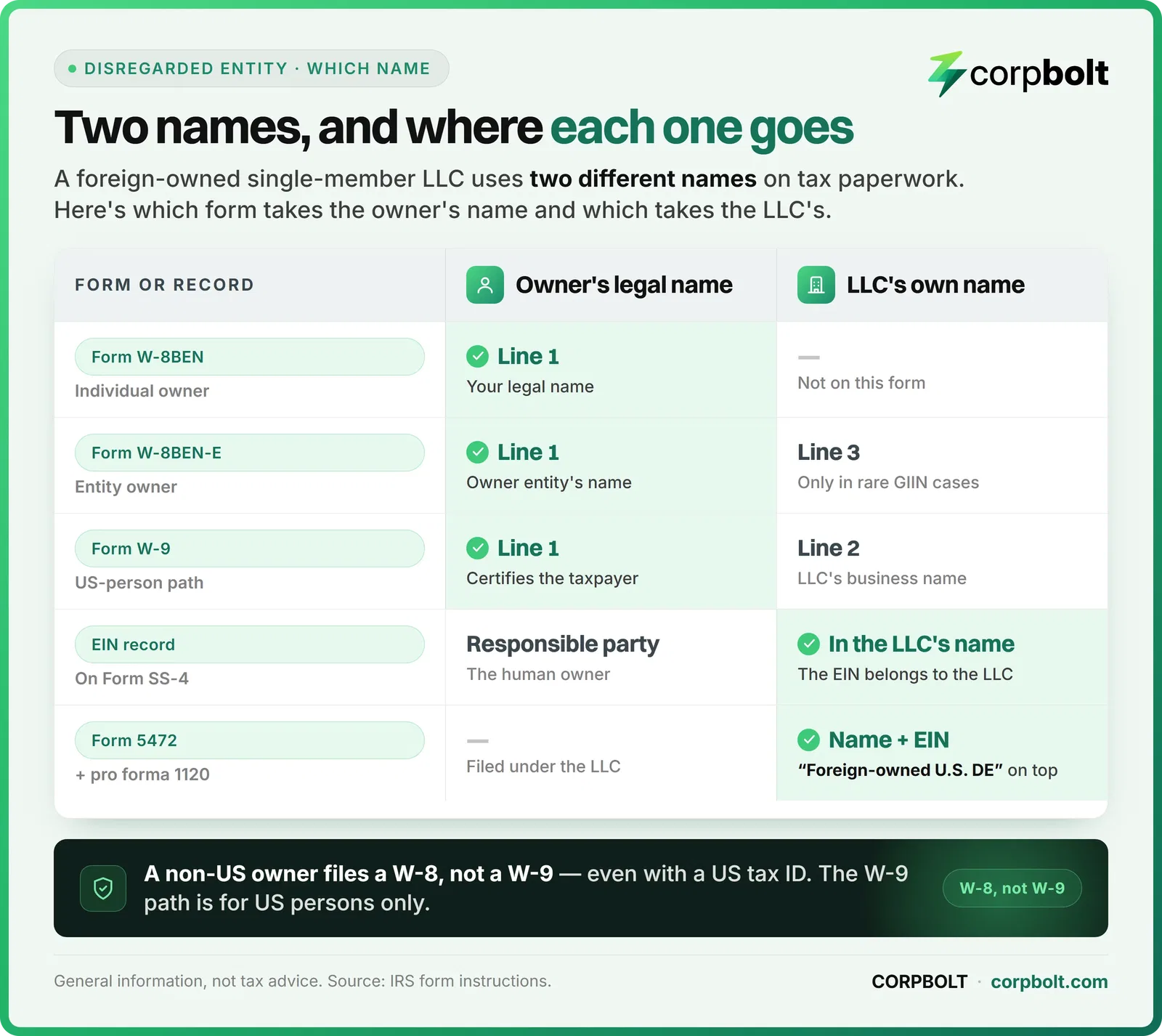
A disregarded entity, like a single-member Wyoming LLC, uses two different names depending on the form. On the identity and withholding forms you actually file, the owner's legal name goes first, and a non-US owner files Form W-8BEN or W-8BEN-E, not a W-9. On the one federal return most non-resident owners must file, Form 5472 with a pro forma Form 1120, the LLC's own registered name and its own EIN go on the return. Get the roles straight and the forms stop contradicting each other.
A Form W-9 or a Form W-8 certifies who the taxpayer or beneficial owner is, so Line 1 shows the owner's legal name, never the LLC's business name.
Form W-9 is for US persons. A foreign owner uses Form W-8BEN as an individual, or W-8BEN-E as an entity, even if they hold a US tax ID.
On the Form 5472 and pro forma Form 1120 that a foreign-owned LLC files, the entity uses its own registered name and its own EIN, because it is treated there as a separate reporting corporation.
Why a disregarded entity has two names in the first place
A single-member LLC is, by default, a disregarded entity for US federal income tax. The IRS looks through the company and treats the owner as the taxpayer, so the LLC's income is reported on the owner's return rather than on a separate LLC income tax return. This default comes from the entity-classification regulations, not from any single form. Our guide to what a disregarded entity is covers the fuller meaning and how the owner reports that income, so this page can stay focused on names.
Because the owner is the taxpayer, most forms want the person, not the company. But a handful of filings treat the LLC as if it were its own taxpayer. That split is the whole reason the name question feels confusing. The rest of this guide sorts each form into one of those two buckets.
One boundary is worth stating up front. All of this assumes the default treatment. If the LLC files Form 8832 to be taxed as a corporation, it stops being disregarded and these naming rules no longer apply. Disregarded status is only a federal income-tax classification, so your Wyoming LLC stays a separate legal entity whichever name a given form calls for.
The form you actually file: W-8BEN or W-8BEN-E
If you are a non-US owner, the identity form you hand to a US bank, marketplace, or payer is usually a Form W-8, not a Form W-9. A foreign individual who owns the LLC files Form W-8BEN. A foreign company that owns it files Form W-8BEN-E. The LLC itself files neither form in its own name, because a disregarded entity does not certify its own status. Its owner provides the documentation as the beneficial owner.
On both W-8 forms, Line 1 must show the owner's legal name. The W-8BEN-E instructions are blunt about it: if you are a disregarded entity, do not enter your business name, enter the legal name of your owner. The LLC's own name has a place only on Line 3, and only in narrow cases, such as when the entity has been assigned a GIIN as a registered foreign financial institution. A plain Wyoming LLC with no financial-institution status meets none of those conditions, so Line 3 stays blank.
Form W-9, and why it usually is not your form
Form W-9 is the form most online guides walk through, but it is built for US persons. The instructions say so directly, and they add that a foreign person may not provide a W-9 and should use the appropriate Form W-8 instead. This holds even if you already have a US tax ID. So for most non-resident owners, the W-9 naming question simply does not apply.
It is still worth knowing the rule, because a US co-owner or a US resident who owns a disregarded entity does file a W-9. On that form the owner's name goes on Line 1 and the disregarded entity's name goes on Line 2. The classification box reflects the owner's tax classification, since the disregarded entity gets no box of its own, and the person named on Line 1 signs. The IRS is explicit that the name on Line 1 should never be a disregarded entity.
Line 1 (name): the owner's legal name, for example Jane Smith, who is the taxpayer.
Line 2 (business name or disregarded entity name): the LLC's legal name, for example Cedar Point Consulting LLC.
One practical note on tax IDs. The number you give on a W-9 must match the name on Line 1, or the payer may apply backup withholding. If you are still sorting out which number you have or need, our explainer on the EIN, ITIN, SSN, and tax ID lays them out side by side.
Your EIN record: whose name is on it?
Being disregarded does not by itself require an EIN. The IRS says a single-member LLC with no employees and no excise-tax liability does not need one. A foreign-owned LLC does need its own EIN, though, because the Form 5472 it must file, on a pro forma Form 1120, asks for that number.
The EIN sits in a category of its own, and it is where both names appear at once. The EIN is issued in the LLC's legal name, but a real person has to stand behind the application. On Form SS-4, Line 1 is the entity's legal name, entered exactly as it appears on your Wyoming formation charter. The responsible party is the human who owns or controls the company, and the IRS requires that to be a natural person, not another entity.
So on the SS-4 the LLC's name and the owner's name both appear, in different roles: the company on Line 1, and you as the responsible party. For the entity type, a single-member LLC checks the Other box on Line 9a and writes that it is a disregarded entity. Our walkthrough of Form SS-4 covers the boxes in order, and our overview of what an EIN is explains why the number matters before you ever file a return.
A non-resident with no SSN or ITIN cannot use the online EIN tool, but that does not block you. You enter foreign on Line 7b of Form SS-4, per its IRS instructions, and you apply by fax, mail, or the international phone line instead. You do not need an ITIN first.
Form 5472 and the pro forma 1120: where the LLC's own name goes
Here the convention flips. For the reporting rules under section 6038A, a foreign-owned US disregarded entity is treated as a separate corporation, per the IRS Instructions for Form 5472. That means the LLC's own name and its own EIN, not the owner's name, go on the return. You write Foreign-owned U.S. DE across the top of the Form 1120, and the only details completed on that 1120 are the entity's name and address plus a couple of header items, with Form 5472 attached.
This is the opposite of the W-8 and W-9 convention, so it is easy to cross-apply the wrong name. On the certification forms the owner is the name. On this information return the LLC is the name. Our deep dive on Form 5472 and the pro forma 1120 walks through preparation, the filing method, and the deadline.
A common and costly assumption is that a year with no revenue means nothing to file. It usually does not work that way. Forming and funding the LLC, including money you contribute to it, counts as a reportable transaction, so most non-resident single-member LLCs have a 5472 obligation even in a zero-income year.
Which name goes on which form
Use this as a quick reference. The pattern is simple once you see it: the owner is the name on the forms that certify who the taxpayer is, and the LLC is the name on the 5472 information return.
Form | Name in the main field | Tax ID used | Applies to a non-US owner with no US presence? |
|---|---|---|---|
W-8BEN (individual owner) | Owner's legal name on Line 1 | The owner's tax ID | Yes, when the owner is an individual |
W-8BEN-E (entity owner) | Owner's legal name on Line 1; LLC name on Line 3 only in rare GIIN cases | The owner's tax ID | Yes, when the owner is a company |
W-9 | Owner's name on Line 1, LLC name on Line 2 | The owner's SSN or EIN | Usually no, this is the US-person path |
Form SS-4 (EIN application) | LLC's legal name on Line 1, with you as responsible party | Foreign on Line 7b if you have no SSN or ITIN | Yes, the LLC needs its own EIN |
Form 5472 with pro forma 1120 | The LLC's own registered name | The LLC's own EIN | Yes, usually your one required federal filing |
Common naming mistakes to avoid
Handing over a W-9 when a W-8 is the right form. A foreign owner uses Form W-8BEN or W-8BEN-E, even with a US tax ID.
Putting the LLC's name on Line 1 of a W-8BEN-E or a W-9. Line 1 is the owner. The LLC belongs on Line 2 of a W-9, or on Line 3 of a W-8BEN-E only in rare cases.
Assuming a zero-income year means no filing. Formation and funding are reportable, so the 5472 obligation usually still stands.
Skipping the EIN. A disregarded entity that has to file Form 5472 needs its own EIN to do it.
Letting the Wyoming LLC lapse. If the entity is administratively dissolved, the name on your forms no longer matches an active company.
That last point is easy to overlook. Wyoming ties the annual report to your formation anniversary month, and an entity that misses it can be administratively dissolved after 60 days. The Wyoming Secretary of State allows reinstatement only within two years of dissolution. After that, the name is forfeited. Keeping the LLC in good standing keeps the name on every one of these forms valid.
Frequently asked questions
What is a disregarded entity name?
It is not one fixed name. On the certification forms you file, Forms W-8 or W-9, the disregarded entity name is your own legal name as the owner, because you are the taxpayer. On the Form 5472 information return, it is the LLC's own registered name and EIN. The correct name depends on which form is in front of you.
W-9 or W-8, which one applies to a non-US owner?
For almost every non-resident owner it is a Form W-8. Form W-9 is for US persons, and the IRS instructions tell foreign persons to use the matching Form W-8 instead, even if they hold a US tax ID. An individual owner files W-8BEN, and a company owner files W-8BEN-E.
Do I have to complete the FATCA, GIIN, or treaty parts of a W-8BEN-E?
Those parts exist on the form, but a typical Wyoming LLC with no US activity has no GIIN and usually makes no treaty claim. The parts you must complete center on Line 1, the owner's legal name, and the beneficial-owner identification. Leave the sections that do not describe your situation blank, and confirm against the current instructions.
When would the LLC's own name and EIN be used besides Form 5472?
Mainly for US payroll or certain excise taxes, where a disregarded entity is treated as a separate employer and uses its own name and EIN. Most non-resident owners have no US employees and no excise activity, so this rarely applies. When it does not, the 5472 and pro forma 1120 remain the main place the LLC's own name appears.
Does Form 8832 change any of this?
Only if you actually file it. Form 8832 lets an LLC elect to be taxed as a corporation, which ends disregarded-entity treatment and the naming rules that come with it. Without that election, your single-member LLC stays disregarded by default, and everything above applies. Adding a second owner also ends disregarded status, because a two-member LLC defaults to a partnership. Our guide to what a disregarded entity is covers those ownership changes.
How this article was prepared
The naming rules are drawn from primary IRS sources: the Instructions for Form W-9, the Instructions for Form W-8BEN-E, the IRS single-member LLC page, the Instructions for Form SS-4, and the Instructions for Form 5472. The default disregarded-entity treatment rests on the entity-classification regulations at 26 CFR 301.7701-3, and the Wyoming good-standing points come from the Wyoming Secretary of State. Last reviewed July 2026. This is general information, not legal or tax advice, and CORPBOLT is a formation service, not a law or accounting firm. IRS line references, penalty figures, and state rules are the agencies' current terms, so confirm them on the live pages before you rely on them.
A quick note on CORPBOLT: CORPBOLT forms and maintains Wyoming LLCs for non-residents from $349/year (Foundation), with the registered agent and US business address included. The EIN is filed in your LLC's legal name, with you as the responsible party, and it is included from $599/year (Launch) or as a $199 add-on. Start your US LLC.
Official references
IRS: Instructions for Form W-8BEN-E (Line 1 owner's legal name; disregarded entity name on Line 3)
IRS: Single Member Limited Liability Companies (default disregarded-entity treatment and EIN use)
IRS: Instructions for Form SS-4 (entity legal name on Line 1, foreign responsible party on Line 7b)
Wyoming Secretary of State: business entity annual reports, dissolution, and reinstatement
Approval note: Eligibility and approval decisions are made by each bank, fintech, and payment processor. Requirements can vary by provider, country, business model, and account history.
