

A Wyoming anonymous LLC works by omission, not secrecy. The state does not require members or managers on the public filing, so owners stay off the Secretary of State record. It is honest privacy, not total anonymity.
Wyoming's Articles of Organization list only the LLC name, the registered office, and the registered agent, never the members or managers.
The registered agent is the public contact point, which lets a non-resident keep a home address off the state filing.
Banks, the IRS, courts, and federal beneficial-ownership rules where they apply can still identify the owner behind the LLC.
The core mechanic: Wyoming does not list owners on the public record
Wyoming keeps LLC owners off the public record through what the law leaves out, not through a special secrecy clause. The privacy comes from the required contents of the filing being short.
Under Wyoming Statute 17-29-201(b), the Articles of Organization must state only two things. First, the LLC name. Second, the street address of the initial registered office, plus the name of the initial registered agent at that office, with the agent's signed written consent.
Members and managers are not a required field. They never appear on the formation document, and they are not entered into the public business registry. This is the main reason a non-resident forming a Wyoming LLC can keep personal identity off the state filing.
The distinction matters because privacy by omission is durable. There is no owner field to fill in, redact, or forget to hide. Some states ask for a member or manager list on the formation document or the annual report, and once that data is entered it is searchable. Wyoming's short required-contents list avoids creating that public data point in the first place.
What is public versus what is not
It helps to separate the fields that show up on a public business search from the details that never enter the state record. The table below maps the split.
Public on the Wyoming record | Not on the record |
|---|---|
LLC name | Member identities |
Registered agent name | Manager identities |
Registered office street address | Owner identities |
Filing and formation dates | The operating agreement |
Entity status | Percentage ownership splits |
The name, registered agent name, and registered-office address are public by statute. The filing dates and entity status are standard fields in the Wyoming Secretary of State business search, so treat those as visible too. The people who own the LLC are not in any of it.
Source note: the required-contents rule reflected in this table is set by Wyoming Statute 17-29-201, and the public fields are the ones returned by the Wyoming Secretary of State business entity search.
Check what is public yourself. You can confirm which fields are visible in two steps. First, open the Wyoming Secretary of State business search. Second, enter the LLC name and read the result: you should see the name, registered agent, office address, filing dates, and status, and no member or manager. Treat it as a privacy check, not an ownership lookup.
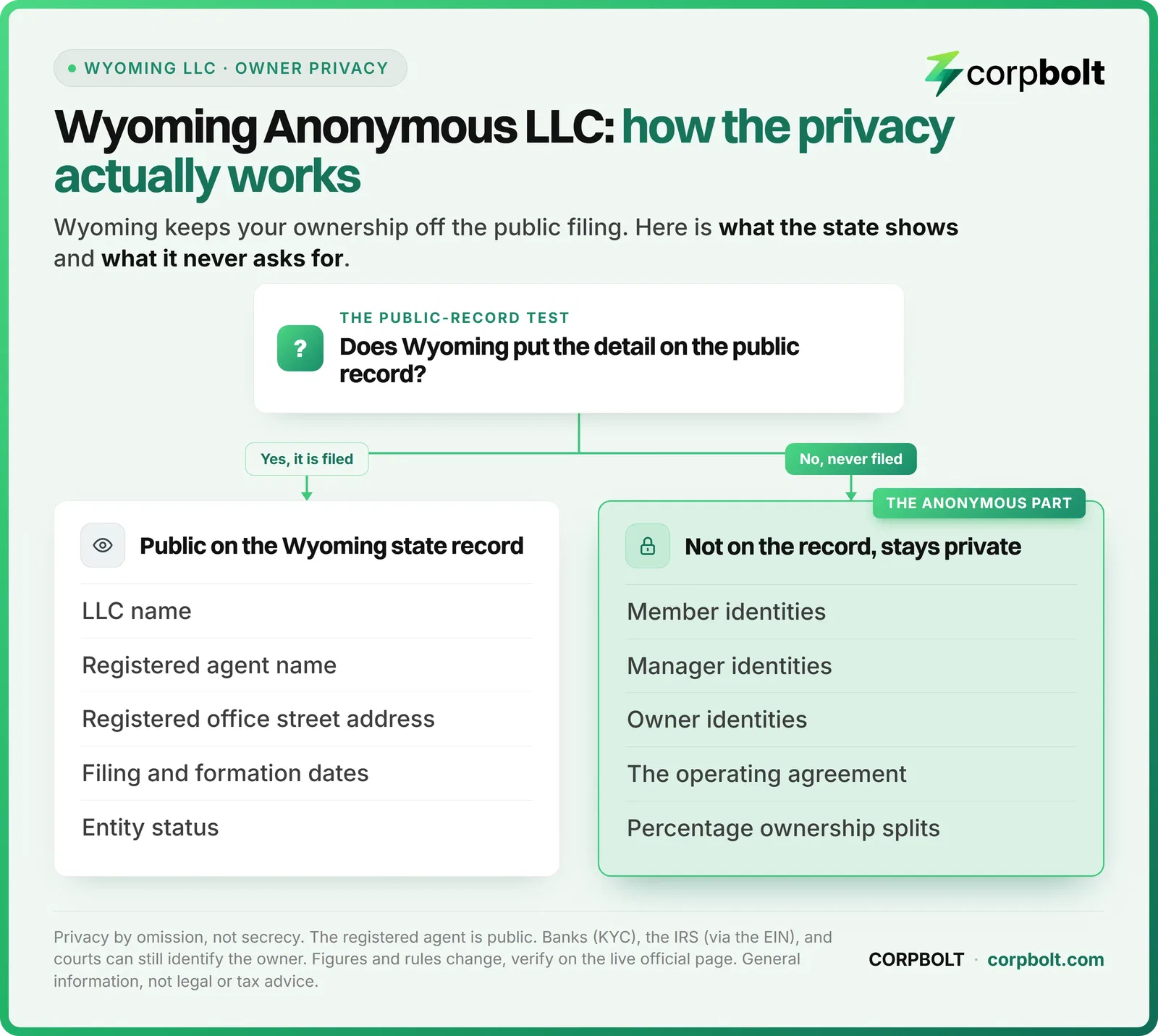
What is public versus private on the Wyoming state record.
The registered agent is your public-facing contact
Every Wyoming LLC must appoint a registered agent with a physical Wyoming street address. That agent is legally required and is publicly identified on the record. In practice the agent, not the owner, becomes the visible contact for the company.
This matters most for founders with no US address. Using the agent's business address as the company's public contact keeps a personal home address off the filing. If you also need a mailing address for banking and forms, a virtual address for an LLC can cover that without exposing where you live.
There is a trade-off to understand. The agent receives service of process and official state mail on the company's behalf, so it is a real legal role, not just a mailbox. That is exactly why the agent has to be publicly listed. The privacy you gain is the gap between the agent being visible and you staying unnamed.
You do not need to live in Wyoming, or in the United States, to form and own the LLC, which is part of why the agent arrangement exists. The full eligibility rules and setup steps for founders abroad are in our guide to forming a Wyoming LLC as a non-resident.
Who files it, and where ownership actually lives
The person who submits the formation is the organizer, and the organizer need not be an owner. Wyoming law permits one or more persons to act in that role, so the filer's name, rather than the owner's, is what connects to the initial paperwork.
Ownership itself lives in the operating agreement. That document governs who owns what and how the LLC is run. It is a private, internal record, and it is not among the filings required under 17-29-201, so it never reaches the state.
That is the practical takeaway. The public filing is a thin shell of name, agent, and address. The substance of who controls and owns the company sits in a document that stays with you, your co-owners, and your bank when they ask to see it. The state simply does not collect it.
How to form it without an unnecessary public trail
The pieces above come together in a short, privacy-first sequence.
Clear the name first. Run a name-availability search in the Wyoming business search before filing. Wyoming requires your LLC name to be distinguishable from existing entities (W.S. 17-29-108), so this check stops you from filing a name you cannot use.
Appoint a registered agent with a physical Wyoming address.
File the Articles of Organization. They list only the LLC name, registered office, and agent.
Keep ownership in a private operating agreement. This document is never filed with the state.
Where the privacy ends
State-level privacy is real, but it has clear edges. Reading "anonymous" as "untraceable" is the misstep we see most often, and it usually shows up at the bank counter. Here is where the wall stops.
Banks and payment processors. They must still identify and record the beneficial owner when you open an account. That comes from federal Bank Secrecy Act identity rules plus each provider's own policy, not from Wyoming law. State anonymity does not switch it off.
The IRS. An EIN application names a responsible party, and that party must be a natural person who owns or controls the entity. A founder with no SSN or ITIN enters "foreign" on line 7b of Form SS-4 but is still named. The IRS knows who stands behind the LLC.
Courts. In litigation a court can compel disclosure. Subpoenas to the agent or bank, post-judgment discovery, and a debtor's exam can all pierce the privacy layer.
Documents you sign. A lease, a bank form, or a contract can tie the real person to the company. Privacy on the state record does not erase a signature elsewhere.
One more clarification. Privacy is not the same as liability or asset protection. Keeping your name off a public database does nothing to shield company assets on its own. The separate question of how Wyoming shields an LLC from an owner's personal creditors is covered in our guide to Wyoming LLC charging-order protection.
Federal beneficial-ownership reporting (BOI and FinCEN)
Beneficial-ownership reporting is the biggest moving piece, so it deserves care. When such a report is required, it goes to FinCEN, a non-public federal database. It never goes to the Wyoming Secretary of State.
Under FinCEN's interim final rule published on March 26, 2025, all entities created in the United States, a Wyoming LLC included, and their beneficial owners are currently exempt from filing a BOI report. The rule revised "reporting company" to mean only entities formed under foreign law that register to do business in a US state. Our fuller walkthrough of whether an LLC must file a BOI report covers the detail.
The annual report keeps you off the record too
Privacy is not a one-time event at formation. Each year the LLC files an annual report, and that report likewise does not require listing members or managers. Ownership stays out of the yearly filing as well.
There is one caveat worth planning for. The annual report still has to be signed, and the name and title of the person who signs or files it can appear on the filing. So the missing owner fields are not a promise that no individual name ever shows. Decide who signs with that in mind.
Treat every figure here as the state's current amount, and verify it on the live Wyoming page before you file. The Articles of Organization filing fee is $100, with online filings adding a card processing fee of 2.4 percent, minimum $1. The annual report license tax is the greater of $60 or two-tenths of one mill ($0.0002) per dollar of assets located in Wyoming, due in the anniversary month of formation.
Frequently asked questions
What are the disadvantages of an anonymous Wyoming LLC?
The main one is that the privacy only covers the public state record, not everyone. Your name stays off the Secretary of State filing, but the registered agent's address is public, the IRS names a responsible party on the EIN application, and banks identify the beneficial owner when you open an account. You also keep paying for a registered agent each year, and that agent, not you, receives the company's legal mail.
Can someone look up who owns my Wyoming LLC?
A public business search returns the LLC name, the registered agent name and address, the filing dates, and the entity status. It does not return the members or managers. Owner identity is not part of the state filing.
Does an anonymous Wyoming LLC hide me from my bank?
No. Banks and payment processors must identify and record the beneficial owner at account opening under federal KYC obligations. That is bank policy plus federal law, and state-level anonymity does not defeat it.
Does Wyoming report my LLC's owners to FinCEN?
Beneficial-ownership reports go to FinCEN, never to the Wyoming Secretary of State. Under FinCEN's March 2025 interim final rule, US-formed entities like a Wyoming LLC are currently exempt.
Can a court force my registered agent to reveal who owns the LLC?
Yes. In litigation a court can compel disclosure through subpoenas, post-judgment discovery, or a debtor's exam. Anonymity is a privacy layer, not a shield against legal process.
Is Wyoming the most private state for an LLC?
Wyoming is among the states that do not list members or managers on the public record, which is why founders choose it. A full state-by-state comparison is outside this guide, which assumes you already own or are forming a Wyoming LLC. If you are still weighing where to form, our guide to choosing the best state for an LLC walks through that decision.
How this article was prepared
The core mechanic and the operating-agreement point map to Wyoming Statute 17-29-201, which sets the required contents of the Articles of Organization. The public-record fields and the annual report license tax draw on the Wyoming Secretary of State Business FAQ, and the $100 filing fee on the wyobiz registration instructions. The IRS responsible-party detail comes from the Instructions for Form SS-4, and the beneficial-ownership status from FinCEN's March 2025 interim final rule. Last reviewed July 2026. This is general information, not legal or tax advice. CORPBOLT is a formation service, not a law or accounting firm. Treat every fee and date as the state's or IRS's current figure to verify on the live official page.
Form it right with CORPBOLT: CORPBOLT forms and maintains Wyoming LLCs for non-residents from $349 per year (Foundation), including the registered agent that keeps your name off the public record, plus annual upkeep. The EIN is included from $599 per year (Launch) or as a $199 add-on, and we are upfront that bank KYC and IRS identification still apply. Form your Wyoming LLC →
Official references
Wyoming Statute 17-29-201, Articles of Organization required contents
FinCEN, March 2025 interim final rule on beneficial-ownership reporting
Approval note: Eligibility and approval decisions are made by each bank, fintech, and payment processor. Requirements can vary by provider, country, business model, and account history.
