

A virtual address for an LLC is a real US street address run by a Commercial Mail Receiving Agency, or CMRA, that accepts your company's mail as a service. It is not a PO box, and it is not your registered agent. For a non-US founder with no US premises, it gives you a US business and mailing address to list on state filings, on the IRS EIN application, and inside the documents a bank asks for. You set one up with USPS Form 1583, which you can complete from abroad by video, and it never replaces the Wyoming registered agent.
A CMRA is a staffed commercial location, so your address is a genuine street address. That lets it accept parcels from private carriers, which a standard PO box cannot.
Wyoming still requires a separate registered agent at a physical in-state address. Legal papers are served there, never at your mailbox.
A US address helps you assemble the physical-address document a bank asks for. The bank still decides, and acceptance is never guaranteed.
What a virtual address actually is
A virtual address is the mailing address behind every legitimate virtual-mailbox service, and it is how most non-residents answer whether they need a US address to form an LLC. In postal terms it belongs to a Commercial Mail Receiving Agency. The USPS defines a CMRA as "a business that, in whole or in part, accepts the delivery of U.S. Mail on behalf of another person or entity as a business service."
So it is a real, staffed commercial building with a street address, not a PO box and not a piece of software. Your company is one of many addressees the agency receives mail for. When you list it, you add a private mailbox number so the agency knows which customer each item belongs to.
Should a non-US founder use a virtual address?
Use one if you need a US mailing point but have no US premises. It solves the mail-and-filing problem, not the legal-representation or bank-approval problem. Match it to the job below before you buy.
A virtual address is the right tool for:
Listing a US mailing and principal-office address on your Wyoming Articles, items 4 and 5.
Giving a US mailing address on the EIN application and receiving IRS and state mail from abroad.
Supplying the physical-address document a bank asks for, and reducing how often your home address appears on paperwork.
Do not rely on a virtual address to:
Replace your Wyoming registered agent, which item 3 requires at a physical in-state street address.
Guarantee a US bank account, since each bank decides under its own risk-based rules.
Make your LLC anonymous, because your registered agent and Form 1583 records are still on file.
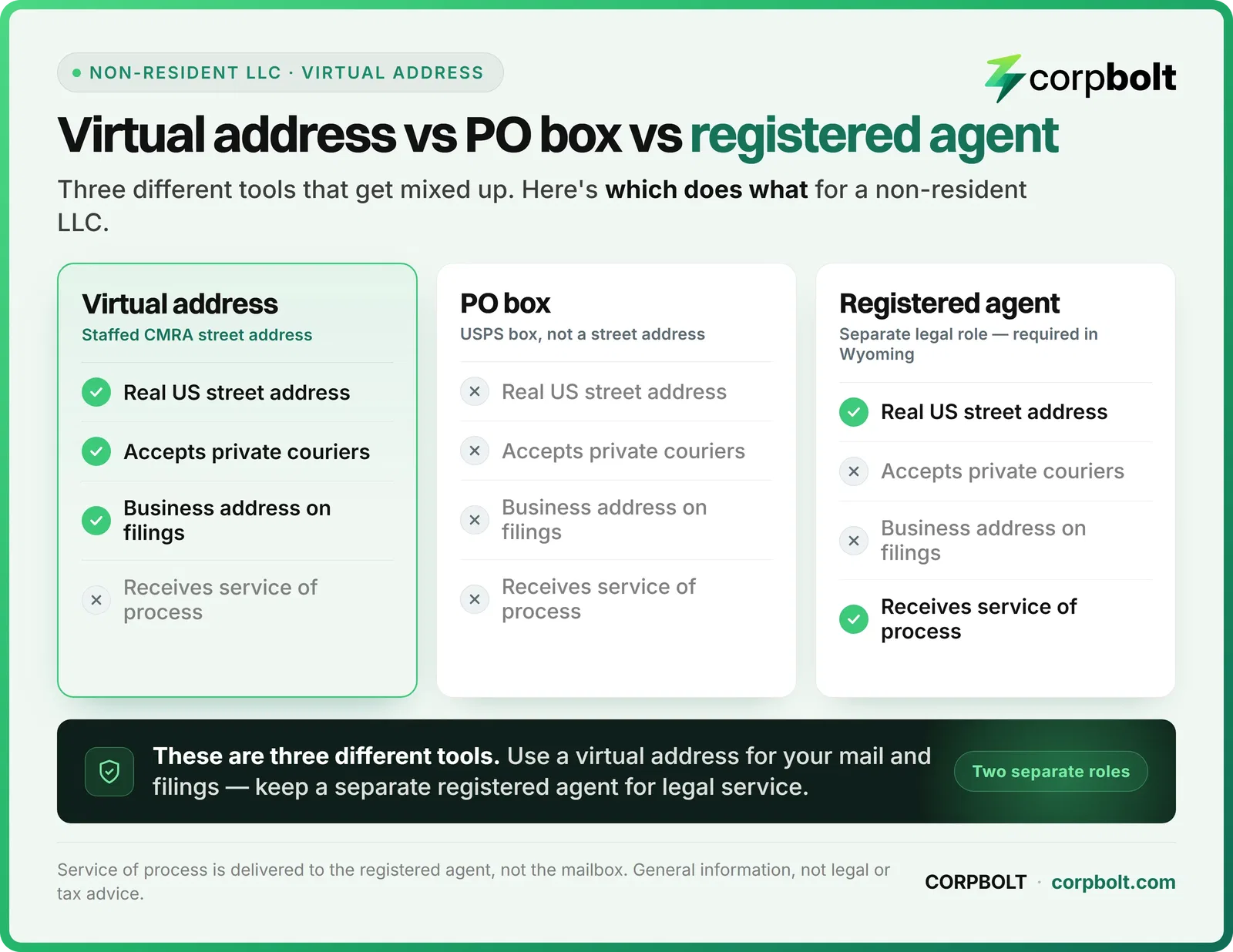
Virtual address vs PO box vs registered agent
These three get confused constantly, and mixing them up causes real filing problems. A virtual address handles general business mail. A PO box is a USPS-operated box for mail only. A registered agent is the person or company at a physical Wyoming address who accepts legal documents for your LLC.
Feature | Virtual address (CMRA) | PO box | Registered agent |
|---|---|---|---|
What it is | A staffed US street address that receives your mail as a service | A USPS box at a post office, for mail only | A person or company at a physical Wyoming street address |
Takes private-carrier parcels (UPS, FedEx, DHL) | Yes, it is a street address | Not by default | Not its role |
Accepts legal service of process | No | No | Yes, this is its core job |
Can be your Wyoming registered agent | No | No | Yes, and Wyoming requires one |
Appears on the public state record | Only if you list it as your mailing or principal office | Rarely used for filings | Yes, its name and physical address are public |
The registered agent line is the one that trips founders up. Wyoming law requires a registered office at "a street address in Wyoming which shall be a physical location where an individual can accept service of process."
On what does not count, the Secretary of State is blunt: "Post office boxes, drop boxes, virtual addresses, mail forwarding locations, UPS or FedEx stores do not qualify as an acceptable registered office address."
Service of process goes to that registered agent, never to your virtual mailbox. The two roles stay separate for the life of the company.
Where a virtual address fits on your state filing
When you form your Wyoming LLC, the Articles of Organization asks for three separate addresses, and that separation is the whole point. Item 3 is your registered agent, which must be a physical Wyoming address. Item 4 is the LLC mailing address, and item 5 is the principal office address.
Only item 3 carries a Wyoming location requirement. Items 4 and 5 have no US or Wyoming location rule, so a virtual address fits there cleanly. What a virtual address must never do is fill item 3.
Using a virtual address on the EIN application
You can also use a virtual address on Form SS-4 when you get an EIN as a non-resident. The mailing address on lines 4a and 4b can be a foreign address or a virtual one. The physical-location line, 5a and 5b, must be a real street address, and the instructions say plainly, "Don't enter a P.O. box number here." A CMRA street address satisfies that line, while a bare PO box does not.
If the responsible party has no SSN or ITIN and cannot get one, you enter "foreign" on line 7b. That is the standard route for a non-resident owner.
Using a virtual address to prepare for a US bank account
This is where honesty matters most. A US bank runs a Customer Identification Program under federal rules. For a company, 31 CFR 1020.220 requires the bank to obtain "a principal place of business, local office, or other physical location." A plain PO box does not meet that standard on its own.
A real CMRA street address can supply the physical-address document a bank's file expects. That is genuine preparation. It is not approval. The same rule says identity checks must be "based on the bank's assessment of the relevant risks," so each institution sets its own policy and makes its own decision.
How your mail is handled day to day
Once your address is live, the agency receives mail for your LLC and you decide what happens to each item. You can have mail forwarded to you abroad, scanned so you can read it online, or shredded when it is junk. It becomes the single US inbox for state notices, IRS letters, and the documents you receive after forming your LLC.
What to check before choosing a provider
Providers are not all built for a non-resident, so screen for the compliance and mail features you actually need. Use this neutral checklist rather than any brand ranking.
Full Form 1583 support with remote signing. Confirm the agency completes PS Form 1583 with you and accepts real-time video or a US notary, so you never need to travel.
Correct PMB or # addressing. The address must carry "PMB" or "#" and your mailbox number, not a suite line dressed up as private office space.
The mail actions you need. Check that you can scan, forward, and shred items, so state notices and IRS letters reach you online or abroad.
Parcel acceptance. A CMRA is a street address, so confirm it signs for UPS, FedEx, and DHL parcels, not just letter mail.
International forwarding. If you live outside the US, confirm the provider forwards to your country and how it handles the postage.
How to get a virtual address with USPS Form 1583
Getting a virtual address is a federal process, not just a signup. It is also a paid service almost everywhere, and we look at whether a free virtual address for an LLC is realistic in a separate guide. The form is USPS Form 1583, titled "Application for Delivery of Mail Through Agent," and you complete it with the CMRA. A non-resident can finish the whole thing from abroad. Here is what it involves.
Complete a Form 1583 with the agency. A separate form is required for each addressee.
Show two forms of ID. One must be a government-issued photo ID, and a passport qualifies. The second must confirm your address. A driver or nondriver ID can count for only one of the two.
Sign the form in the real-time audio and video presence of the agency, or before a notary commissioned in the United States. No US trip is required.
For a company mailbox, an officer of the LLC signs, gives their title, and completes the business block, item 7. The applicant address section has a country field, so your home address abroad is valid.
The agency then uploads your completed Form 1583 and a copy of your ID to the USPS CMRA Customer Registration Database, where the Postal Service keeps it on file.
What a virtual address does and does not hide
A virtual address reduces how often your home address appears on public-facing paperwork. That is a real benefit. It is not anonymity, and it is important not to oversell it.
Two facts keep a virtual address from hiding your LLC. First, your registered agent's name and physical Wyoming address are part of the public state record, and anyone can search them. Second, the agency holds your Form 1583 and your ID in the USPS database, available to the Postal Service and the Postal Inspection Service. The identity behind the mailbox is on file, so treat a virtual address as reduced disclosure, not a shield.
Keeping the address current
Two housekeeping habits keep the address working. When your business mailing address, business location, or responsible party changes, report it to the IRS on Form 8822-B, and report a responsible-party change within 60 days. When any detail on your Form 1583 changes, you file a fresh one with the agency.
Separately, keep your Wyoming annual report current. It is due on the first day of your LLC's anniversary month, and the state can dissolve an LLC that stays unpaid for 60 days past the due date. Treat the $60 minimum as the state's current figure and confirm it on the live Secretary of State site before you rely on it.
Frequently asked questions
Is a virtual address the same as a virtual office?
No, and the difference matters. A virtual address is a CMRA mail-receiving address, so its job is to accept and handle your mail. A virtual office is a rented workspace product with things like a receptionist, meeting rooms, and a business phone. This article is about the mail address, not office space.
Does a virtual address replace my Wyoming registered agent?
No. They are different legal roles. Wyoming requires a registered agent at a physical in-state address where a person can accept service of process, and the Secretary of State says a virtual address does not qualify. A registered agent service covers that role, so you keep both it and your virtual address.
Do I need a US address to get an EIN?
No. A non-resident can obtain an EIN with a foreign mailing address and "foreign" on line 7b of Form SS-4. A virtual address is helpful for receiving US mail, but it is not required for the EIN itself.
Can I open a US bank account with just a virtual address?
It helps you prepare. A CMRA street address can supply the physical-address document a bank asks for, but the bank makes the final call under its own risk-based rules. No address guarantees that an account will be approved.
Is there a free virtual address for an LLC?
Almost never. A compliant CMRA has to verify your identity and keep your Form 1583 on file, so the service is paid at nearly every provider. We weigh whether a genuinely free virtual address for an LLC is realistic in a separate guide.
What are the drawbacks of using a virtual address?
There are four to keep in mind, and they are limits rather than reasons to avoid one. It does not replace your Wyoming registered agent. It does not guarantee a US bank account, since each bank decides. It is reduced disclosure, not anonymity, because your agent and Form 1583 records stay on file. And it must show "PMB" or "#" with your mailbox number, and be updated whenever your details change.
How this article was prepared
The postal rules and the Form 1583 mechanics are drawn from the USPS Domestic Mail Manual, section 508, and PS Form 1583 itself. The registered-agent and state-filing points come from the Wyoming Secretary of State and the Wyoming LLC Articles of Organization. The EIN details are from the IRS Instructions for Form SS-4, and the bank identification rule is 31 CFR 1020.220. Last reviewed July 2026. This is general information, not legal or tax advice, and CORPBOLT is a formation service, not a law or accounting firm. Treat every fee, deadline, and government address here as the current figure, so verify it on the official source before you rely on it.
A quick note on CORPBOLT: CORPBOLT forms and maintains Wyoming LLCs for non-residents from $349/year (Foundation), which includes the Wyoming registered agent and a US business address. The EIN is included from $599/year (Launch) or as a $199 add-on. Start your US LLC.
Official references
USPS: PS Form 1583, Application for Delivery of Mail Through Agent
USPS: Domestic Mail Manual 508 (CMRA rules and PMB or # addressing)
USPS: PO Boxes (private-carrier delivery and Street Addressing)
IRS: Instructions for Form SS-4 (mailing vs physical address, line 7b)
IRS: About Form 8822-B (change of business address or responsible party)
Wyoming Secretary of State: LLC Articles of Organization (address fields and fees)
Approval note: Eligibility and approval decisions are made by each bank, fintech, and payment processor. Requirements can vary by provider, country, business model, and account history.
