

A Wyoming holding company is not a special entity type. It is a standard Wyoming LLC whose job is to hold assets, or ownership in other LLCs, rather than to trade. Non-US founders choose it for charging order asset protection, no state income tax, and formation privacy. That privacy has limits, and federal filing duties still apply.
Wyoming has no separate holding-company entity or license. You file the same Articles of Organization, then name the LLC as the owner of your assets or subsidiaries.
Wyo. Stat. 17-29-503 makes a charging order the only way a member's personal creditor can reach the LLC, and it applies even to a sole member.
Members stay off the public Articles, but the registered agent is public and the IRS learns the owner through Form 5472.
What a Wyoming holding company actually is
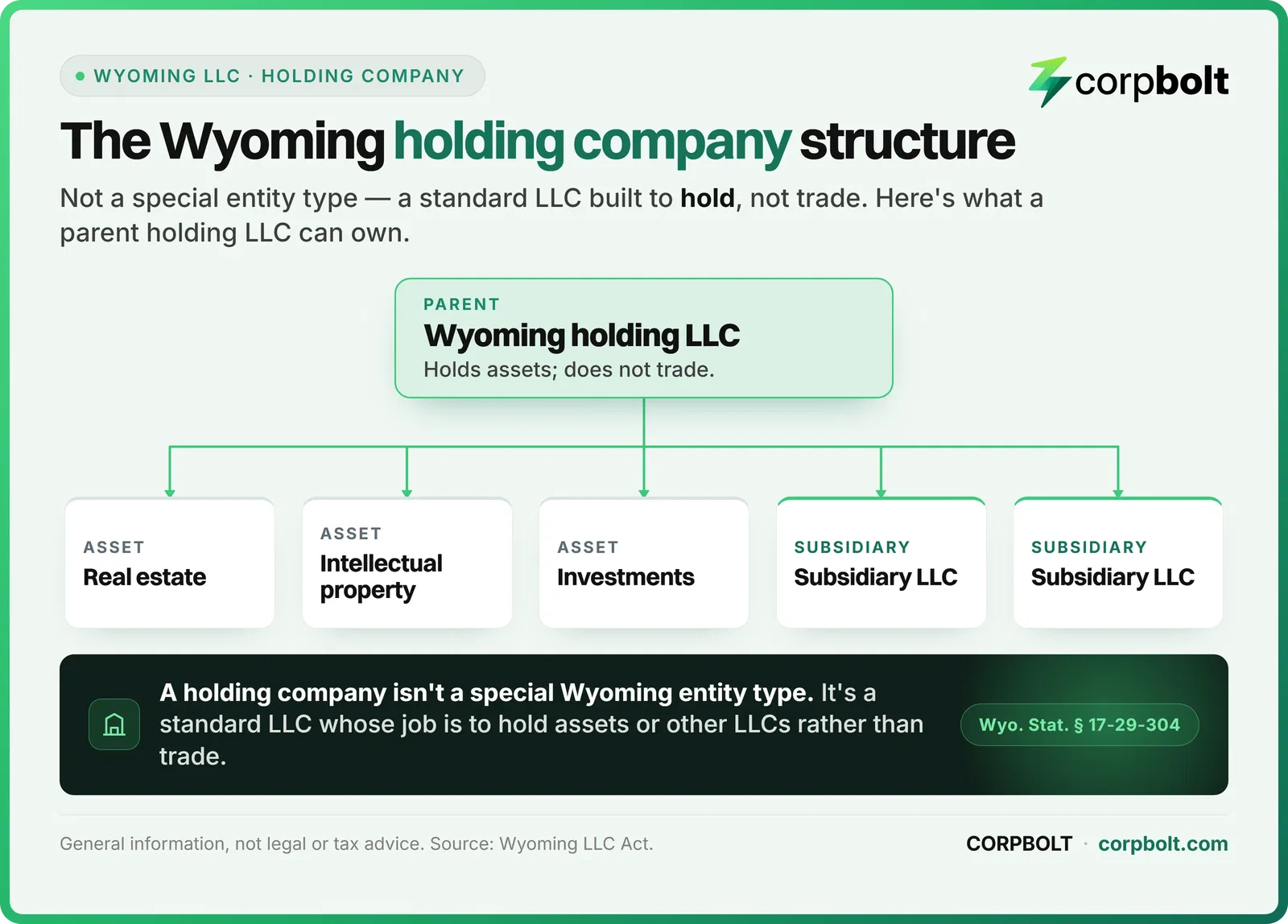
A holding company is a company whose main purpose is to own things rather than to run day to day operations. It holds assets, or the ownership interests of other companies. Those other companies, the subsidiaries, carry the trading activity and the risk that comes with it.
In Wyoming there is no separate holding-company entity or license. You form an ordinary limited liability company under the Wyoming LLC Act, then use it to hold. The statute treats every LLC the same way. Wyo. Stat. 17-29-104 states that a limited liability company is an entity distinct from its members, and that it may have any lawful purpose.
So a Wyoming holding LLC is simply a normal LLC that holds. The same rules that govern a trading LLC govern it. If this structure is new to you, start with our guide to forming a Wyoming LLC as a non-resident.
Why non-US founders use Wyoming for a holding LLC
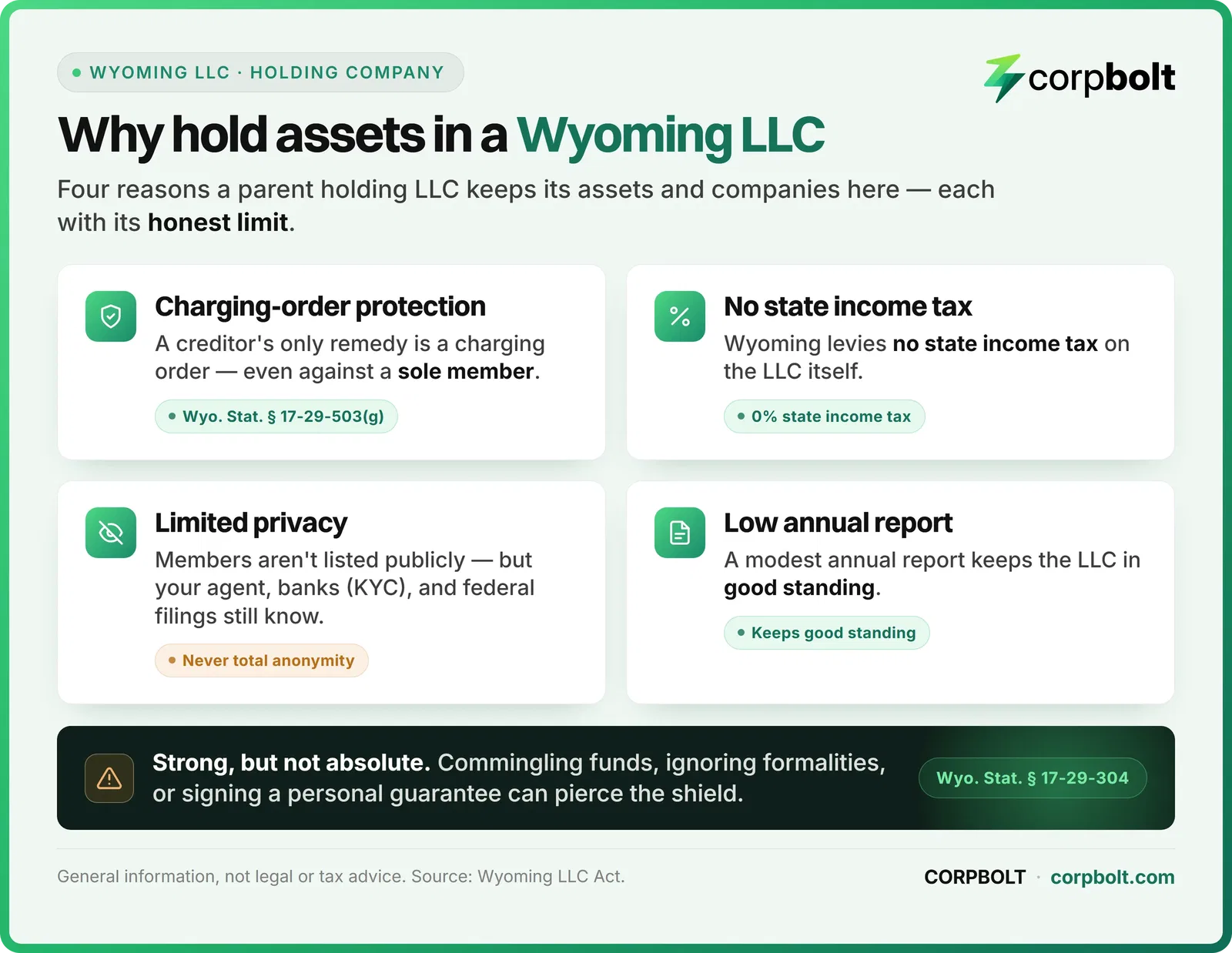
Four features do the work here. None of them is unique magic, and each has a limit worth knowing. If you are still deciding where to form, our guide to the best state for an LLC compares Wyoming with the other common options.
Charging order asset protection. A specific statute limits what a member's personal creditor can take from the LLC. This is the differentiator, and the next section covers it.
No Wyoming income tax. Wyoming levies no personal or corporate income tax, so the LLC owes no state income tax on what it holds. This is a state-level fact only, not a federal one.
Formation privacy. Member and manager names are not required in the public Articles of Organization. This is privacy, and it is real, but it is not anonymity.
A low annual report. A holding LLC with no assets located in Wyoming pays the $60 minimum license tax. Treat that as the state's current figure, and confirm it on the live Wyoming Secretary of State site.
Charging order protection, and what it really does
This is the main reason Wyoming appeals to asset holders, and it rests on a specific statute rather than a slogan. Wyo. Stat. 17-29-503 governs what a member's personal creditor can do. Subsection (g) makes the charging order the exclusive remedy. It applies even where the debtor may be the sole member, and it bars foreclosure on the member's interest.
A charging order is narrow by design. Under subsection (a), it only requires the LLC to pay the creditor any distribution that would otherwise reach the debtor member. The creditor gains no management rights and no ownership of the LLC or its assets. Under subsection (d), the member can extinguish the order by satisfying the judgment.
The LLC itself is also a separate legal person. Wyo. Stat. 17-29-304 provides that the debts and liabilities of the company are solely the company's. They do not become the member's simply because the member acts as a member. That is the liability shield that keeps you and the business apart.
What a Wyoming holding LLC can hold
A holding LLC can own most kinds of property. For a non-US owner, the common categories are these.
Real estate, held in the LLC's name rather than your own.
Intellectual property, such as trademarks, software, or a brand licensed to an operating company.
Investments and securities, including brokerage holdings and private stakes.
Membership interests in other LLCs, so one parent can hold several separate businesses.
Holding an asset only works if the LLC actually owns it on paper. Titling real estate into the company, or assigning the membership interests of a subsidiary to it, is what creates the separation. Skipping that paperwork leaves the asset in your own hands.
A rental portfolio shows the shape in practice. A founder can place each property, or a small group of properties, in its own subsidiary LLC, then have the Wyoming parent hold the membership interests of those property LLCs. The aim is to keep a claim tied to one property from reaching the others. This is a general separation principle, not a guarantee, and a property usually follows the rules of the state where it sits, so confirm local titling and registration there.
Member-managed vs manager-managed for a holding LLC
Every Wyoming LLC is either member-managed or manager-managed. You choose this when you form the company. It is a structuring decision, not an asset-protection feature, and guides often skip it.
In a member-managed LLC, the owners run the company directly. In a manager-managed LLC, the owners appoint one or more managers to run it, and those managers may or may not be owners. A single non-US founder holding passive assets usually chooses member-managed. The owner is the manager, there is no one else to appoint, and it is the simplest arrangement.
Manager-managed earns its place when you want a named manager to act while owners stay passive, or when several owners prefer to delegate control. For a one-owner holding LLC, that extra layer rarely pays for itself.
Holding other companies: parent-child vs sister-sister
When a holding LLC owns other LLCs, two shapes are common. In a parent-child structure, the holding LLC sits on top and owns each subsidiary beneath it. In a sister-sister structure, several subsidiaries sit side by side, each owned by the same parent.
The point of both shapes is separation. Because each LLC is its own legal person under Wyo. Stat. 17-29-304, a claim against one subsidiary generally stays with that subsidiary. A problem in one company does not automatically become a problem for the others or for the parent. This is a general principle rather than a guarantee. Veil-piercing and personal guarantees can still cross the line.
One practical note belongs here. A subsidiary that actually operates in another US state may need to register there as a foreign entity. Passively owning an asset from Wyoming is not the same as a subsidiary actively operating in another state, so assess where each entity really does business and verify that state's rules with its own authority. That is a concept to plan for, not something you handle at formation.
Taxes: what the holding LLC does and does not owe
Wyoming charges no state income tax, so the holding LLC owes nothing to Wyoming on what it holds. That is a state-level fact only. It does not remove your federal obligations, and it does not touch your home-country tax.
A single-member LLC owned by a foreign person is a disregarded entity by default. For income tax the IRS looks through it to the owner, so there is no separate entity-level federal income tax. The same entity, though, is treated as a corporation for one reporting rule under section 6038A.
That reporting rule is the one to respect. The LLC must file a pro forma Form 1120 with a Form 5472 attached for any year it has a reportable transaction with its owner. The IRS counts contributions and distributions as reportable transactions. So even a dormant holding LLC that only received your funding can owe the filing. Our guide to Form 5472 and the pro forma 1120 walks through it.
Tax on the assets themselves is situational. Income effectively connected with a US trade or business is taxed at graduated rates on the net amount. US-source passive income, such as dividends, is generally taxed at 30 percent, or a lower treaty rate. A purely passive foreign-asset holder often has neither, but your own facts decide this.
Privacy, and what Wyoming does and does not hide
Wyoming keeps ownership off the public record at formation, and that is the privacy people mean. Wyo. Stat. 17-29-201 lists what the Articles of Organization must state. It is the LLC name, plus the street address of the registered office with the registered agent's name. The agent's signed consent must accompany the filing. Member and manager names are not required in the public Articles.
That is genuine, but it is not anonymity. Several parties still know who you are.
Your registered agent is named on the public record, and holds your identity.
The IRS receives the direct and ultimate foreign owner's name, address, and tax ID through Form 5472.
Courts can compel disclosure of ownership.
Banks and payment processors identify owners through their own KYC checks.
How to set up a Wyoming holding LLC
For a non-US founder with no US presence, the path is short and mostly paper based.
Check the name is available. A Wyoming LLC name must be distinguishable on the Secretary of State's records from other business names, so search the state business database before you file. The search is free on the state's WyoBiz portal.
File the Articles of Organization with the Wyoming Secretary of State. The filing fee is the state's current $100, so confirm it on the live site before you file.
Appoint a Wyoming registered agent with a physical Wyoming street address. A P.O. box does not qualify, and the agent's written consent is required. Our guide to the registered agent requirement explains why it is mandatory.
Adopt an operating agreement. It is an internal agreement, not part of the public Articles, and it records who owns the LLC, who may act for it, and how any subsidiaries are held. Our Wyoming LLC operating agreement guide covers the clauses.
Get an EIN. An applicant with no US presence cannot use the online tool, and applies instead by fax, mail, or the international phone line. Enter foreign on line 7b if you have no SSN or ITIN. The IRS returns a faxed EIN in about four business days, which is the agency's figure, not a promise. See getting an EIN without an SSN.
Move the assets in. Title real estate into the LLC, or assign the membership interests of your subsidiaries to it, so the company is the legal owner.
File the annual report each year. It is due the first day of your anniversary month, with the $60 minimum license tax for a holding LLC that holds no Wyoming-located assets.
Mistakes to avoid
Treating privacy as anonymity. Off the public Articles is not off the record. Plan for disclosure to the IRS, the courts, and your bank.
Assuming no Wyoming tax means no US tax. The state fact is real, but federal filing duties and your home-country tax do not disappear.
Skipping the Form 5472 filing. The penalty is $25,000, plus $25,000 for each 30-day period it continues after 90 days of IRS notice. The pro forma return cannot be e-filed.
Commingling funds or ignoring formalities. Mixing personal and company money, or running the LLC loosely, weakens the liability shield.
Not actually titling the asset into the LLC. If the paperwork never transfers ownership, the LLC does not hold the asset and the separation fails.
Letting the annual report lapse. The LLC is delinquent the second day of the month after its due date. If the report is still unfiled 60 days after the due date, the state administratively dissolves it, which can jeopardize good standing and the liability shield.
Frequently asked questions
What are the downsides of a Wyoming holding company?
The main downside is cost and upkeep. Every LLC you add has its own filing fee, annual report, registered agent, and records you must keep separate. A foreign-owned LLC also carries the Form 5472 reporting duty and its $25,000 penalty for getting it wrong. The protections are limited, not absolute. Privacy keeps members off the public Articles but not from the IRS, the courts, or your bank, and the charging order does not shield the LLC's own assets from the LLC's own creditors.
Is a Wyoming holding company a separate type of company or filing?
No. You form a standard LLC. Wyoming has no holding-company entity type, license, or registration. The LLC holds assets or other LLCs simply by being named as their owner.
Is a single-member Wyoming LLC still protected by the charging order?
Yes. Wyo. Stat. 17-29-503(g) names a judgment debtor who may be the sole member, and it bars foreclosure on that member's interest. The charging order is the creditor's exclusive remedy.
Does a Wyoming holding LLC need a US bank account or US address to form?
No, not under Wyoming law. You need a Wyoming registered agent and registered office. Bank and processor requirements are each institution's own policy, and they vary by provider.
Do I still file US taxes if the LLC only holds foreign assets?
Possibly. A foreign-owned single-member LLC must file Form 5472 with a pro forma Form 1120 for any year it has a reportable transaction with you, and contributions and distributions count. Check your facts against the IRS instructions.
How this article was prepared
The formation, protection, and privacy points are drawn from the Wyoming LLC Act, including Wyo. Stat. 17-29-104, 17-29-201, 17-29-304, and 17-29-503, and from the Wyoming Secretary of State Business FAQ and fee schedule. The federal points are drawn from the IRS Instructions for Form 5472, the IRS Instructions for Form SS-4, the IRS single-member LLC page, and the IRS guidance on effectively connected income. The beneficial ownership status reflects the FinCEN interim final rule of March 26, 2025. State fees, IRS figures, and the FinCEN rule are current figures to verify on the live pages before you rely on them. Last reviewed July 2026. This is general information, not legal or tax advice, and CORPBOLT is a formation service, not a law or accounting firm.
A quick note on CORPBOLT: CORPBOLT forms and maintains Wyoming LLCs for non-residents from $349/year (Foundation), including the registered agent and US business address. The EIN is included from $599/year (Launch) or as a $199 add-on, and we file your annual report each year. Start your US LLC.
Official references
Wyoming Secretary of State: Wyoming LLC Act (Wyo. Stat. 17-29-201, 17-29-304, 17-29-503)
Wyoming Secretary of State: Business FAQ (annual report, license tax, delinquency)
IRS: Instructions for Form 5472 (foreign-owned US disregarded entity, pro forma 1120, penalty)
IRS: Instructions for Form SS-4 (EIN application channels for applicants with no US presence)
IRS: Single Member Limited Liability Companies (disregarded entity treatment)
FinCEN: interim final rule removing BOI reporting for US companies
