

Wyoming does not legally require a written operating agreement, and the state never files one. You should still keep a written agreement, because it sets your own rules and shows the LLC is a separate legal person. A ready operating-agreement template is included with any CORPBOLT plan.
The agreement can be oral or implied under Wyoming law, but a signed written one is the practical best practice.
A complete agreement covers company details, members, capital, profits, management, transfers, dissolution, and amendment.
It is never sent to the Secretary of State, so it stays a document you keep in your own files.
Is an operating agreement legally required in Wyoming?
No. Wyoming does not require your limited liability company to have a written operating agreement at all. Under Wyoming Statutes section 17-29-102(a)(xiv), the agreement can be oral, in a record, implied, or any combination of those. The Wyoming LLC Act at section 17-29-110 recognizes the operating agreement but never mandates one.
The agreement is also not filed with the state. When you form the company, the Articles of Organization carry only the company name, the street address of the registered office, and the name of the registered agent (section 17-29-201). Members and the operating agreement are not listed there. That makes the operating agreement a private internal document, not a public filing.
So a written form is best practice, not a legal command. The rest of this article explains what a good agreement should contain and why even a solo owner benefits from having one in writing.
Why a single-member LLC still needs one
Not by law, but by good practice. A written agreement documents that the LLC is a separate legal person from you, the owner. That separateness is the whole point of the limited liability structure, often described as the corporate veil. A single-member LLC operating agreement is widely recommended as evidence of that separateness.
Section 17-29-110 shows how this works. The agreement governs relations among members, the duties of managers, the company's activities, and voting. Where the agreement is silent, the Act supplies default rules under section 17-29-110(b). Without your own document, the statute's gap-fillers decide your internal affairs by silence.
To be clear, an agreement is not a guarantee against a court disregarding the entity. Veil questions turn on how you actually run the company, not on paperwork alone. Still, having a written agreement is one recommended step toward showing the LLC operates on its own.
What a Wyoming LLC operating agreement should contain
A complete agreement is built from a handful of standard clauses. Each one answers a specific question about how the company runs and who owns it. The sections below walk through the eight blocks a solid Wyoming agreement usually includes.
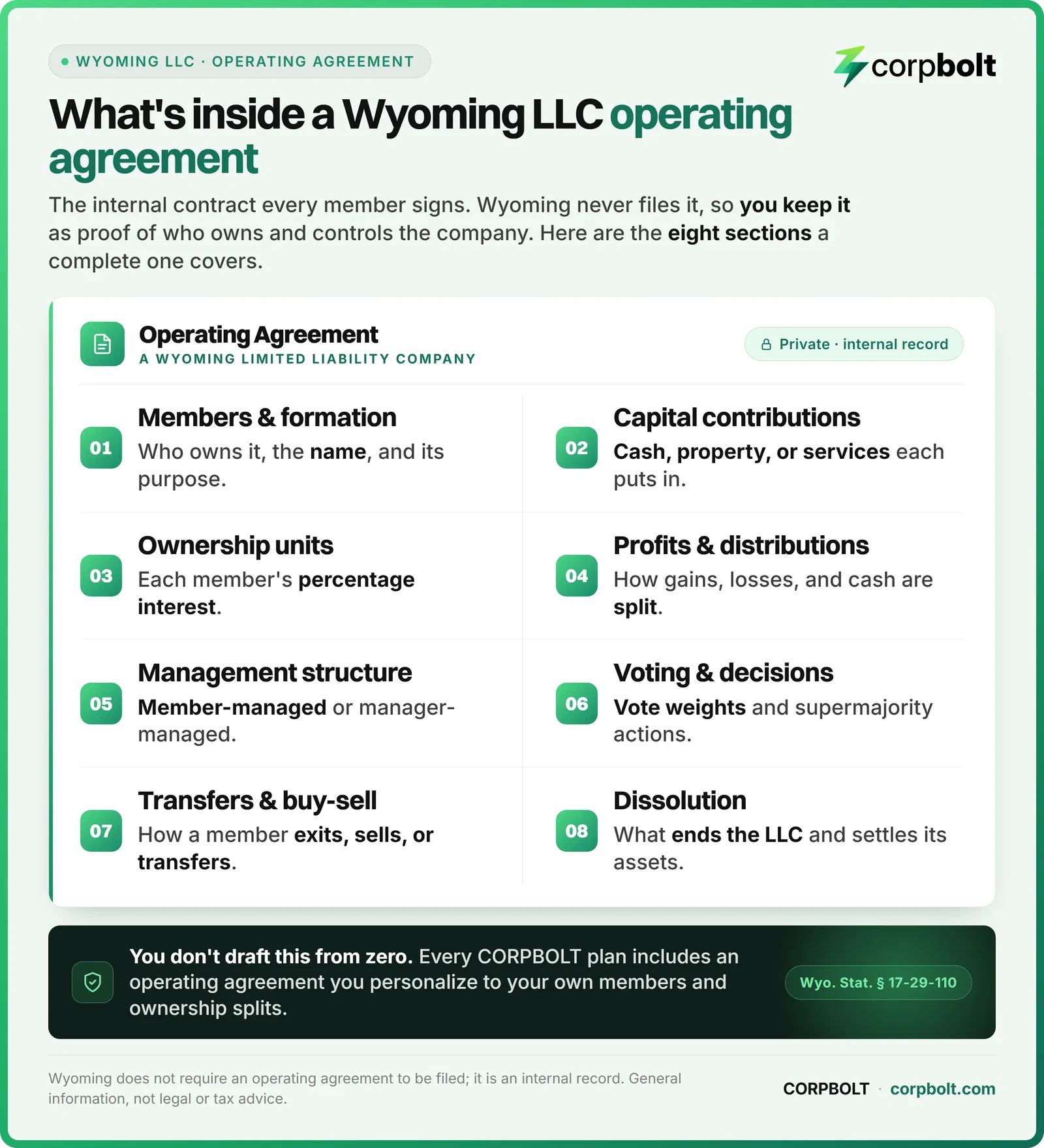
The eight sections a complete Wyoming LLC operating agreement covers.
Clause | What it governs | Why it matters |
|---|---|---|
Company and organization details | Company name, principal address, formation date, and the Wyoming registered agent | Sets the entity's identity and the agent it must maintain under section 17-29-113 |
Members and ownership interest | Who the members are and each member's percentage of the membership interest | Documents the foreign sole member's 100% ownership so federal reporting stays consistent |
Capital contributions | What each member contributes, whether cash, property, or services | Fixes a clear starting point for the books and keeps company money separate from personal; Wyoming itself sets no minimum capital, so the amount is yours to choose |
Allocation of profits, losses, and distributions | How profits, losses, and distributions are shared among members | Governs payouts and respects Wyoming's distribution limits under section 17-29-405 |
Management structure and voting | Member-managed or manager-managed, and how votes are counted | Overrides the per-capita default vote under section 17-29-407 if you want ownership-weighted voting |
Transfer or assignment of membership interest | What happens if you add a member, sell part of the company, or exit | Future-proofs a one-person LLC before you bring in a partner or sell |
Dissolution and winding up | What triggers a wind-up and how the company closes down | Keeps the close orderly, with creditors covered before the owner under section 17-29-702 |
Amendment procedure | How the agreement itself can be updated later | Lets you adapt the document without refiling anything with the state under section 17-29-110(a) |
Company and organization details
This block records the basics: the company name, its principal address, and the formation date. It also names the Wyoming registered agent. A Wyoming LLC must continuously maintain a registered agent in the state under section 17-29-113. For a non-resident owner with no US presence, that agent is not optional, and a CORPBOLT plan includes one.
Members and ownership interest
This section names the member or members and states each one's percentage of the membership interest. For a foreign-owned company it is load-bearing. Documenting the sole non-US member's 100% interest keeps your federal reporting consistent.
Capital contributions
Here you record what each member contributes to the company. That can be cash, property, or services. Even for a one-person LLC, writing down the initial contribution creates a clear starting point for the company's books and reinforces that its money is separate from yours.
Allocation of profits and losses and distributions
This clause states how profits, losses, and distributions are shared. For a solo owner it is simple, since one member holds everything. It is still worth documenting. Under section 17-29-110(a) these matters are governed by the agreement, and the Act fills any gap you leave. Wyoming also caps distributions. You can't pay yourself out if afterward the company couldn't cover its debts as they come due, or its total liabilities (plus any preferential rights on dissolution) would top its total assets (section 17-29-405). So note that money reaches the owner only after the company's obligations are covered. This is educational only and not tax advice.
Management structure and voting
A Wyoming LLC is member-managed by default unless the articles or the agreement elect manager-managed (section 17-29-407). In a member-managed company each member has equal management rights, and ordinary matters are decided by a majority of the members. Choosing manager-managed is an election you make in your own document.
If you do elect manager-managed, a manager is chosen and removed by majority-member consent under section 17-29-407, so the agreement should name the manager's authority and that removal rule.
Choice | Who runs the company | When it fits |
|---|---|---|
Member-managed (default) | The member runs day-to-day operations directly, with no separate manager role | A solo owner who wants to operate the company personally |
Manager-managed (elect it) | A named manager runs operations, chosen and removed by majority-member consent | An owner who appoints someone else to run the company, or plans to bring in outside management |
Transfer or assignment of membership interest
This section covers what happens if you later add a member, sell part of the company, or exit. It future-proofs a one-person LLC before you need it. Even a solo owner benefits from spelling this out, so a clean transfer path is ready if you later bring in a partner or sell.
Dissolution and winding up
Here the agreement sets out what triggers a wind-up and how the company closes down. Documenting these triggers keeps the process orderly and predictable. Section 17-29-702 requires a dissolved company to discharge its debts, obligations and liabilities and to marshal and distribute its assets. As a matter of standard winding-up practice, creditors are paid or provided for before anything reaches the owner, so a complete clause should reflect that. It tells a future reader, including a bank or a successor, how the company is meant to end if that day comes.
Amendment procedure
A good agreement explains how it can be updated later. Section 17-29-110(a) explicitly names the means and conditions for amending the operating agreement as one of the things the agreement itself governs. Building in an amendment step means you can adapt the document as the company changes, without refiling anything with the state.
Using a Wyoming operating-agreement template
A template is a fill-in-the-blanks version of the clauses above. In practice it is a word-processing or PDF document you complete, sign, and keep with your records. Because Wyoming never files the agreement (section 17-29-110), a template is for your own internal use, not a state form you submit anywhere. A ready single-member template is included with any CORPBOLT plan, but any template only becomes yours once you fill in the company's specifics.
Before you fill one in, gather the details the agreement needs so you can complete it in one sitting:
Company name, principal address, and formation date, exactly as on your Articles of Organization.
The name and registered-office address of your Wyoming registered agent.
The legal name of the member and confirmation of 100% ownership.
The initial capital contribution, whether cash, property, or services.
Your management choice, member-managed or manager-managed.
Your EIN, once you have it, to reference in the document.
Two standard fields round out the document beyond the eight core clauses. The first is a business purpose. Wyoming lets an LLC be formed for any lawful purpose under section 17-29-104(b), so most templates use a broad "any lawful business" statement rather than a narrow one, which saves you from amending the document every time the business shifts. The second is duration. A Wyoming LLC has perpetual duration by default under section 17-29-104(c), so a template usually states that the company continues until it is dissolved, which simply matches that default.
What the agreement should reflect for a non-US-resident owner
Most guides stop at a generic clause list. If you are forming a Wyoming LLC as a non-resident, a few points deserve extra attention in your agreement.
First, make the foreign sole member's 100% ownership explicit. Banks and payment providers often ask to see an operating agreement as a matter of their own policy, not Wyoming law. A clear ownership statement helps that onboarding, though it never guarantees account approval.
Second, the agreement should sit consistently alongside your federal reporting. For US tax, a single-member LLC is by default a disregarded entity, so its activity is reported on the owner's return rather than by the company. Whether the company owes US tax depends on its income, which is a separate question and not covered here.
Third, the agreement references your EIN, but the EIN is a separate document you obtain on its own. A non-resident whose responsible party has no SSN or ITIN enters "Foreign" on line 7b of Form SS-4. Because the online tool is unavailable without an SSN or ITIN, non-residents apply by phone, fax, or mail. We do not promise any turnaround.
Signing, notarization, and filing
A member signature is recommended so the agreement reads as adopted. Wyoming does not require notarization, and there is no writing formality forcing it. The agreement is never sent to the Secretary of State. It is simply one of the internal records you keep, alongside the other documents you receive after forming an LLC.
On asset protection, Wyoming makes the charging order the exclusive creditor remedy against a member's interest, and section 17-29-503(g) says this reaches even a sole member. That is a statutory feature of the state's law, not a promise of any particular outcome in a given dispute.
On privacy, owner names do not appear on the public formation filing, so the operating agreement stays a private record. That is not the same as anonymity. The registered agent is public, and federal beneficial-ownership rules can apply separately, so never treat a Wyoming LLC as fully anonymous.
One misstep we see: owners treat the agreement as a one-time formality, sign it, and never look at it again. When they later add a partner or change how profits are split, the document no longer matches reality. Update the agreement as the company changes, using the amendment clause you built in.
Frequently asked questions
Does Wyoming provide or require an official operating-agreement template?
No. Wyoming neither requires, provides, nor files an operating agreement. Section 17-29-110 recognizes it as a purely internal document. The state's forms page and the Wyoming LLC Act statute are different things, and neither is itself an operating agreement.
Do I have to notarize the agreement or file it with the state?
No. Wyoming imposes no notarization requirement, and the agreement is not filed with the Secretary of State. A member signature is recommended, and you keep the signed agreement in your own records rather than sending it anywhere.
Does a single-member LLC really need an operating agreement?
Not by law, but it is strongly recommended. It evidences the LLC as separate from you and helps support limited-liability protection. In Wyoming a sole member still keeps the charging-order protection under section 17-29-503(g).
Do banks require an operating agreement to open an account?
Many banks and payment providers ask for one as a matter of their own policy, not Wyoming law. That is one reason non-resident owners keep a clear written agreement showing 100% ownership. Having one does not guarantee that an account will be approved.
Can I change the operating agreement later?
Yes. A good agreement includes its own amendment procedure under section 17-29-110(a). If you add a member, sell, or restructure, you update the agreement itself. You do not refile anything with the state to make that change.
Does the operating agreement have to be in a specific Word or PDF format?
No. Wyoming does not prescribe any format for an operating agreement, and it never files one (section 17-29-110), so there is no official form to match. A template is simply a word-processing or PDF document you complete, sign, and keep with your records. What matters is that the agreement covers the eight core clauses above, not the file type it lives in.
How this article was prepared
Each statutory and IRS point in this article is linked to its primary source where the point is made and gathered under Official references below. It reflects the operating-agreement questions non-resident founders raise most when forming a Wyoming LLC with CORPBOLT, and the single-member template included with every plan follows the eight-clause structure above. Reviewed by Edgar Loui Francisco, a Formation Specialist at CORPBOLT who works with non-resident founders on operating agreements and EIN applications. Last reviewed July 2026. This is general information and not legal or tax advice. CORPBOLT is a formation service, not a law or accounting firm. Treat any fee or date as the state's or the IRS's current figure to verify on the live page.
Do this with CORPBOLT: CORPBOLT forms and maintains Wyoming LLCs for non-residents from $349/year (Foundation), including the registered agent, US business address, annual upkeep, and a ready operating-agreement template. The EIN is included from $599/year (Launch) or available as a $199 add-on. Form your Wyoming LLC →
Official references
Wyoming Statutes, LLC Act sections 17-29-102 and 17-29-110 (operating agreement)
Wyoming Statutes section 17-29-201 (Articles of Organization)
Wyoming Statutes section 17-29-503 (charging order, sole member)
Wyoming Statutes section 17-29-104 (purpose and perpetual duration)
Wyoming Statutes section 17-29-405 (limitations on distribution)
IRS: Instructions for Form 5472 (foreign-owned disregarded entity)
Approval note: Eligibility and approval decisions are made by each bank, fintech, and payment processor. Requirements can vary by provider, country, business model, and account history.
