

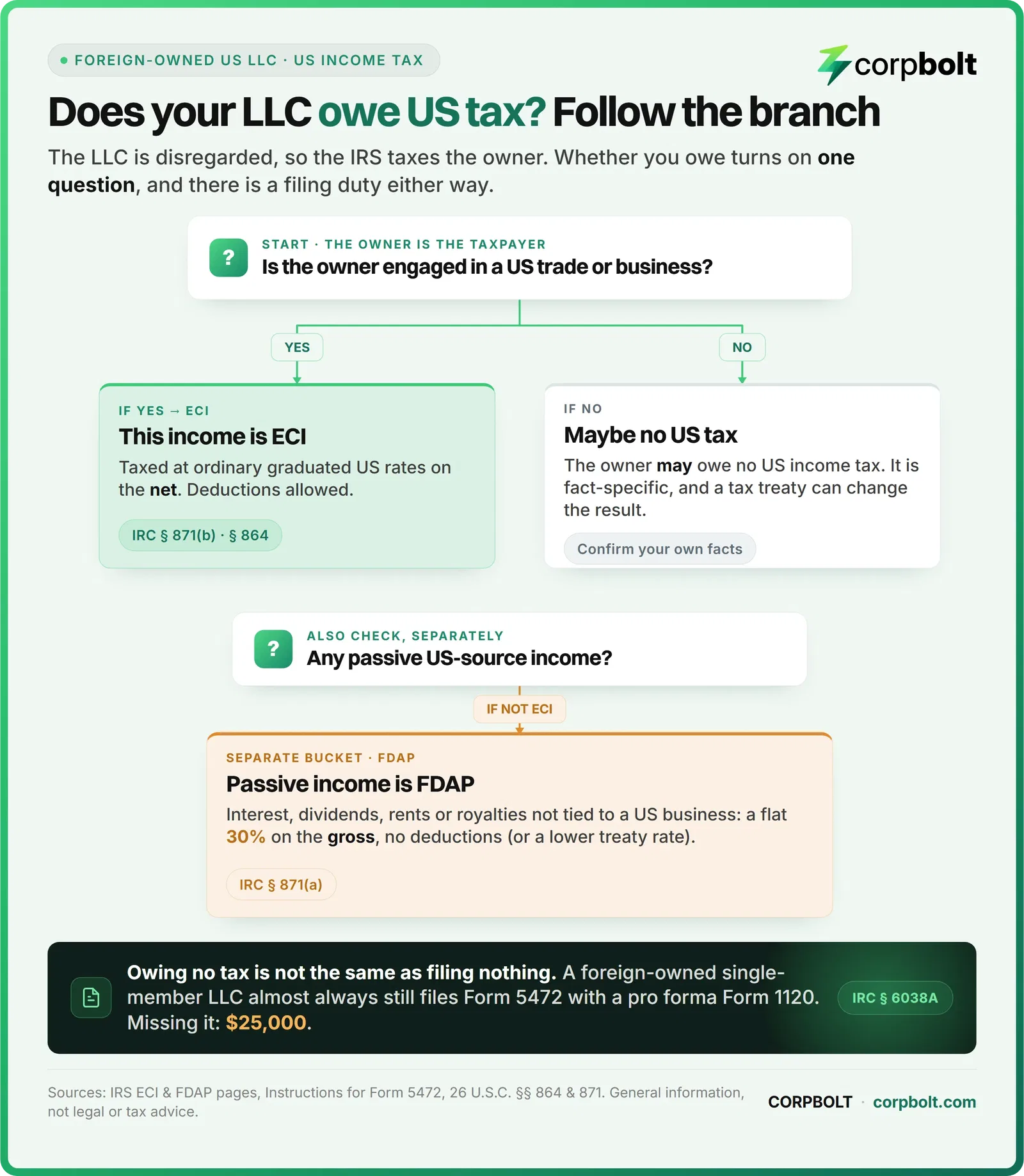
It depends on your facts, not on the LLC itself. A US LLC owned by one non-resident is disregarded for federal income tax, so the IRS looks through it to you, the owner. Whether you owe US income tax turns on whether your income is effectively connected with a US trade or business.
Because a single-member LLC is disregarded, the US tax question is really about you. If your income is effectively connected income (ECI), it is taxed at ordinary graduated US rates on the net amount.
If the owner has no US trade or business, they may owe no US income tax on the business profit. This is fact-specific, not a blanket rule, so confirm your own situation with a cross-border tax professional.
Owing no tax is not the same as filing nothing. A foreign-owned single-member LLC almost always still files Form 5472 with a pro forma Form 1120, and missing it carries a $25,000 penalty.
Search results love a clean answer, and the popular one is that a foreign-owned US LLC never pays US tax. That is folklore, and it is a risky thing to believe. The honest answer depends on one question: is your income effectively connected with a US trade or business? This guide walks through that test in plain terms. It is general information, not tax advice, so treat it as a map, not a ruling on your own return. This guide assumes you already run, or are setting up, a US LLC as a non-resident. If you are still weighing whether you can open a US LLC from outside the US, start there first.
Why the answer starts with your owner, not your LLC
A single-member LLC with one non-US owner is, by default, a disregarded entity for federal income tax. Disregarded means the IRS looks straight through the company to its owner. The LLC does not file its own income tax return, and its profit is treated as the owner's.
So the real question is never does my LLC pay US tax. It is whether its owner owes US tax on this income. That shifts the analysis onto your personal tax position as a non-resident, which is where the ECI test lives.
What is effectively connected income (ECI)?
Here is the core rule from the IRS. When a foreign person is engaged in a trade or business in the United States, the US-source income connected with that trade or business is effectively connected income, or ECI.
ECI is taxed at graduated US rates on the net amount. Graduated means the same progressive brackets US individuals face, and net means you may deduct business expenses against gross ECI to reach the taxable figure. A tax treaty can lower the rate further.
The IRS uses two tests to decide whether income is effectively connected. The asset-use test ties income to US assets used in the business. The business-activities test asks whether US business activities were a material factor in producing the income.
In the tax code, this sits in Section 871(b), which taxes a non-resident's effectively connected income at the ordinary graduated rates, and Section 864, which defines a US trade or business and effectively connected income.
US tax generally reaches only income it treats as US-source, so a useful first step is to ask where each stream of your income is sourced. The rules below come from IRS Publication 519.
Revenue stream | What generally sets its US source |
|---|---|
Services you perform yourself, such as design, consulting, software, or freelancing | Where you physically perform the work |
Goods you buy and resell (inventory) | Where the sale happens, generally where title to the goods passes to the buyer |
Rent from US property | The location of the property |
Royalties | Where the intellectual property is used |
Interest and dividends | Interest follows the payer's residence; dividends follow where the paying company is incorporated |
Source is only the first input, not the final answer. Even US-source income is taxed only if the ECI or FDAP rules reach it, and that still turns on your own facts, so confirm your position with a tax professional.
When are you engaged in a US trade or business?
You can only have ECI if you are a non-resident, or a foreign company, engaged in a US trade or business during the tax year. The IRS treats owning and operating a business that sells services, products, or merchandise in the United States as generally meeting that threshold.
For personal services, the bar is activity that is considerable, continuous, and regular. A one-off or trivial touch inside the US is different from running an active US operation. Section 864(b) also folds the performance of personal services in the United States into the definition, with limited exceptions.
When might a non-resident owner owe no US income tax?
This is where the folklore comes from. If the owner runs everything from abroad, with no US office, no US employees, and no dependent US agent, some argue there may be no US trade or business, and so no ECI to tax.
Picture a freelance designer based in London who serves US clients. She does all the work herself in London, with no US office, no US staff, and no US agent who closes deals for her. On those facts, some practitioners reason there may be no US trade or business, so possibly no US income tax on that profit. It is not automatic, though. Doing the work while physically in the US, hiring US-based staff, or using a US agent who can bind the business can each change the answer, and a treaty adds its own permanent establishment test.
But this is a facts-and-circumstances judgment, not a bright-line rule. The IRS gives no simple test for online or remote sellers. A US tax treaty adds another layer, because its permanent establishment analysis can change the outcome. So no honest guide can tell you that you owe nothing. Your own facts decide it.
FDAP income and the flat 30% withholding
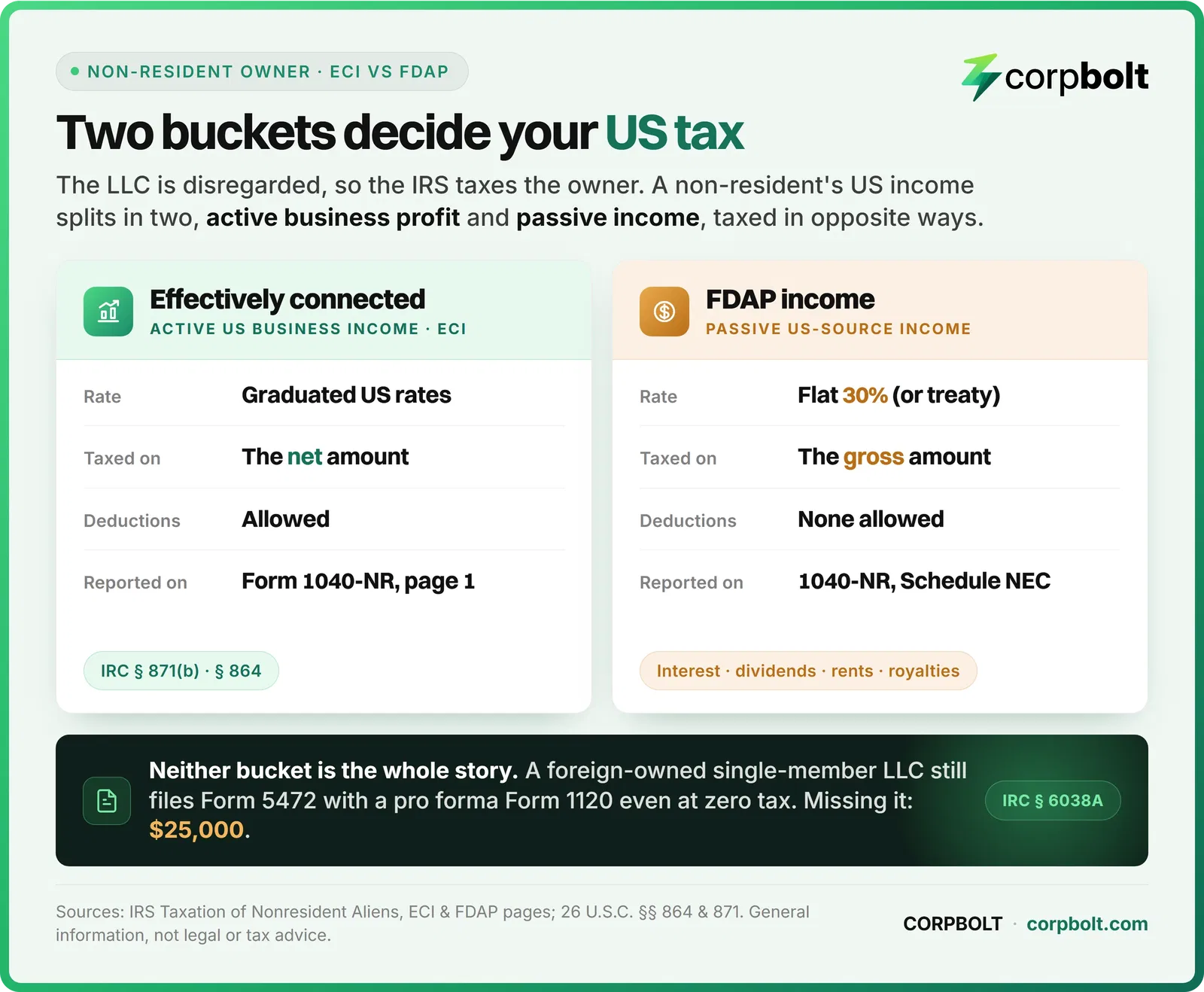
There is a second bucket of US tax that works very differently. A non-resident's US-source income splits into ECI on one side and FDAP income on the other. FDAP stands for fixed, determinable, annual, or periodical income, and it usually means passive US-source income like interest, dividends, rents, and royalties.
FDAP that is not effectively connected with a US trade or business is taxed at a flat 30% rate, or a lower treaty rate. No deductions are allowed against it, so the tax falls on the gross amount, not the net. In the code, this 30% charge sits in Section 871(a).
So the two buckets behave in opposite ways:
ECI: active US business income, taxed at graduated rates on the net, deductions allowed, reported on page one of Form 1040-NR.
FDAP: passive US-source income, taxed at a flat 30% or treaty rate on the gross, no deductions, reported on Schedule NEC of Form 1040-NR.
Either bucket can create a filing duty for you personally. If you have ECI, or US-source FDAP income that withholding did not fully settle, you as the owner may need to file Form 1040-NR, the US non-resident income tax return. That return is yours, and it is separate from the LLC's own Form 5472 information filing. Whether you must file turns on your facts, so confirm it with a tax professional.
You still have to file: Form 5472 even at zero tax
Now the part people miss. Whether or not you owe a cent of US income tax, the reporting duty stands on its own. A foreign-owned single-member LLC is treated as a corporation for the limited purposes of the Section 6038A reporting rules.
The trigger is having a reportable transaction with a related party during the year. For most single-owner LLCs that is easy to meet, because money you put into the company, and money it pays back out, both count. Our guide to Form 5472 filing requirements covers who must file and what a reportable transaction is.
That means it must file a pro forma Form 1120 with Form 5472 attached, even though it has no income tax return of its own. Our guide to Form 5472 and the pro forma Form 1120 covers that pairing in depth, and the step-by-step filing guide walks the mechanics.
The stakes are the reason this matters. Missing or late-filing a required Form 5472 triggers a $25,000 penalty per reporting company, with a further $25,000 if the failure continues beyond 90 days after IRS notice.
This is not tax advice: how to confirm your own facts
You have probably noticed the pattern. Almost every answer here ends in it depends, because it genuinely does. The label on the LLC does not decide your US tax. Your activity, your presence, and any treaty do.
A cross-border tax professional can look at your real facts and tell you whether you have a US trade or business, whether your income is ECI or FDAP, and what you must file. If you formed your company through the non-resident Wyoming LLC route, that professional review is the natural next step.
One narrow point on scope: this guide is about US federal income tax. Wyoming itself has no state income tax, but state and sales tax questions are separate, and a professional should cover those too. And if the owner is a foreign company rather than an individual, the analysis shifts to the rules for foreign corporations and a different return, Form 1120-F, so that case needs its own review.
Frequently asked questions
Does a foreign-owned single-member LLC automatically pay US tax?
No, not automatically. The LLC is disregarded, so the IRS looks at the owner. US income tax applies only if the owner's income is effectively connected with a US trade or business (ECI). If there is no US trade or business, the owner may owe no US income tax, but this is fact-specific, so confirm it with a tax professional.
What is effectively connected income (ECI)?
Per the IRS, when a foreign person is engaged in a US trade or business, the US-source income connected with that business is ECI. ECI is taxed at graduated US rates on the net amount, and deductions are allowed against it.
If I owe no US tax, do I still have to file anything?
Almost always yes. A foreign-owned US single-member LLC must file a pro forma Form 1120 with Form 5472 attached, even when no tax is due. Missing it carries a $25,000 penalty under Section 6038A.
What is the 30% withholding I keep hearing about?
That is the flat 30% or lower treaty tax on US-source FDAP income, meaning passive income like interest, dividends, rents, and royalties that is not effectively connected with a US trade or business. No deductions are allowed against it, so it applies to the gross amount.
Is this tax advice?
No. This is general educational information. Whether your income is ECI is a fact-specific determination, and a tax treaty can change the outcome, so confirm your own situation with a qualified cross-border tax professional.
How this article was prepared
The ECI definition, the graduated-rate and net treatment, and the asset-use and business-activities tests come from the IRS Effectively Connected Income page. The two-bucket split between ECI and FDAP comes from the IRS Taxation of Nonresident Aliens page, and the flat 30% no-deductions rule from the IRS FDAP page. The statutory basis, the 30% charge in Section 871(a), the graduated-rate charge in Section 871(b), and the definitions in Section 864, comes from the US Code as published by the Legal Information Institute. The Form 5472 reporting duty, the pro forma Form 1120, and the $25,000 penalty come from the IRS Instructions for Form 5472. Last reviewed July 2026. This is general information, not legal or tax advice, and CORPBOLT is a formation service, not a law or accounting firm. Whether your income is effectively connected is your own fact-specific determination, so confirm it with a qualified cross-border tax professional before you rely on any outcome.
Sorting out US tax on CORPBOLT: CORPBOLT forms and maintains Wyoming LLCs for non-residents from $349/year (Foundation), including the registered agent and US business address. The EIN your Form 5472 filing depends on is included from $599/year (Launch) or as a $199 add-on. We are a formation service, not a law firm or CPA, so speak to a qualified tax professional about your own ECI position. Start your US LLC.
