

A Wyoming series LLC is one parent LLC that can hold several internal series, each able to own assets and, in the right conditions, wall off those assets from the debts of the other series. It suits people juggling several distinct assets, such as a real estate investor holding multiple properties. Most non-resident founders running one online business do not need one. A standard Wyoming LLC is simpler, cheaper, and easier to file for the IRS.
One LLC filed with Wyoming, holding internal cells called series. Each series can own its own assets and run its own line of business under the parent.
A series shields its assets from other series only if you keep separate records, put the limitation in your operating agreement, and give notice of it in the Articles.
For a single online business, a plain Wyoming LLC is cheaper, keeps your US tax filings simpler, and avoids a shield the courts have barely tested.
What is a Wyoming series LLC?
A Wyoming series LLC is a single limited liability company whose operating agreement can create one or more internal divisions, called series. Wyoming authorizes the structure at W.S. 17-29-211, a section of its Limited Liability Company Act titled series of members, managers, transferable interests or assets. Each series can hold its own assets, take on its own members or managers, and run its own line of business, all under one parent company.
If you are still weighing the base entity, it helps to be clear on what an LLC is before you layer a series on top. The series feature is also one reason founders choose Wyoming in the first place, alongside its low fees and privacy.
How does the liability shield between series actually work?
The point of the structure is an internal wall. Under W.S. 17-29-211, the debts and liabilities of one series are enforceable only against that series' own assets. They cannot reach the parent LLC's general assets, the assets of any other series, or the members personally. The wall runs both ways, so the parent's debts and another series' debts cannot reach into a given series either.
On paper, that lets one company hold several walled-off pockets of assets. In practice the wall only stands if you meet a set of conditions, and courts have rarely tested it. Both points matter, so take the conditions first.
What does Wyoming require to keep each series separate?
The shield in W.S. 17-29-211 is conditional, not automatic. Three things must all be true for the separation between series to hold. First, you keep separate records for each series that account for its assets separately from the others. Second, your operating agreement states the limitation on liabilities between series. Third, the Articles of Organization give notice of that limitation. Miss any one of the three and the wall may not hold.
In day to day terms, each series that holds assets or trades should keep its own books and its own bank account. Commingling money between series, or failing to document each series' assets on their own, is the fastest way to collapse the separation for the whole company.
That disclosure has a privacy cost. Because the parent and every series sit on the same public filing with the state, they are tied together on the public record, not held apart the way separately formed LLCs would be. If keeping ownership off the public record matters to you, read our guide to a Wyoming anonymous LLC before you choose the series route.
How do you set up a Wyoming series LLC?
The pieces above turn into a short sequence. Each step is series specific, so it assumes you already know how a plain Wyoming LLC is formed.
File the Articles of Organization with the series notice. One parent filing creates the company, and the Articles must give notice of the limitation on liabilities between series.
Adopt an operating agreement that states the limitation. This internal document must carry the liability limitation between series, one of the three conditions the shield depends on.
Name and establish each initial series. Give every series a numbered designator, for example Doe LLC Series 1, and record it so its assets are accounted for separately.
Keep separate records and a bank account per series. Each trading series needs its own books and account, which is how you meet the separate records condition in practice.
Disclose any later series by amending the Articles. A series added after formation must be disclosed to the Secretary of State by amendment, as Wyoming's series LLC rules require. Confirm the current filing window before you rely on a deadline.
How much does a Wyoming series LLC cost to form and maintain?
Wyoming keeps formation cheap, and the series sits on your single parent filing rather than a stack of separate companies. Here is what to budget, treating every figure as the state's current amount and confirming it before you pay.
Formation filing. The Articles of Organization fee is $100, the same as any Wyoming LLC. Your series are established through that one parent filing, not a separate registration for each.
Per-series charge. Wyoming's own series instructions quote an extra $10 for each series established, while some other sources describe only the flat $100. Confirm the current per-series charge on the WyoBiz portal before you file.
Annual report. The yearly report has a $60 minimum license tax, rising above $60 only if the company holds more than $250,000 of assets in Wyoming. The parent files one report that covers the whole structure.
The per-series fee is the one figure that varies between sources, so do not assume it. Check the live Wyoming series instructions before you send payment.
Who actually needs a series LLC, and who does not?
A series LLC earns its keep when you are truly siloing several distinct assets under one roof. The classic example is a real estate investor who places each property in its own series, so a claim against one building does not expose the others. An operator running several separate brands or product lines can use it the same way, keeping each line's liability in its own box.
Most non-resident founders are not in that position. If you run a single online business, a standard Wyoming LLC for non-residents already gives you one clean liability shield, and a series only adds cost and paperwork you will not use. The honest test is simple. Count your distinct, asset-holding activities. If the answer is one, you do not need a series.
How is a foreign-owned series LLC taxed?
This is the least settled part, so read it with care. The IRS proposed regulations on series LLCs in 2010, under REG-119921-09, and those rules have never been finalized. As of 2026 they are not in effect. They would treat each series of a domestic series LLC as a separate entity for federal tax, each one classified on its own as a disregarded entity, a partnership, or a corporation.
For a foreign owner, that proposed treatment points in an expensive direction. A foreign-owned single-member US LLC that is a disregarded entity already has to obtain an EIN and file Form 5472 with a pro forma 1120 for any year with reportable transactions. If each active series is its own entity, you may face that same duty for every revenue-generating series, not once for the whole company.
Will other states recognize the series liability shield?
The internal wall is a Wyoming statutory feature, and its reach outside Wyoming is uncertain. There is little case law testing it, so no one can promise how a court will treat it. A judge in a state that has no series-LLC statute, or a federal bankruptcy court, is not obliged to respect the separation between your series.
A creditor can argue that the whole LLC is really one entity, and the outcome is hard to predict. None of this means a series LLC does not work. It means you should treat the cross-state and cross-court protection as unsettled, and not lean on it as if it were guaranteed.
EINs and banking for a series LLC as a non-resident
Two practical questions follow from the tax uncertainty: how many EINs you need, and how you bank. Because the proposed rules treat each series as its own entity, plan for the possibility that each active series needs its own EIN, rather than one number for the parent alone. Keep that flexible until the rules are settled or a US tax professional confirms your position.
On banking, each series that trades should hold its own account, which is also how you meet the separate records condition in practice. A formation service can prepare the paperwork a bank will ask for, but no provider can guarantee that any bank will open an account, so treat banking as preparation rather than approval.
Series LLC vs a standard Wyoming LLC: which should you choose?
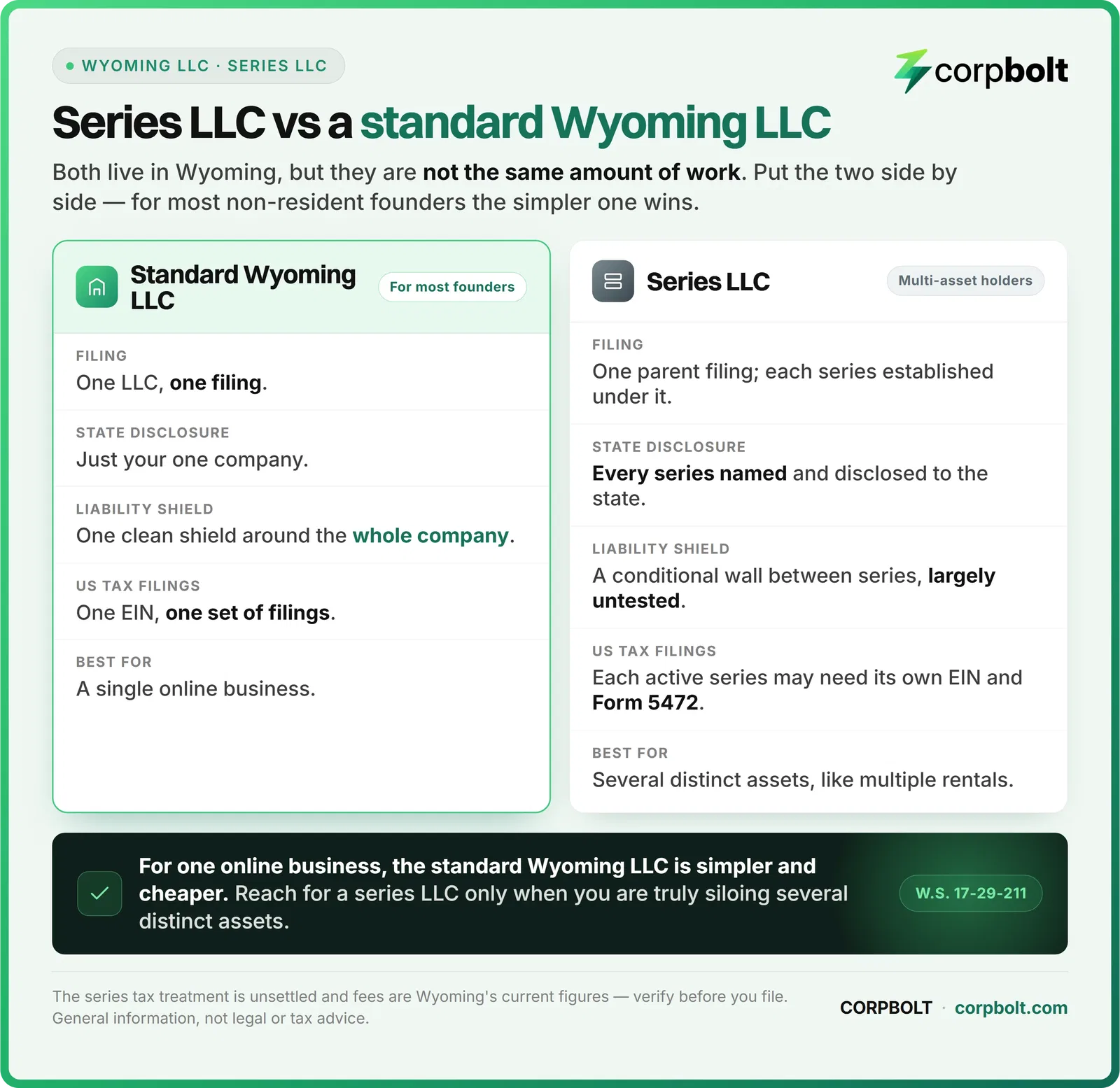
Put the two side by side. A standard Wyoming LLC is one company, one filing, one annual report, and one set of US tax filings. A series LLC adds internal cells, extra disclosure to the state, a conditional shield you must maintain, and a tax picture that may multiply your IRS filings.
The short recommendation: choose a standard Wyoming LLC unless you are holding several distinct assets that each need their own liability box. This table sets the two structures against each other.
Factor | Standard Wyoming LLC | Wyoming series LLC |
|---|---|---|
Entities and filings | One company on one Articles filing | One parent, but each series must be named and disclosed |
Public disclosure | The single company appears on the state record | The parent and every series are linked on the same record |
Recordkeeping | One set of books and one bank account | Separate books and a bank account for each active series |
Annual report | One report, $60 minimum | Still one parent report, but more series to maintain |
Foreign owner tax | One EIN and one Form 5472 filing path | Proposed rules may treat each series separately, so filings could multiply |
A series LLC is also not the same as a holding company. A holding company owns separately formed subsidiary LLCs, each its own filing and its own legal entity, while a series keeps everything inside one company behind a conditional internal wall. If you are weighing separate subsidiaries instead, our Wyoming LLC holding company guide covers that setup.
If you are still comparing structures rather than states, our guide on how an LLC compares with a corporation covers that decision at the entity level. For the series question specifically, the deciding factor is how many distinct assets you are protecting.
For nearly every non-resident building one online business, the standard route is the right call. Form the plain Wyoming LLC, keep clean books, and revisit the series option only if you later hold several distinct assets.
Frequently asked questions
Does Wyoming allow series LLCs?
Yes. Wyoming authorizes series LLCs under W.S. 17-29-211, which lets an operating agreement establish one or more designated series of members, managers, interests or assets.
Are the assets of one Wyoming series protected from another series' debts?
They can be. Under W.S. 17-29-211, a series' debts are enforceable only against that series' assets. That protection holds only if you keep separate records for each series, put the liability limitation in the operating agreement, and give notice of it in the Articles of Organization. Miss any of those and the separation may not hold.
Do I have to tell Wyoming about each series?
Yes. Unlike some states, Wyoming requires each series to be named and disclosed to the Secretary of State. You do this in the original Articles of Organization or in an amendment filed after you establish the series. Confirm the current filing window on the Wyoming Secretary of State site.
How is a foreign-owned series LLC taxed by the IRS?
It is unsettled. IRS proposed regulations from 2010, REG-119921-09, would treat each series as a separate entity for federal tax, but they have never been finalized. In practice a foreign owner should plan for each active series to potentially need its own EIN and its own Form 5472 with a pro forma 1120. Confirm your position with a US tax professional.
Do most non-resident founders need a Wyoming series LLC?
No. A series LLC suits people siloing several distinct assets, such as multiple rental properties. If you run one online business, a standard Wyoming LLC is simpler and cheaper, avoids the largely untested inter-series shield, and keeps your US tax filings straightforward.
Will other states recognize the liability wall between my series?
Maybe not. There is little case law, and a court in a state without a series-LLC statute, or a bankruptcy court, is not obliged to respect the internal separation. Treat cross-state protection as uncertain.
How this article was prepared
The statutory rules come from the Wyoming Limited Liability Company Act, mainly W.S. 17-29-211, which authorizes series and sets the conditions for the inter-series liability shield. The disclosure and naming requirements come from the Wyoming Secretary of State series LLC rules and instructions. The federal tax discussion is based on the IRS proposed regulations REG-119921-09 in the Federal Register and the IRS instructions for Form 5472. The cross-state and asset-protection cautions reflect practitioner commentary noting how little case law exists. Fees and filing windows are the state's current figures, so verify them on the live Wyoming Secretary of State forms and the WyoBiz portal before you file. Last reviewed July 2026. This is general information, not legal or tax advice, and CORPBOLT is a formation service, not a law or accounting firm.
A quick note on CORPBOLT: CORPBOLT is a US business formation service for non-resident founders, and it forms a standard Wyoming LLC without an SSN or a US visit. For most people building one online business that is the right structure, not a series LLC. It comes with a registered agent and a US business address from $349 a year, or $599 a year with the EIN included. If your situation genuinely calls for a series LLC, talk to a US attorney about the operating agreement and the tax filings before you commit. Start your US LLC when you are ready.
Official references
Wyoming Secretary of State: Series LLC Rules (each series named and disclosed to the state)
Wyoming Secretary of State: Series LLC Articles of Organization instructions (filing fees)
Federal Register: proposed regulations REG-119921-09 on series LLCs (still not finalized)
IRS: Instructions for Form 5472 (foreign-owned disregarded entity reporting)
Approval note: Eligibility and approval decisions are made by each bank, fintech, and payment processor. Requirements can vary by provider, country, business model, and account history.
