

Yes, in most cases you do not need an SSN or ITIN to open a US business bank account for your LLC. Federal identification rules let a non-US person be identified by a passport, and the account keys on your LLC's EIN, not your personal number. What you cannot control is approval, because each bank sets its own policy.
A bank's Customer Identification Program must collect a few basics. For a non-US person, a passport number and country of issuance can stand in for a US taxpayer number.
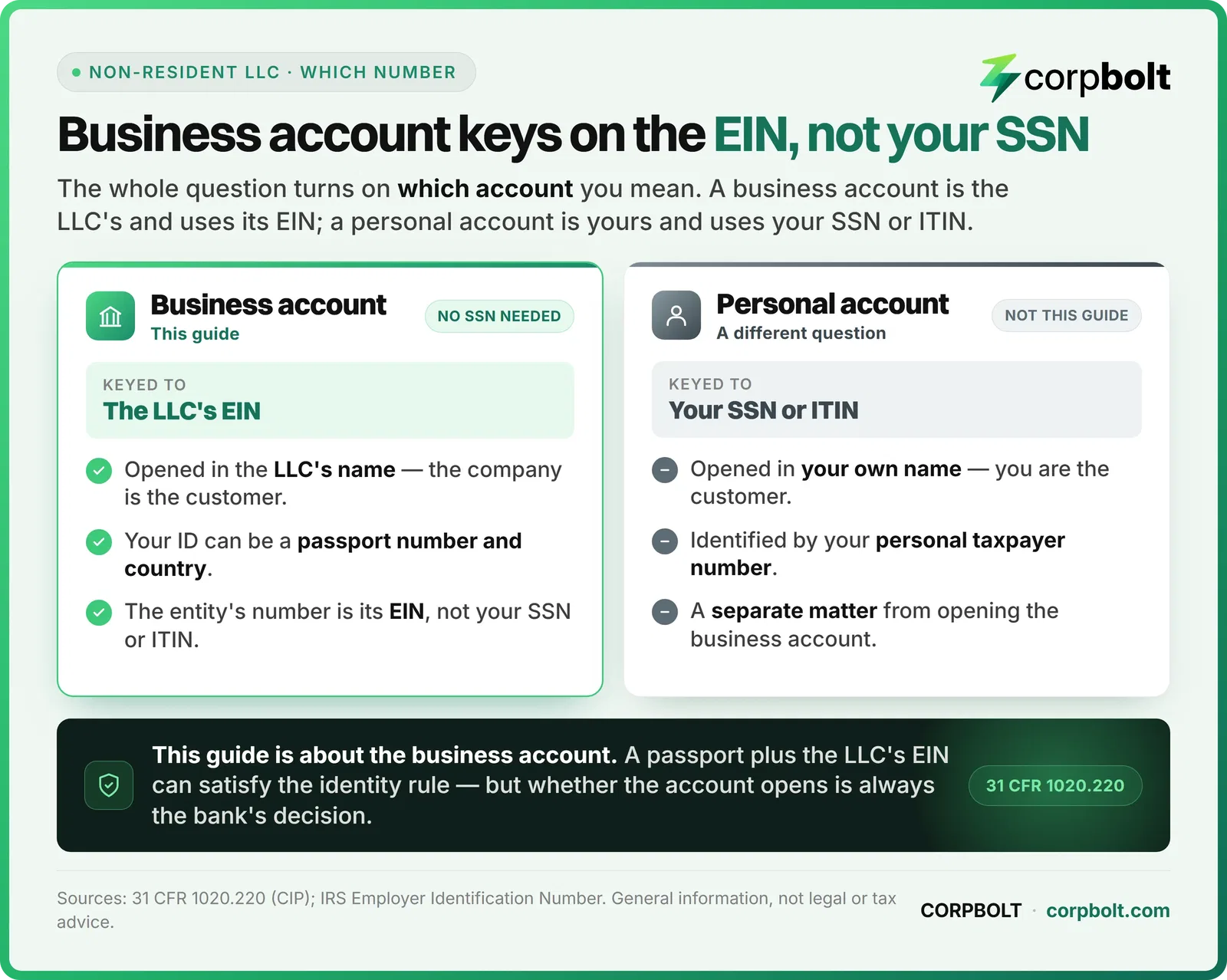
A business account is opened under the entity's own federal tax ID, the EIN, not your SSN or ITIN. You can get an EIN without either number.
The rule is a legal minimum, not a promise. Some banks still want an SSN, US residency, or an in-person visit. CORPBOLT helps you prepare a clean application but cannot guarantee any bank will open the account.
Can you open a US bank account without an SSN or ITIN?
For a business account, the answer is usually yes. The federal rule that governs how banks verify customers, the Customer Identification Program, does not force a non-US person to hand over a US taxpayer number. A passport can satisfy the identity check instead, and the account itself is opened under your LLC's EIN. That said, meeting the legal minimum is not the same as being approved. Every bank layers its own risk policy on top, so no guide can promise you an account. What this article does is show you what the law requires, what you present in place of an SSN or ITIN, and how to prepare an application a bank is more likely to accept.
What it identifies | What you provide | Who sets it |
|---|---|---|
The business, the customer of record | The LLC's EIN, its own federal tax ID | Federal law requires an identification number for the customer (31 CFR 1020.220) |
You, the owner or control person | Passport number and country of issuance, in place of an SSN or ITIN | Federal law lets a non-US person use a passport (31 CFR 1020.220) |
Extra conditions, such as US residency, a US address, or an in-person visit | Varies; some banks ask, others do not | Each bank's own risk policy, not the federal rule |
What the law actually requires: the bank's Customer Identification Program
Before a US bank opens an account, federal rules require it to run a Customer Identification Program, or CIP. Under 31 CFR 1020.220, the bank must collect at least four things: your name, your date of birth if you are an individual, a physical address, and an identification number.
The identification number is where non-residents get nervous, and it is the heart of the answer. A US person must give a taxpayer identification number. A non-US person may instead supply one or more of the following, in the exact language of the rule:
A taxpayer identification number.
A passport number and country of issuance.
An alien identification card number.
The number and country of issuance of any other government-issued document that evidences nationality or residence and bears a photograph or similar safeguard.
In plain terms, a passport satisfies the rule. An SSN or ITIN is not the only acceptable identifier for a non-US person, so the common belief that you must have one is simply wrong at the level of federal law.
Why a business account keys on your LLC's EIN, not your SSN
There is a second reason an SSN is not required: the account is not in your personal name. When you open a business account, the customer is the LLC, and the LLC has its own federal tax ID. That number is the EIN, which the IRS defines as the tax ID for businesses and other entities. The company is the customer of record, and its identification number is the EIN, so the CIP identification box is filled by the entity, not by you.
You also do not need an SSN or ITIN to get that EIN in the first place. A non-resident founder can obtain one directly from the IRS. Our guide on getting an EIN without an SSN walks through the form, and if you are still untangling which number is which, how an EIN, ITIN, SSN, and tax ID differ lays them side by side.
What a non-resident presents instead of an SSN or ITIN
Putting the two rules together, here is what actually goes on the application in place of an SSN or ITIN.
Your passport, giving the passport number and country of issuance, as your personal identification number under the CIP rule.
Your date of birth and a physical residential address, which the rule requires for every individual.
Your LLC's EIN, the entity's federal tax ID, which is the identification number for the business customer.
Your formation documents, such as the filed articles of organization, showing the LLC legally exists.
Where the bank asks, an operating agreement and proof of who owns and controls the company.
Some banks accept an alien identification card number or another government photo ID in place of a passport, exactly as the rule allows. A passport is simply the document most non-residents have and most banks expect.
Business account vs. personal account: which one this is about
This distinction decides the whole question, so it is worth being precise. A business account belongs to the LLC and is keyed to the company's EIN. A personal account belongs to you as an individual and is keyed to your own SSN or ITIN. Everything in this guide is about the business account, the one your company needs to receive payments and pay expenses.
That is also why the answer can be yes for the business account even when a bank would ask an individual for an SSN. You are not opening an account in your own name. If your real question is whether you personally need a US tax number at all, that belongs to a different guide on whether you need an ITIN, and if you are unsure what an ITIN even is, start there.
What the bank still checks: beneficial ownership and its own risk policy
Even for a business account, the bank does more than record the company's EIN. Federal rules also require it to identify the people behind the company. Under 31 CFR 1010.230, the bank must collect the name, date of birth, address, and an identification number for each beneficial owner, and verify their identity using methods that mirror the CIP rule.
Because that verification mirrors the CIP rule, the same allowance flows through. A non-US beneficial owner can be identified by a passport, not an SSN. So being a foreign owner does not, by itself, block the account.
One caution on names. This beneficial ownership check by the bank is not the same as the separate FinCEN beneficial ownership report that some companies file. That is a different rule with a different agency, covered in whether LLCs need to file a BOI report.
Prep, not approval: why the bank makes the final call
Here is the honest limit of everything above. The CIP rule is a floor, not a guarantee. It tells a bank the least it must collect. It does not compel any bank to open your account, and banks routinely apply stricter internal policies than the law demands.
In practice, some banks still ask a non-resident for an SSN, a US address, US residency, or an in-person visit at a branch. Others, including various online business banking platforms, can open accounts for non-resident-owned US LLCs remotely. Remote does not mean automatic, though. You still complete identity verification, usually by uploading your passport and formation documents, and some providers add a live video call or an in-person step. Which bank says yes depends on its own risk appetite, your country, and your business, none of which a formation service controls.
So treat "no SSN required" as a statement about the law, not a promise about any particular bank. What you can do is remove the avoidable reasons for a decline by preparing a complete, consistent application.
How to prepare a strong application
A bank's biggest worry with a remote, foreign-owned company is not your missing SSN. It is not being able to understand who you are and what the business does. A tidy, consistent file answers that worry before it is asked. When you are ready to actually choose and open the account, our companion guide on the Wyoming LLC bank account walks through the options and the steps. A few habits raise your odds:
Keep every detail identical across documents. The exact legal name, address, and owners must match what the state and the IRS have on file.
Have your EIN letter ready, because banks treat it as proof the entity exists and is registered with the IRS.
Be ready to explain your business plainly, including your customers, your expected activity, and the source of your funds.
Expect identity checks and answer them fully, since a complete response moves faster than a blank field.
Frequently asked questions
Do I need an SSN to open a US business bank account for my LLC?
No. The federal CIP rule (31 CFR 1020.220) lets a non-US person be identified by a passport number and country of issuance instead of a US taxpayer number, and the business account is opened under your LLC's EIN. Individual banks may still set stricter policies, so approval is never guaranteed.
Do I need an ITIN to open the account?
No. An ITIN is a personal tax ID for individuals. A business account is opened under the LLC's EIN, not your ITIN. You can also obtain an EIN without an SSN or ITIN.
What identification does a bank legally have to collect?
At a minimum: your name, your date of birth if you are an individual, a physical address, and an identification number. For a non-US person that number can be a passport number and country of issuance, an alien identification card number, or another government-issued photo ID (31 CFR 1020.220).
If I have an EIN and a passport, am I guaranteed an account?
No. The CIP rule is a legal minimum, not a promise. Each bank sets its own risk-based account-opening policy, and some require US residency, an SSN, or an in-person visit. CORPBOLT helps you prepare a strong application but cannot guarantee any bank will approve it.
Does my LLC need an ITIN for banking?
No. The LLC uses its EIN for the business account. You may still need an ITIN later for certain personal US tax filings, which is separate from opening the account. If that applies to you, our guide on how to apply for an ITIN with Form W-7 walks through the steps.
What is the "$3,000 bank rule," and does it affect opening my account?
No, it does not decide whether a bank will open your LLC's account. The "$3,000 bank rule" refers to Bank Secrecy Act recordkeeping requirements that apply to certain transactions, not to account eligibility. For example, a bank must keep records when someone buys a cashier's check, money order, or similar instrument with $3,000 to $10,000 in cash, and for funds transfers of $3,000 or more (31 CFR 1010.415). Whether a bank can open your account is governed by the Customer Identification Program, a separate rule.
How this article was prepared
The identification rules here come from the federal Customer Identification Program regulation at 31 CFR 1020.220 and the FinCEN beneficial ownership rule at 31 CFR 1010.230, with FinCEN's customer due diligence guidance for context. The EIN definition comes from the IRS Employer Identification Number page. Last reviewed July 2026. This is general information, not legal or tax advice, and CORPBOLT is a formation service, not a law firm or a bank. Because a bank's decision to open an account is always its own, treat every point here as what the law allows, not a promise that any bank will approve you.
A quick note on CORPBOLT: CORPBOLT forms and maintains Wyoming LLCs for non-residents from $349 per year. The EIN your business account is built on is included from $599 per year, or available as a $199 add-on. We help you assemble a clean, consistent application so you meet each bank's own checks with less friction. We cannot promise that any particular bank will open the account, because that decision is always the bank's to make. Start your US LLC.
